
Human settlement is confined to the Nile …
Years: 4077BCE - 3934BCE
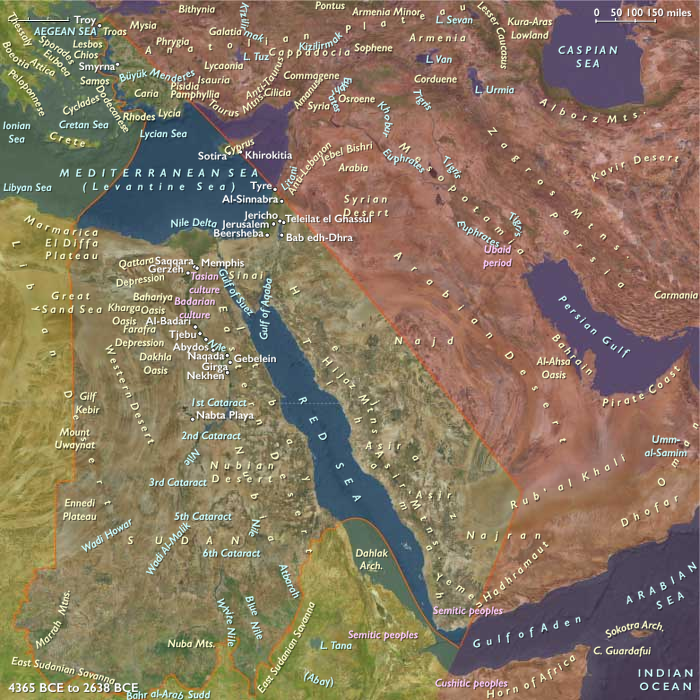
Human settlement is confined to the Nile valley and its fringes and the western lands become arid deserts as rainfall decreases in Egypt, especially after 4000 BCE.
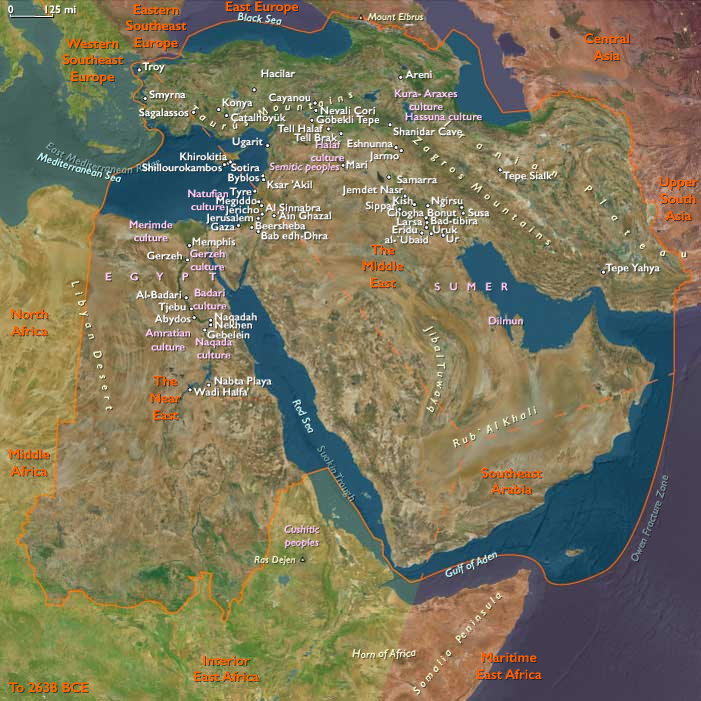
Two cultures exist in southern Egypt by around 4000 BCE: the Tasian, influenced by the north, and the Badarian, which originated in the eastern desert.
The former, identified by phases labeled Naqada I (Amratian) and II (Gerzean), has evolved into a material culture very different from that of the north.
In the south, among other differences, pottery is more varied in fabric, often has a black top, and favors painted decoration (white on red and red on light-colored desert clays).
There is archaeological evidence of date cultivation in eastern Arabia in 6000 BCE.
The date palm is believed to have originated around the Persian Gulf, and have been cultivated since ancient times from Mesopotamia to prehistoric Egypt, possibly as early as 4000 BCE.
The Egyptians use the fruits to be made into date wine, and eat them at harvest.
Copper is first worked in Egypt (and Mesopotamia) around 4000; Copper pins dating to 4000 BCE have been found in Egypt.
The ancestors of the modern donkey are the Nubian and Somalian subspecies of African wild ass, which is domesticated around 4000 BCE.
The donkey becomes an important pack animal for people living in the Egyptian and Nubian regions as they can easily carry twenty to thirty percent of their own body weight and can also be used as a farming and dairy animal.
Groups
- Mesopotamia
- Egyptians
- Egypt (Ancient), Predynastic
- Chalcolithic culture
- Tasian culture
- Amratian culture (Naqada I)
- Badarian culture
Topics
Commodoties
Subjects
- Commerce
- Painting and Drawing
- Environment
- Labor and Service
- Conflict
- Faith
- Government
- Technology
- Anthropology
- Archaeology
Regions
Subregions
Years: 4077BCE - 3934BCE
Groups
- Mesopotamia
- Egyptians
- Egypt (Ancient), Predynastic
- Chalcolithic culture
- Tasian culture
- Amratian culture (Naqada I)
- Badarian culture
Topics
Commodoties
Subjects
- Commerce
- Painting and Drawing
- Environment
- Labor and Service
- Conflict
- Faith
- Government
- Technology
- Anthropology
- Archaeology
Regions
Subregions