
As the Buddha, Guatama preaches his first…
537 BCE to 526 BCE
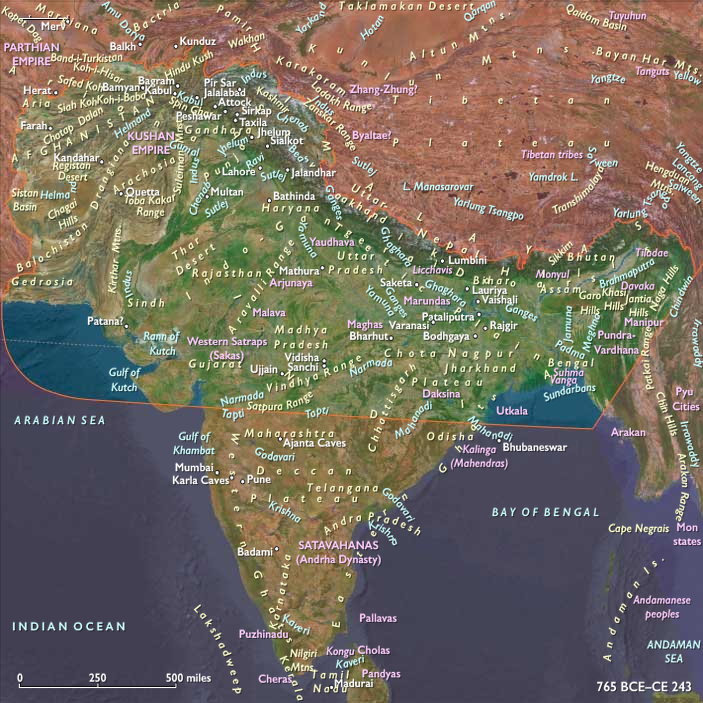
As the Buddha, Guatama preaches his first sermon at Sarnath (a part of modern Varanasi, or Benares), on the north bank of the Ganges River, where he sets forth his doctrine of the Four Noble Truths, accepts lay disciples (male and female), and converts his former ascetic companions as the first monks.
People
Subjects
Regions

South Asia
View →Subregions
Upper South Asia
View →Related Events
No active filters.
Showing 10 events out of 65800 total
Cyrus has followed his conquest of Babylonia with campaigns against the nomads—called the Massagetae—living east of the Caspian Sea.
The details of Cyrus's death vary by account.
The account of Herodotus from his Histories provides the second-longest detail, in which Cyrus met his fate in a fierce battle with the Massagetae, a tribe from the southern deserts of Khwarezm and Kyzyl Kum in the southernmost portion of the steppe regions of modern-day Kazakhstan and Uzbekistan, following the advice of Croesus to attack them in their own territory.
The Massagetae are related to the Scythians in their dress and mode of living; they fight on horseback and on foot.
Cyrus, in order to acquire the realm, had first sent an offer of marriage to its ruler, Tomyris, a proposal she rejected.
He then commenced his attempt to take Massagetae territory by force, beginning by building bridges and towered war boats along his side of the river Jaxartes, or Syr Darya, which separated them.
Tomyris, sending him a warning to cease his encroachment, in which she stated she expected he would disregard anyway, challenged him to meet her forces in honorable warfare, inviting him to a location in her country a day's march from the river, where their two armies would formally engage each other.
He accepted her offer, but, learning that the Massagetae were unfamiliar with wine and its intoxicating effects, he set up and then left camp with plenty of it behind, taking his best soldiers with him and leaving the least capable ones.
The general of Tomyris's army, who was also her son Spargapises, and a third of the Massagetian troops, killed the group Cyrus had left there and, finding the camp well stocked with food and the wine, unwittingly drank themselves into inebriation, diminishing their capability to defend themselves, when they were then overtaken by a surprise attack.
They were successfully defeated, and Spargapises, who had been taken prisoner, committed suicide once he regained sobriety.
Tomyris, upon learning of what had transpired, denounced Cyrus's tactics as underhanded and swore vengeance, leading a second wave of troops into battle herself.
Cyrus the Great was ultimately killed, and his forces suffered massive casualties in what Herodotus referred to as the fiercest battle of his career and the ancient world.
When it was over, Tomyris ordered the body of Cyrus brought to her, then decapitated him and dipped his head in a vessel of blood in a symbolic gesture of revenge for his bloodlust and the death of her son.
Some scholars question this version, however, mostly because Herodotus admits this event was one of many versions of Cyrus's death that he heard from a supposedly reliable source who told him no one was there to see the aftermath.
Ctesias, in his Persica, has the longest account, which says Cyrus met his death while putting down resistance from the Derbices infantry, aided by other Scythian archers and cavalry, plus Indians and their elephants.
This event, according to Ctesias, took place northeast of the headwaters of the Syr Darya.
An alternative account from Xenophon's Cyropaedia contradicts the others, claiming that Cyrus died peaceably at his capital.
The final version of Cyrus's death comes from Berossus, who only reports that Cyrus met his death while warring against the Dahae archers northwest of the headwaters of the Syr Darya.
The Middle East: 537–526 BCE
Consolidation of the Persian Empire
By 537 BCE, Cyrus the Great has vastly expanded the Achaemenid Persian Empire, encompassing territories stretching from the Mediterranean Sea to the northwestern frontiers of India. Following his conquest of Babylonia, Cyrus integrates former Babylonian territories, including Syria, Judah, and parts of Arabia Petraea. His policies toward conquered peoples are relatively tolerant; notably, Cyrus permits the Judahites—who had been exiled to Babylon nearly half a century earlier—to return to their homeland and rebuild their temple in Jerusalem. However, a majority of Judahites choose to remain in the Diaspora, particularly in Babylon, which emerges as a significant center of Jewish cultural and religious life for centuries.
Cultural Influence and Innovations
Under Persian rule, cultural and economic connections flourish across the empire. On Cyprus, the artistic influence of Ionia becomes pronounced during the late Archaic Period, reflected in significant developments such as the introduction of coinage. The first Cypriot coins appear under King Euelthon of Salamis around 560–525 BCE, signaling the island’s growing economic complexity and interaction with broader Mediterranean trade networks.
Transition of Power to Cambyses II
The era witnesses the death of Cyrus the Great in 529 BCE, who is succeeded by his eldest son, Cambyses II. Prior to his death in battle during a campaign in Central Asia, Cyrus had initiated ambitious architectural projects at Pasargadae, which include grand palaces, audience halls, and his tomb—a limestone mausoleum resembling a gabled wooden house atop a stepped plinth. Cambyses continues his father’s expansive policies, maintaining the vast territories and administrative structures established by Cyrus.
This era (537–526 BCE) thus represents a critical period of consolidation and cultural integration within the Persian Empire, setting the stage for further expansion and influence across the Near East.
The vast domain of the Achaeminids, with Babylon’s incorporation into the Persian Empire, stretches from the Mediterranean Sea to the northwestern borders borders of India, as the Neo-Babylonian Empire had conquered many kingdoms prior to Cyrus's invasion of Babylon.
In addition to Babylonia itself, Cyrus probably incorporated its subnational entities into his empire, including Syria, Judah, and Arabia Petraea, although there is no direct evidence of this fact.
Having defeated the Babylonians, Cyrus, a Zoroastrian, had permitted the Judahites, possibly regarding them as fellow monotheists, to return to their homeland after nearly a half-century of captivity “to rebuild the house of the Lord”.
The majority of Judahites choose, however, to remain in the Diaspora (i.e., the settlements of Judahites, soon to be known as Jews, outside Palestine), especially in Babylon, which is to become a great center of Jewish culture for fifteen hundred years.
The artistic schools of Ionia are an important influence on the island of Cyprus in the late Archaic Period (750-475 BCE)..
These are also probably the same source of the inspiration for issuing coinage; the first Cypriot coins are circulated for King Euelthon of Salamis (560-525 BCE).
The eldest son of Cyrus the Great succeeds him in 529 BCE as Cambyses II, following the battle death of his father during his campaign in central Asia.
Cyrus had ordered construction of palaces, audience halls, and a towerlike structure (with the folk name of Solomon's Prison) undertaken at a valley site known to the Greeks as Pasargadae.
After Cyrus's death, his body is placed there within a limestone mausoleum built to resemble a gabled wood house and set on a plinth composed of six very high steps.
His tomb is said to have been covered with precious carpets.
Siddhartha Guatama, on his way to political leadership at twenty-nine, takes a chariot trip outside the palace and, for the first time, witnesses irremediable suffering.
Overwhelmed with sorrow, he begins to contemplate renunciation of worldly pleasures, and leaves the palace, and his newborn son, to live as a religious ascetic and recluse.
During the next six years of ascetic self-mortification, Siddhartha travels from teacher to teacher, seeking but failing to find enlightenment.
He then recalls his meditation as a young boy, abandons his asceticism, and conceives of a "middle path" between asceticism and luxuries, determining to sit in meditation until attaining enlightenment.
He begins to meditate one evening while sitting under a pipal tree and, at dawn, is Supreme Buddha.
Concerned that his new insights are too deep for ordinary human beings, Siddhartha prepares to enter nirvana, but the god Brahma persuades him to delay his entry into nirvana and share his insight.
Theravada Buddhist doctrine places Siddhartha in a series with several earlier Buddhas and one Buddha—Mettayya, or Maitreya—yet to come, perceiving Buddhahood as lasting only the duration of life itself. Mahayana Buddhist doctrine claims Siddhartha as one historical manifestation of an eternal, ultimate Buddha, whose manifestations are called bodhisattva.
According to the Mahayana view, the historical Buddha—and other bodhisattvas—partake of a transcendental state of being; Siddhartha, in refusing to enter nirvana until all are saved, adopted the bodhisattva ethic.
In Chan (Ch'an), or Zen Buddhist doctrine, which denies the distinction between nirvana and samsara, or ordinary life, all beings equally partake of this Buddha-nature and are as much Buddha as Siddhartha himself.
Near East (537–526 BCE): Restoration, Return, and Persian Expansion
Judahite Return from Exile
Following Cyrus the Great's conquest of Babylon in 539 BCE, Judahites, exiled for nearly half a century, are permitted to return to their ancestral homeland. Under the leadership of Zerubbabel, a prince of the Davidic lineage, approximately forty thousand Judahites journey back to rebuild the sacred Temple in Jerusalem. Yet their return is marked by considerable hardship and opposition. Southern Judah, notably the region south of Hebron, has been settled by Edomites, while northern areas have fallen under the jurisdiction of the governor of Samaria. This complex political situation poses significant obstacles to the Judahite restoration efforts.
Transition and Conquest in Egypt
In Egypt, Pharaoh Amasis II, who had cultivated prosperous alliances and brought Egypt notable stability and economic growth, dies in 526 BCE. He is succeeded briefly by his son, who takes the throne as Psamtik III (Psammetichus III). However, Psamtik's reign is short-lived, as the Persian king Cambyses II, son and successor of Cyrus, swiftly capitalizes on Egyptian vulnerability. Within mere months of Psamtik III’s accession, Cambyses launches a decisive invasion, defeats the Egyptian forces, deposes the young pharaoh, and embarks upon the subjugation of all Egypt, bringing the entire Nile Valley under Persian domination.
Legacy of the Era
This era is characterized by profound geopolitical shifts. For the Judahites, the return from Babylonian captivity initiates a difficult but transformative chapter in their history, significantly reshaping their cultural and religious identity. Simultaneously, Cambyses' invasion signals the end of Egypt's native Saite dynasty and marks the integration of Egypt into the expansive Persian Empire, heralding a new period of imperial rule and cultural integration in the Near East.
Cyrus’s conquest and occupation of Babylon in 539 BCE has enabled the Judahites to return to their erstwhile kingdom, with the permission of Cyrus, after nearly a half-century of captivity.
Led by Zerubbabel of the Davidic house, the Judahites return to Jerusalem to rebuild their Temple.
The political situation is extremely unfavorable, however, since Judah south of Hebron has been occupied by Edomites, while the tiny remainder north of Hebron has passed under the control of the governor of Samaria.
In time, some forty thousand Judahites reportedly make their way back to their ancestral land.
Egyptian pharaoh Amasis II dies in 526 BCE; his son succeeds him as Psamtik (Psammetichus) III.
Cambyses II of Persia invades Egypt edarli in the following year and defeats and deposes the new pharaoh only a few months after his accession to the throne, then embarks upon the conquest of all Egypt.
Thespis of Icaria (present-day Dionysos, Greece) is the first person ever to appear on stage as an actor playing a character in a play (instead of speaking as him or herself), according to certain Ancient Greek sources and especially Aristotle.
In other sources, he is said to have introduced the first principal actor in addition to the chorus.
According to Aristotle, writing nearly two centuries later, Thespis, a singer of dithyrambs (songs about stories from mythology with choric refrains), supposedly introduced a new style in which one singer or actor performed the words of individual characters in the stories, distinguishing between the characters with the aid of different masks.
This new style is called tragedy, and Thespis is the most popular exponent of it.
Athenians institute a contest in tragedy at a festival held in honor of Dionysus, the god of wine, fertility, and revelry.
Thespis, the inventor of the new form, wins the first documented competition in 537.
Capitalizing on his success, Thespis also invents theatrical touring: he tours various cities while carrying his costumes, masks and other props in a horse-drawn wagon.
It is implied that Thespis invented acting in the Western world, and that prior to his performances, no one had ever assumed the resemblance of another person for the purpose of storytelling.
In fact, Thespis is the first known actor in written plays.
He may thus have had a substantial role in changing the way stories were said and inventing theater as we know it today.
In reverence to Thespis, actors throughout western history have been referred to as thespians.
Red-figure vase painting, one of the most important styles of figural Greek vase painting, develops in Athens around 530 BCE; replacing the previously dominant style of Black-figure vase painting within a few decade, sit will remain in use until the late third century BCE.
Its modern name is based on the figural depictions in red color on a black background, in contrast to the preceding black-figure style with black figures on a red background.
Details are painted rather than incised on the light ground, giving painters greater freedom to perfect their rendering of anatomy and perspective.
The most important areas of production, apart from Attica, are in Southern Italy.
The style is also adopted in other parts of Greece.
Etruria becomes an important center of production outside the Greek World.
Athenian industry and commerce expand tremendously in the latter half of the sixth century; the main contribution of Peisistratid rule to these developments is probably the guarantee of internal tranquility and the protection of foreign immigrants.
Externally, the tyrant pursues a policy of peace, probably because he dares not allow the Athenian citizenry to bear arms in a major war, but at this time, the Greek world is also in a temporary state of balance.
In the Aegean, Peisistratus has helped such friends as Lygdamis of Naxos to become local tyrants.
He has purified the sacred island of Delos by removing the old graves near its temple of Apollo.
His main efforts, however, are concentrated in gaining control of the Hellespont, through which comes the exported grain of south Russia.
To this end, he secures command of Sigeum and installs a younger son, Hegesistratus, as its ruler.
Of greater importance is his encouragement of the Athenian Miltiades in leading a private venture that gains mastery over Chersonesus (near modern Sevastopol, Ukraine).
Peisistratus remains in power until his death in 527, when his sons Hippias and Hipparchus succeed him as co-tyrants.