
International patriotic insurgency had begun to arise…
October 1873 CE
International patriotic insurgency had begun to arise in support of the Cuban rebellion and war bonds are sold in the U.S. to support the Cuban resistance as the Cuban war continues.
The Virginius is a small, high-speed side-wheel steamer built to serve as a blockade runner between Havana and Mobile, Alabama, for the Confederacy during the American Civil War.
Originally built as the Virgin by Aitken & Mansel of Whiteinch, Glasgow in 1864, she had become a prize of the United States when captured on April 12, 1865.
In August 1870, the Virginius had been purchased from the Washington Navy Yard by an American, John F. Patterson, acting secretly as an agent for Cuban insurgent Manuel Quesada and two U.S. citizens—Marshall O. Roberts and J.K. Roberts.
The ship had originally been captained by Francis Sheppherd; both Patterson and Shepphard had immediately registered the ship in the New York Custom House; having paid two thousand dollars to be bonded, however, no sureties had been listed.
Patterson had taken a required oath that he was the sole owner of the Virginius.
The secret purpose for the purchase of the Virginius was to transport men, munitions, and supplies to aid the Cuban rebellion.
For three years, the ship has aided the Cuban rebellion and has been protected by U.S. naval ships including the USS Kansas and the USS Canandaigua.
The Spanish regard it as an outlaw ship and aggressively seek to capture it.
Captain Joseph Fry, the new captain of the Virginius from October 1873, is a large imposing man with a full beard in his mid forties.
Fry had served in the U.S. Navy for fifteen years, before joining the Confederacy during the American Civil War; he had been promoted to Commodore in the Confederate Navy.
However, after that position disappeared following the Union victory in 1865, Fry had found himself underemployed, and had taken the job as Captain of the Virginius, which, moored in Kingston, Jamaica, by this time needed repair, and the boilers were breaking down.
As most of the previous crew had deserted, Fry has recruited a new crew of fifrty-two men, both American and British; many whom are inexperienced and apparently do not understand that the Virginius is supporting the Cuban rebellion.
Three are very young recruits, no older than thirteen years of age.
The Virginius has taken on one hundred and three native Cuban soldiers that had arrived on board a New York steamer.
Fry has been warned by U.S. Consul at Kingston, Thomas H. Pearne, that he will be shot if captured.
However, Fry does not believe the Spanish will shoot a blockade runner.
In mid October, Captain Fry, accompanied by four mercenaries, takes the Virginius to Haiti and loads the ship with munitions.
On October 30, the Virginius sails to Comito to pick up more weapons, then on the same day starts toward Cuba.
The Spanish, having been warned when the Virginius left Jamaica, send out the warship Tornado to capture the vessel.
Locations
Groups
Commodities
Subjects
Regions
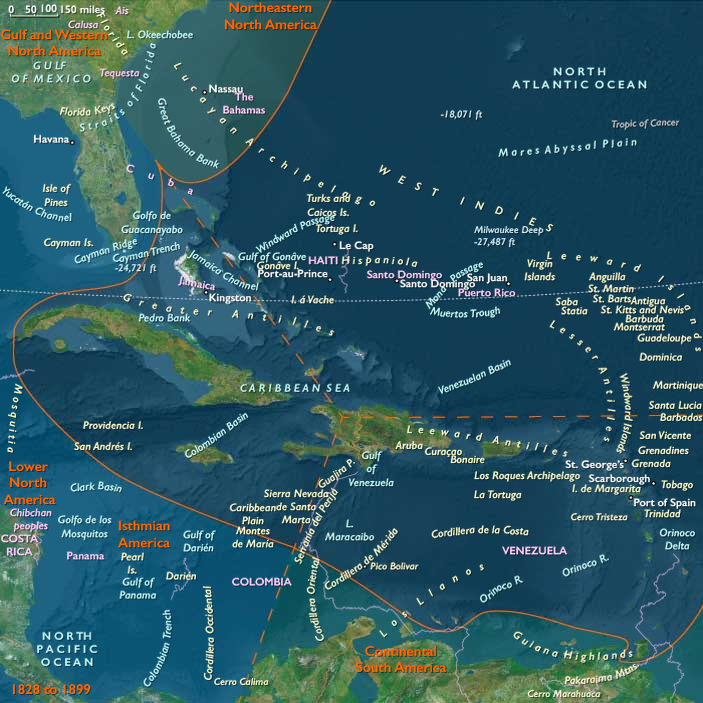
West Indies
View →Subregions
