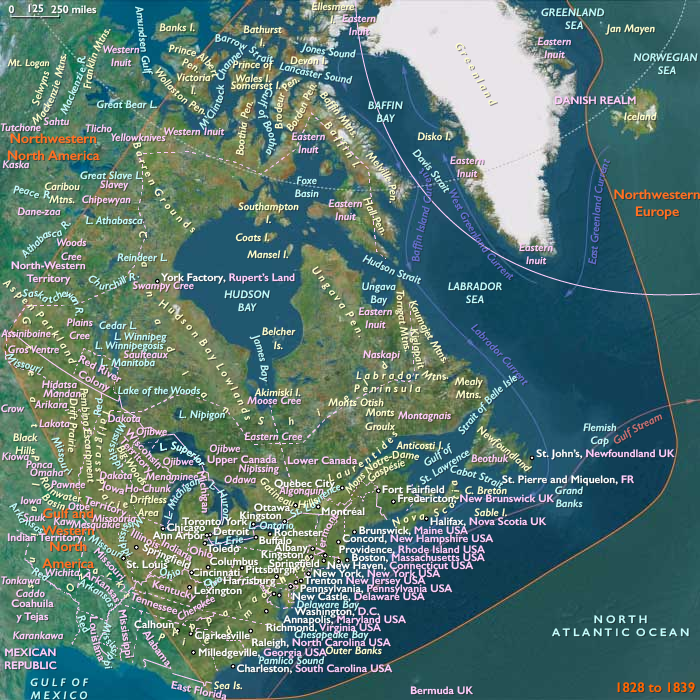
The timber trade becomes Canada's most important…
1828 CE
The timber trade becomes Canada's most important commodity as the fur trade declines in importance.
The industry becomes concentrated in three main regions.
The first to be exploited is the St. John River system.
Trees in the still almost deserted hinterland of New Brunswick are cut and transported to St. John where they are shipped to England.
One of the most important side effects of the timber trade is immigration to British North America.
Timber is a very bulky and not particularly valuable cargo.
For every ship full of British manufactured goods, dozens are needed to carry the same value of timber.
There is no cargo coming from the British Isles to Canada that can take up as much room on the return voyage.
Exporting salt fills a few ships, and some vessels are even filled with bricks, but many timber ships make the westward voyage filled with ballast.
The population of Canada is small and the lack of wealth in the area makes it an unattractive market.
Many of the timber ships turn to carrying immigrants for the return voyage from the British Isles to fill this unused capacity.
Timber ships unload their cargo and sell passage to those desiring to emigrate.
During the early nineteenth century, with the preferential tariff in full effect, the timber ships are among the oldest and most dilapidated in the British merchant fleet, and traveling as a passenger upon them is extremely unpleasant and dangerous.
It is, however, very cheap.
Since timber exports peak at the same time as conflicts in Europe, such as the Napoleonic Wars, a great mass of refugees have sought this inexpensive passage across the Atlantic Ocean.
Locations
Groups
Regions

Northern North America
View →Subregions