
Assyria allies for a brief time with…
1293 BCE to 1282 BCE
Assyria allies for a brief time with a diminished Mitanni to liberate the Mitanni subkingdom of Hangibat from Hittite control.
A widespread system of treaty relationships with allies and vassal states effectively governs the now firmly established new Hittite Empire.
The Hittite Empire concludes a peace treaty with Egypt in 1285.
Groups
Regions
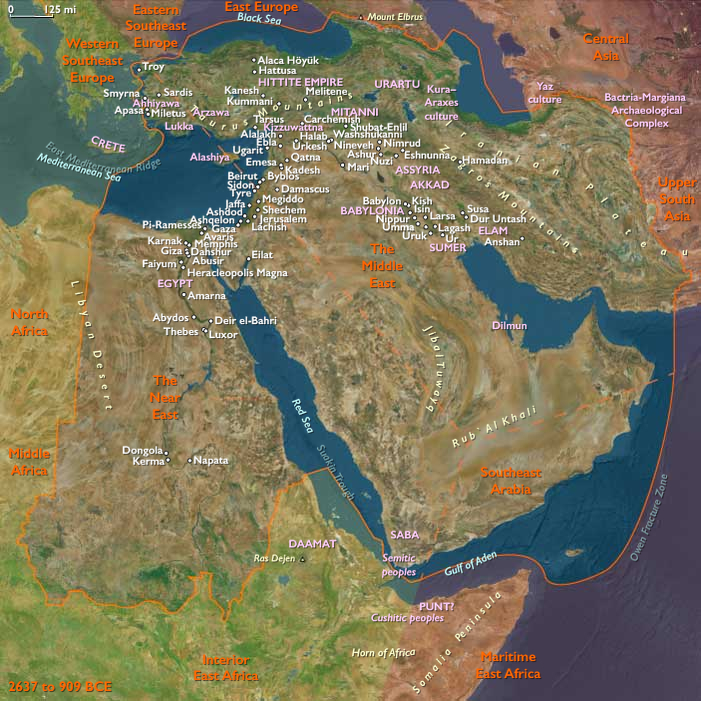
The Near and Middle East
View →Subregions

Middle East
View →Related Events
No active filters.
Showing 10 events out of 67253 total
Adad-nirari, who has succeeded his father Arik-den-ili, is the earliest Assyrian king whose annals survive in any detail.
A few years after his accession in 1295, he defeats the Kassite king Nazimaruttash of Babylonia, forcing his retreat.
Horemheb, the last pharaoh of the Eighteenth dynasty, apparently chooses a commander of his army to succeed him to the throne.
upon Horemheb’s death in 1292 BCE, Ramesses I inaugurates the Nineteenth dynasty.
Ramesses, who plans and begins construction on the colonnaded hall in the temple at Karnak, reigns for little more than a year before dying in 1290 BCE; his son succeeds him as Seti I.
Egypt’s populace abandons Thebes for a new capital at Tell el-Amarna during the brief Egyptian experiment with monotheism.
A concurrent decline in the empire is reversed with the establishment of the Nineteenth dynasty; which establishes a new royal capital at Per-Ramesse ("the house of Ramesses") in the Nile's eastern delta.
Egyptian women of the Nineteenth Dynasty period have a number of legal rights: they may own property and request divorce.
Although barred from holding government office, a woman may fill in for her husband in his absence.
A woman can earn her own living by managing a farm, weaving or dancing.
Mycenaean civilization reaches its height; Mycenae may at this time be the capital of an empire controlling the whole Aegean region.
In Canaan, Hazor reaches its peak with the construction of several temples some containing unusual cult objects and furnished with such objects as Mycenaean pottery, Egyptian scarabs, jewelry, and statuettes.
The Hittites answer Egypt’s campaigns against them at Kadesh on the Orontes River.
Initially surprised and surrounded by a Hittite pincer movement, the Egyptians hold out and escape defeat, counterattacking the Hittite forces when they stop to loot their fallen enemies.
The Orontes River in Syria, today mainly unnavigable and of little use for irrigation, derives its historical importance solely from the convenience of its valley for traffic from north to south; roads from the north and northeast, converging at Antioch, follow the course of the stream up to Homs where the roads fork to Damascus and to Syria and the south.
Along its valley pass the armies and traffic bound to and from Egypt in all ages.
On the Orontes is fought the Battle of Kadesh during the reign of Ramesses II (1279 – 1213 BCE).
Kadesh on the Orontes River, originally a Cananite city and an Egyptian vassal for approximately one hundred and fifty years, had eventually defected to Hittite suzerainty, thereby placing the city on the contested frontier between the two rival empires.
The Hittites under Muwatallis, answering Ramesses II’s first campaigns against them, meet the Egyptians around 1275 in a major, and violent, battle, one of the best documented of the ancient world.
Ramesses’ twenty thousand infantry troops include Numidian mercenaries and are superior in number, but Muwatalli’s sixteen thousand-strong force includes twenty-five hundred three-man chariots.
Initially surprised and surrounded by a Hittite pincer movement, the Egyptians, rallied by Ramesses’ personal courage, hold out and escape defeat, counterattacking the Hittite forces when they stop to loot their fallen enemies.
Ramesses, who himself narrowly escapes capture, unsuccessfully besieges Kadesh, then withdraws, incorrectly calling the battle an Egyptian victory instead of the draw it is in fact.
A struggle by Hittite king Muwatalli (who reigns from about 1320 BCE to about 1294 BCE) with resurgent Egypt under Seti I and Ramesses II for the domination of Syria leads to one of the greatest battles of the ancient world, which takes place at Kadesh on the Orontes in about 1299 BCE.
Ramesses II, seeking to recapture the Hittite-held city of Kadesh in Syria, invades Syria with four divisions and an auxiliary force.
Muwatalli gathers a large alliance among his vassal states.
Ramesses' twenty thousand infantry troops include Numidian mercenaries and are superior in number, but Muwatalli's sixteen thousand-strong force includes twenty-five hundred three-man chariots.
Muwatalli, hiding his army behind the city mound, sends out false reports that he is at Aleppo, farther north.
Ramesses, falling into the trap, hurries his army toward Kadesh, his units stretched along the Orontes valley road.
Toward evening, the king with the first division reaches Kadesh and sets up camp.
Too late, two captured Hittite scouts confess the actual situation.
The Hittites ford the river and, after routing the second division, storm the Egyptian camp.
His first division destroyed, Ramesses is saved mostly by his auxiliary force that strikes the attacking Hittites in the rear.
Pushing the Ramesses into the river, the mauled Egyptians retain the battlefield.
The next day, after indecisive fighting, Ramesses is compelled to withdraw his battered army; and in the aftermath, …
…the Hittites advance south to the region of Damascus, halting the Egyptian resurgence into Syria. (The biased Egyptian version of the battle was recorded on numerous temples by Ramesses, incorrectly calling the battle an Egyptian victory instead of the draw it was in fact, but a Hittite version excavated at Boghazköy has enabled a truer assessment of the battle.)
Shalmaneser I of Assyria takes Babylon from the Kassites and defeats both the Hittites and the Hurrians.
Adad-Nirari, ruler of Assyria from about 1307 BCE, defeats two consecutive Mitanni kings in a series of undateable wars, and brings all of Mesopotamia under Assyrian control; this is according to Assyrian chronicles.
Hanigalbat remains an enemy of Assyria.