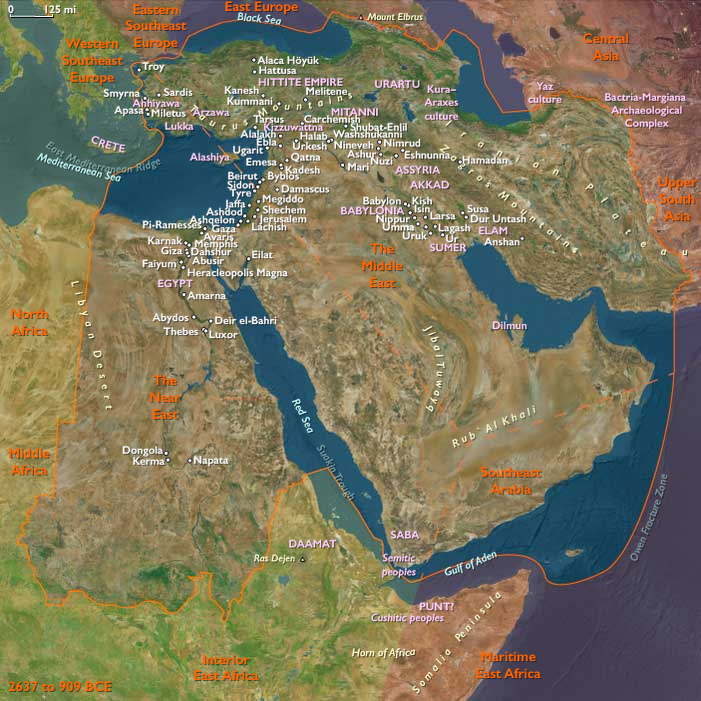
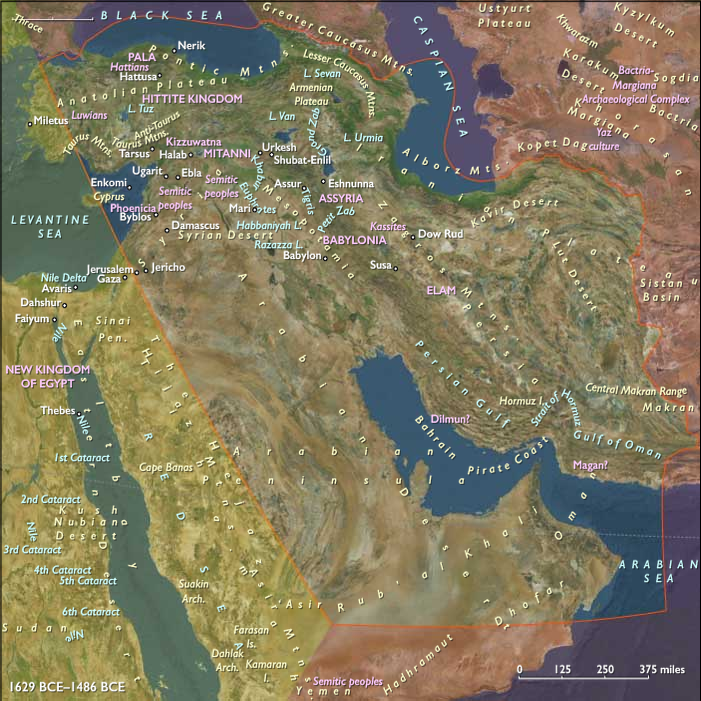
The Babylonian Empire engages in regular trade with city-states to the west; with Babylonian officials or troops sometimes passing to Syria and Canaan, and Amorite merchants operating throughout Mesopotamia.
The Babylonian monarchy's western connections have remained strong.
An Amorite named Abi-ramu or Abram had been the father of a witness to a deed dated to the reign of Hammurabi's grandfather; Ammi-Ditana, great-grandson of Hammurabi, still titled himself "king of the land of the Amorites".
Ammi-Ditana's father and son also bear Canaanite names: Abi-Eshuh and Ammi-Saduqa (or Ammisaduqa, Ammizaduga).
Samsu-Ditana (Samsuditana) succeeds Ammi-Saduqaas king of Babylon in 1626 BCE.
The well-disciplined armies of Babylonia had conquered the city-states of Isin, Elam, and Uruk, and the strong Kingdom of Mari, and the rule of Babylon has been obeyed as far as the shores of the Mediterranean.
But Mesopotamia has no natural, defensible boundaries, making it vulnerable to attack, and the Babylonian Empire suffers increasingly from incursions by Kassites invading from the north.