Claudius, in front of a crowd of …
Years: 47 - 47
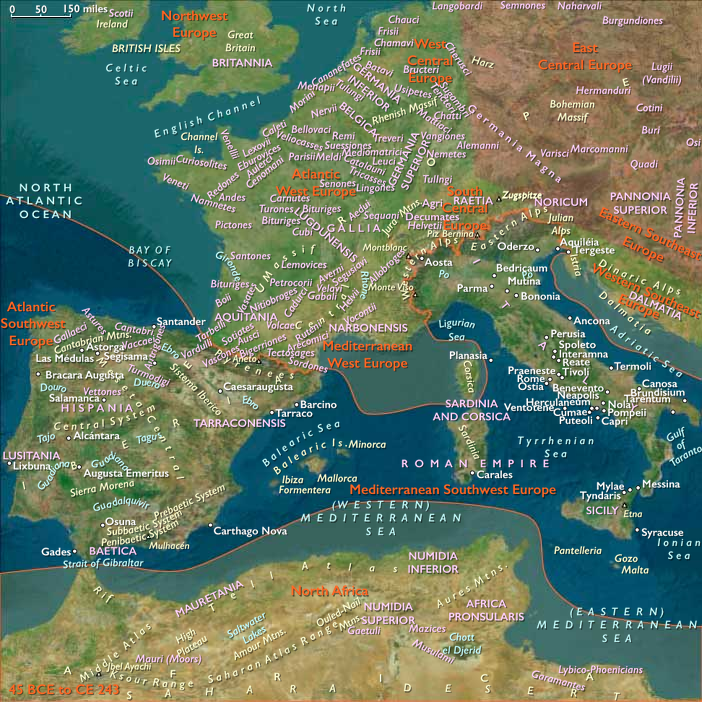
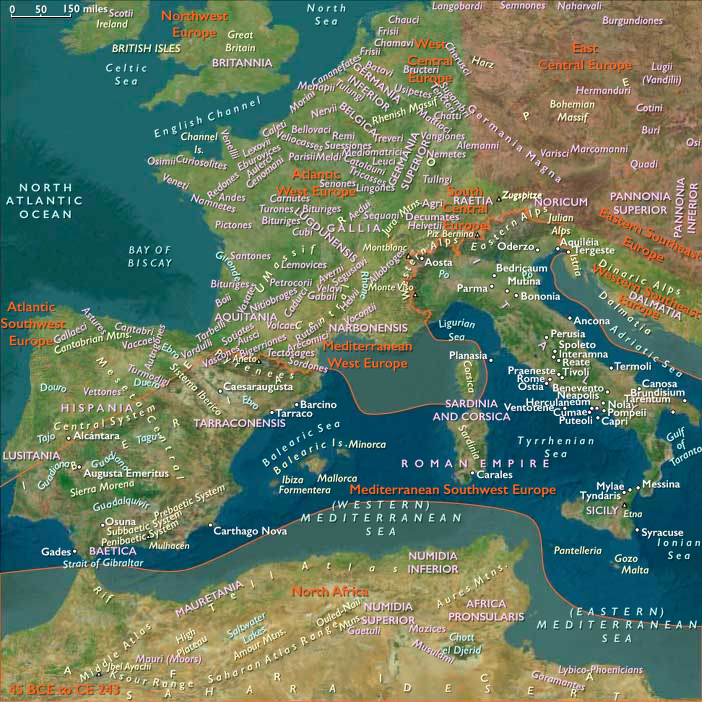
Claudius, in front of a crowd of spectators, fights a killer whale that is trapped in the harbor of Ostia.
The event is witnessed by Pliny the Elder: A killer whale was actually seen in the harbor of Ostia, locked in combat with the emperor Claudius.
She had come when he was completing the construction of the harbor, drawn there by the wreck of a ship bringing leather hides from Gaul, and feeding there over a number of days, had made a furrow in the shallows: the waves had raised up such a mound of sand that she couldn't turn around at all, and while she was pursuing her banquet as the waves moved it shorewards, her back stuck up out of the water like the overturned keel of a boat.
The Emperor ordered that a large array of nets be stretched across the mouths of the harbor, and setting out in person with the Praetorian cohorts gave a show to the Roman people, soldiers showering lances from attacking ships, one of which I saw swamped by the beast's waterspout and sunk.— "Historia Naturalis" IX.14–15.
Locations
People
Groups
Topics
Commodoties
Subjects
Regions
Subregions
Related Events
Filter results
Showing 10 events out of 20 total
Le Mans: A Roman City Holding onto the Past
Le Mans, despite shifting rulers, retains much of its Roman heritage:
- A third-century amphitheater, still visible today, reflects the city's former prosperity.
- The Roman thermae (baths) were demolished during the Crisis of the Third Century, as workers repurposed materials to construct the city’s defensive walls.
- Much of these walls survive, serving as a reminder of the Roman legacy in Gaul even as Germanic rulers take control.
The Last Days of Roman Gaul
- Syagrius remains the last guardian of Roman civilization in Gaul, but his power is increasingly encircled by the Franks and Visigoths.
- As local rulers like the one in Le Mans break away, the final remnants of centralized Roman governance fade.
- By the end of the fifth century, Gaul will be firmly in the hands of the Franks, marking the definitive transition from the Roman world to the early medieval order.
Syagrius' defeat at the hands of Clovis I in 486 CE will mark the final end of Roman rule in Gaul, leaving only the Byzantine Empire in the east as the last vestige of the once-mighty Roman world.
The Final Elimination of Ragnachar’s Line and the Complete Unification of the Frankish Kingdom (509 CE)
Following the execution of Ragnachar and his brother Ricchar, Clovis ensures the total eradication of their lineage and claim to power.
The Killing of Rignomer at Le Mans
- Ragnachar’s other brother, Rignomer, survives the initial purge but remains a potential rival.
- On Clovis’ orders, Rignomer is later assassinated in Le Mans, eliminating the last member of Ragnachar’s bloodline.
- With his death, all of Ragnachar’s family wealth and his former kingdom pass to Clovis, further enriching the Merovingian royal treasury.
The Theological Framing of Clovis’ Victory
- Hincmar of Reims, writing in the ninth century, gives a Christianized account of Ragnachar’s downfall.
- He attributes Clovis' success to the "grace of Christ," reinforcing the idea that Clovis' rule is divinely sanctioned.
- According to Hincmar’s version, Ragnachar, "submitting to the shame of baseness," is betrayed by his own men and bound to be handed over to Clovis.
- Hincmar links Clovis’ victory with the mass conversion of the Franks, stating that "all the people of the Franks, by the Blessed Remigius, were converted to the faith and received baptism."
The Final Consolidation of Frankish Power
With Ragnachar, Ricchar, and Rignomer dead, Clovis has:
- Eliminated all remaining rival Frankish rulers, bringing the kingdom under sole Merovingian rule.
- Absorbed Ragnachar’s kingdom and treasure, further strengthening the centralized Frankish state.
- Solidified his image as a Christian king, with religious narratives framing his victories as part of divine providence.
By 511 CE, Clovis rules a unified Frankish kingdom, marking the true foundation of Frankish dominance in Western Europe. His strategic eliminations, political consolidation, and religious alliances set the stage for the Merovingian dynasty's long-lasting reign.
The Fall of Frankish Garrisons and the Ravaging of Le Mans
- The Frankish garrisons in Rennes and Nantes, installed by Charles the Bald in 850, capitulate to Nominoe in 851.
- With Brittany free of Frankish military presence, Nominoe turns eastward, launching raids into Neustria, particularly targeting Le Mans, which he ravages.
- His campaign demonstrates Breton military strength, taking the fight beyond Brittany’s borders into the heart of West Francia.
Rollo’s Expansion Westward: The Growth of Normandy (922–924)
Following the Treaty of Saint-Clair-sur-Epte (911), Rollo, the Viking ruler of Normandy, had fulfilled his oath to defend the shores of the Seine River from further Viking incursions. However, his loyalty was tied to King Charles the Simple, and after Charles was deposed by Robert I in 922, Rollo considered his obligations void, leading him to pursue his own expansionist policies.
Rollo’s Continued Raids on Flanders
- Even after settling in Normandy, Rollo continued raiding into Flanders, expanding his influence into Carolingian territories.
- His attacks targeted Flemish settlements, including monasteries and trade routes, further destabilizing West Francia during its period of political upheaval.
Rollo’s Expansion Westward (924): The Seizure of Bessin
- With Charles the Simple no longer in power, Rollo looked westward to expand his control beyond the Seine Valley.
- French barons, seeking peace and an alliance with the Normans, negotiated with Rollo, ultimately ceding him Le Mans and ...
Fulk III Extends Angevin Power Over Maine and Touraine
Following his victory over Conan I of Brittany at the Battle of Conquereuil in 992, Fulk III of Anjou expanded his authority beyond Brittany, consolidating Angevin control over the strategically vital Counties of Maine and Touraine. His campaigns in these regions further solidified Anjou’s position as one of the dominant feudal powers in western France.
Expansion into Maine
- The County of Maine, situated between Anjou and Normandy, was a contested region between the Counts of Anjou and the Dukes of Normandy.
- Fulk III took advantage of regional instability and extended Angevin influence over Maine, making it semi-dependent on Anjou.
- Although Maine would remain a highly contested territory in later decades, Fulk’s intervention laid the groundwork for future Angevin dominance in the region.
The Struggle for Maine: Geoffrey Martel vs. William of Normandy and King Henry I (1051–1053)
Following the death of Hugh IV of Maine in 1051, Geoffrey Martel, Count of Anjou, sought to expand his control over the county of Maine. His occupation of Le Mans, the county’s capital, brought him into direct conflict with Duke William of Normandy and King Henry I of France, leading to a complex three-way power struggle.
At the heart of this conflict was the strategically positioned Bellême family, whose holdings along the Maine–Normandy–Anjou frontier allowed them to manipulate their competing overlords and maintain de facto independence.
Geoffrey Martel’s Initial Success in Maine (1051–1052)
- Upon Hugh IV’s death, the citizens of Le Mans welcomed the Angevins, allowing Geoffrey Martel to occupy the city without resistance.
- Maine was of critical strategic importance, serving as a buffer state between Normandy, Anjou, and the French crown.
- Geoffrey’s expansion into Maine posed a serious threat to both Normandy and Capetian France, prompting William and King Henry to intervene.
The Role of the Bellême Family
- The Bellême family held key strongholds on the border of Maine and Normandy, including:
- Bellême, their ancestral seat, under the overlordship of the King of France.
- Domfort, under the overlordship of Geoffrey Martel of Anjou.
- Alençon, which was under William of Normandy’s suzerainty.
- Given their complex allegiances, the Bellêmes skillfully played their three overlords against one another, ensuring their own autonomy in the region.
- However, as the war over Maine escalated, they were eventually forced to align with one side—and William took advantage of this.
William and King Henry’s Counteroffensive (1052–1053)
- Recognizing the strategic necessity of preventing Angevin expansion, William and King Henry joined forces once more to expel Geoffrey Martel from Maine.
- In the course of their campaign, William was able to secure the Bellême family’s strongholds at Alençon and Domfort, reinforcing Norman influence on the Maine border.
- By asserting direct overlordship over the Bellême family, William eliminated a major source of instabilityand brought the key border fortresses firmly under Norman control.
Outcome and Aftermath
- Though William succeeded in taking key strongholds on the Maine–Normandy border, Geoffrey Martel retained effective control over most of the county of Maine.
- The conflict weakened Geoffrey Martel’s position, as he now had to contend with Norman expansion along his frontier while maintaining control of Maine’s rebellious nobility.
- The capture of Alençon and Domfort was a major victory for William, further consolidating Norman influence in the region and preparing the way for a future full-scale Norman invasion of Maine.
- The Bellême family, once an unpredictable force, was now compelled to act in Norman interests, removing a major source of instability on Normandy’s southern border.
Legacy and Significance
- The Norman-Angevin rivalry for Maine would continue for years, shaping the balance of power in northern France.
- William’s ability to gain control over the Bellême family strongholds demonstrated his growing influence and furthered his reputation as a military strategist.
- This victory solidified Normandy’s position as the dominant force in northern France, setting the stage for future campaigns into Maine and beyond.
Though Anjou still held much of Maine, William’s success in securing the Bellême fortresses and asserting control over key border regions was a critical step in his rise to power, proving his ability to outmaneuver rival lords and expand Norman authority.
The Death of Herbert II of Maine and the Succession Crisis (1062)
In 1062, Herbert II of Maine, the eldest son of Hugh IV, died without an heir, leading to a major succession crisis in the County of Maine. Prior to his death, Herbert had declared Duke William II of Normandy as his heir, setting the stage for Norman intervention in the region.
Herbert II’s Flight to Normandy and the Angevin-Norman Rivalry
- In 1056, Geoffrey II Martel, Count of Anjou, invaded Le Mans, prompting Herbert to flee to the Norman court.
- Some historians argue that Herbert may have initially fallen under Angevin control, before later seeking refuge with Duke William of Normandy.
- His asylum in Normandy strengthened Norman influence in Maine, as Herbert increasingly aligned himself with William.
Herbert’s Death and the Maine Succession Crisis (1062)
- Herbert II died childless in 1062, having previously designated Duke William of Normandy as his successor.
- This move provoked immediate opposition, as local factions in Maine resisted Norman rule, leading to a succession crisis.
The Struggle for Control of Maine
- The Angevins and local nobility of Maine opposed William’s claim, fearing increased Norman dominance in the region.
- A pro-Angevin faction attempted to resist William’s control, supported by Baldwin V of Flanders and Geoffrey III of Anjou ("le Barbu").
- However, William, already one of the most powerful rulers in northern France, was determined to enforce his claim over Maine.
Consequences and Legacy
- William’s assertion of his claim to Maine marked a significant expansion of Norman influence, bringing him into closer conflict with Anjou and its allies.
- The struggle over Maine would continue for several years, culminating in William’s full conquest of the county in 1064, further strengthening his position before his invasion of England in 1066.
- Maine’s strategic location between Normandy and Anjou made it a contested borderland, influencing Norman-Angevin relations for decades to come.
The death of Herbert II in 1062 and his decision to name William of Normandy as heir triggered a succession crisis that led to Norman intervention in Maine, reinforcing William’s growing power in France just years before he set his sights on the English throne.
The Norman Conquest of Maine (1063–1064) and Its Role in William’s Rise to Power
By 1063, the County of Maine was in Angevin hands, but a succession crisis following the death of Count Herbert II in 1062 created an opportunity for Duke William of Normandy to assert his own claim over the region. This campaign, marked by stiff resistance from Fulk IV of Anjou and local barons, was crucial in securing Normandy’s southern border and setting the stage for William’s invasion of England in 1066.
Competing Claims to Maine
After Herbert II’s death, two rival factions vied for control of Maine:
-
William’s Claim via Margaret of Maine
- Herbert II’s young sister, Margaret, was betrothed to William’s son, Robert Curthose.
- William claimed the county in her name, arguing that this secured her rightful inheritance.
-
The Claim of Biota and Walter of the Vexin
- Biota, Herbert II’s aunt, and her husband, Walter, Count of the Vexin, asserted their own claim to the county.
- They gained support from local barons and the Angevins, creating a strong opposition to Norman rule.
William’s Military Campaign (1063–1064)
- In 1063, William invaded Maine in force, launching a well-coordinated attack on the county’s key strongholds.
- The invasion met heavy resistance from:
- Fulk IV of Anjou, who sought to keep Maine under Angevin control.
- Local barons, such as Geoffrey of Mayenne and Hubert de Sainte-Suzanne, who resisted Norman domination.
- Despite the stiff opposition, William overran Maine by early 1064, effectively bringing it under Norman control.
The Fate of Biota and Walter: Allegations of Poisoning (1063)
- Biota and Walter were captured when William took Le Mans, the capital of Maine.
- Sometime later in 1063, both died under mysterious circumstances, leading to rumors that they had been poisoned by the Normans.
- Their deaths eliminated the rival claim to Maine, leaving William’s rule uncontested.
Significance and Impact of the Conquest of Maine
- Securing Maine ensured William’s southern border, neutralizing Angevin threats before his campaign in England.
- Maine’s conquest reinforced William’s reputation as a formidable military leader, proving his ability to subdue rebellious barons and rival claimants.
- The county’s strategic location gave Normandy a stronger defensive position, allowing William to shift his focus toward his claim on the English throne.
The Norman conquest of Maine (1063–1064) was a key prelude to the Norman Conquest of England, giving William the territorial security and strategic advantage needed for his historic invasion in 1066.
The Revolt of Le Mans and the Restoration of Maine (1069–1070)
In 1069, the citizens of Le Mans rose in revolt against Norman rule, expelling their occupiers and restoring local control over the County of Maine. By 1070, the Normans had been fully driven out, and young Hugh V was proclaimed Count of Maine, ending William of Normandy’s brief control over the region.
The Revolt Against Norman Rule (1069)
- Norman forces had occupied Maine since William’s conquest of the county in 1063–1064, but their rule was deeply unpopular.
- In 1069, the citizens of Le Mans initiated an uprising, challenging Norman authority.
- Their rebellion quickly gained support from local barons, most notably Geoffrey of Mayenne, a key figure in Maine’s anti-Norman resistance.
- The Normans struggled to contain the insurrection, and by 1070, they were expelled from the county.
Hugh V Becomes Count of Maine
- Following the expulsion of the Normans, the Manceaux proclaimed Hugh V as the new Count of Maine.
- Hugh was the son of Azzo d’Este, an Italian nobleman, and Gersendis of Maine, a sister of the late Count Hugh IV.
- Despite his son’s new title, Azzo d’Este returned to Italy, leaving Gersendis to govern the county.
The Rise of Geoffrey of Mayenne
- In practice, the real power in Maine did not rest with Gersendis but with Geoffrey of Mayenne, a leading baron who had played a major role in the revolt.
- Geoffrey essentially ruled in all but name, securing Maine’s independence from Normandy and acting as the de facto leader of the county.
Consequences and the Future of Maine
- The expulsion of the Normans from Maine in 1070 marked a temporary reversal of William’s territorial expansion.
- Geoffrey of Mayenne’s control over the region ensured that Maine remained independent for now, though the Normans would return in later years.
- This revolt weakened Norman influence in northern France, as William now had to focus on consolidating his rule in England, leaving Maine’s political fate uncertain.
The 1069–1070 revolt in Maine proved that Norman rule was not unchallenged, and while Hugh V was proclaimed count, the real power remained with local barons like Geoffrey of Mayenne, setting the stage for further struggles between Maine and Normandy.
William I’s 1073 Campaign in Maine and the Changing Balance of Power in Northern France
With his conquest of England largely complete, William I ("the Conqueror") turned his focus back to continental affairs, returning to Normandy in early 1073 to confront Fulk IV ("le Réchin"), Count of Anjou, who had invaded Maine. In a swift and decisive campaign, William reclaimed Le Mans by March 30, 1073, securing his dominance in northern France. However, opposition to Norman power remained, as the new Count of Flanders, Robert I ("the Frisian"), took in Edgar the Ætheling, while also forging an alliance with King Philip I of France.
The 1073 Campaign: William's Reconquest of Maine
- Fulk IV of Anjou, having taken advantage of William’s absence in England, invaded Maine, a region that William had subjugated in 1063–1064.
- William, always conscious of the strategic importance of Maine, launched a swift counteroffensive, returning to Normandy in early 1073.
- His forces moved quickly, retaking Le Mans by March 30, 1073, forcing Fulk to withdraw.
- This victory restored Norman control over Maine, strengthening William’s influence in northern France and keeping Anjou in check.
Growing Anti-Norman Resistance: Flanders and France
Even as William’s power in Normandy and Maine was secured, new threats emerged on the continent:
-
Robert I of Flanders and Edgar the Ætheling
- Robert I ("the Frisian"), Count of Flanders, took in Edgar the Ætheling, the last surviving heir of the Anglo-Saxon royal house, offering him protection and support.
- This move signaled Robert’s hostility toward Norman rule in England, as Edgar had previously led failed rebellions against William.
-
The Flemish-Capetian Alliance: Bertha’s Marriage to Philip I
- Robert I strengthened his ties with King Philip I of France by marrying his half-sister, Bertha, to Philip.
- This union aligned Flanders with the Capetian monarchy, creating a new anti-Norman alliance in northern France.
- Philip I had long been opposed to Norman expansion, and this marriage further cemented his resistance to William’s continental ambitions.
Impact and Consequences
- William’s victory in Maine secured his power in northern France, reinforcing his territorial dominance over Anjou.
- However, new alliances against him—particularly between Flanders and France—posed fresh challenges to Norman authority.
- Edgar the Ætheling’s presence in Flanders meant that William still had to contend with potential threats to his rule in England, as exiled Anglo-Saxon nobles sought support for rebellion.
While William’s swift reconquest of Maine in 1073 strengthened his continental holdings, the emerging anti-Norman coalition between Flanders and France meant that William could not ignore European affairs, even as he worked to consolidate control over his English kingdom.