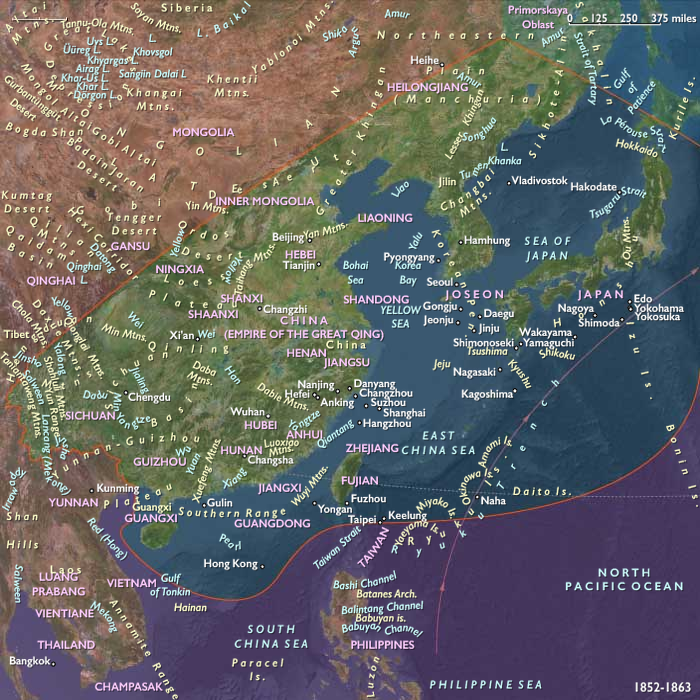
Foreign contacts increase as japan grants more…
1852 CE to 1863 CE
Foreign contacts increase as japan grants more concessions in the final years of the Tokugawa.
The new treaty with the United States in 1859 allows more ports to be opened to diplomatic representatives, unsupervised trade at four additional ports, and foreign residences in Osaka and Edo.
It also embodies the concept of extraterritoriality (foreigners are subject to the laws of their own countries but not to Japanese law).
Hotta loses the support of key daimyo, and when Tokugawa Nariaki opposes the new treaty, Hotta seeks imperial sanction.
The court officials, perceiving the weakness of the bakufu, reject Hotta' s request and thus suddenly embroil Kyoto and the emperor in Japan's internal politics for the first time in many centuries.
When the shogun dies without an heir, Nariaki appeals to the court for support of his own son, Tokugawa Yoshinobu (or Keiki), for shogun, a candidate favored by the shinpan and tozama daimyo.
The fudai win the power struggle, however, installing Tokugawa Yoshitomi, arresting Nariaki and Keiki, executing Yoshida Shoin (1830-59, a leading sonnō jōi intellectual who had opposed the American treaty and plotted a revolution against the bakufu), and signing treaties with the United States and five other nations, thus ending more than two hundred years of exclusion.
Locations
Groups
Commodities
Regions
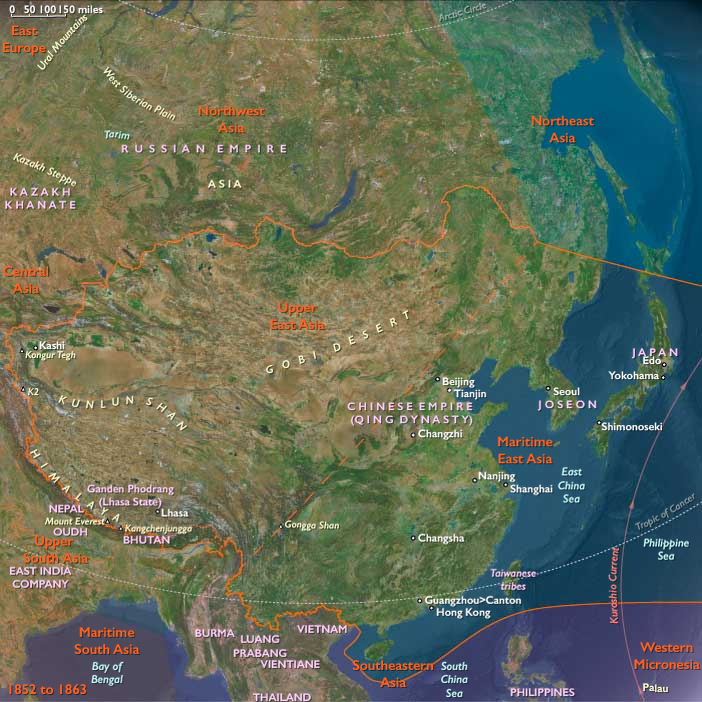
East Asia
View →Subregions