
Liu Zhang, at the suggestion of his …
Years: 211 - 211
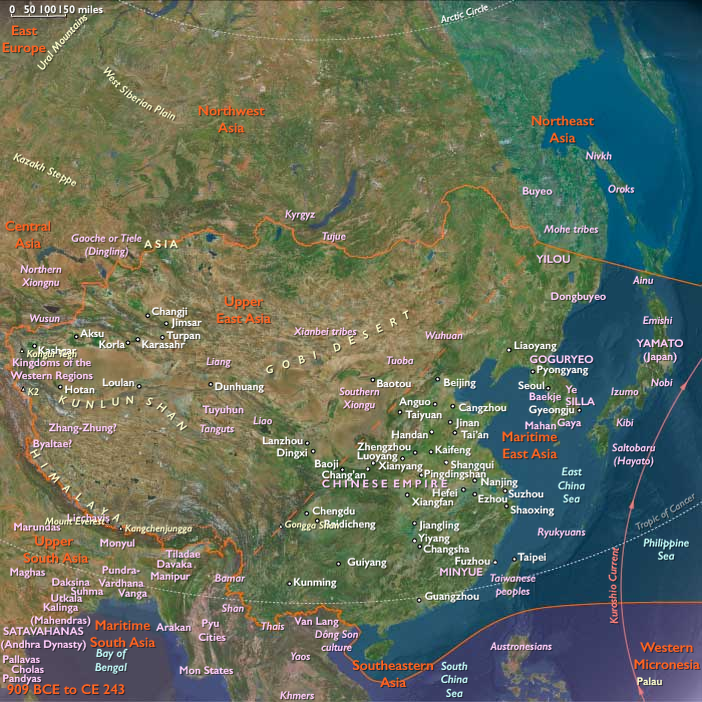
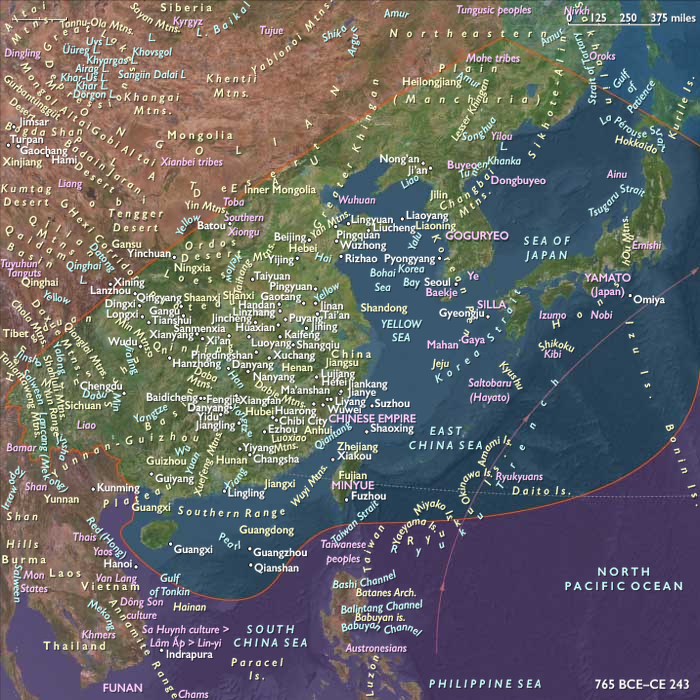
Liu Zhang, at the suggestion of his advisor Zhang Song, asks Liu Bei to come to his assistance in the battle against Zhang Lu in 211.
The welcoming of Liu Bei is a plan by Zhang Song, Fa Zheng, and Meng Da to ultimately make him their leader, since they consider him more ambitious and worthy of serving than Liu Zhang.
Wang Lei, Huang Quan, Li Hui, and others try to persuade Liu Zhang not to accept Liu Bei into his territory, but their pleas are ignored and Liu Bei is welcomed as a guest general of Liu Zhang who will go to the front to fight against Zhang Lu.
Locations
People
- Fa Zheng
- Huang Quan
- Li Hui
- Liu Bei
- Liu Zhang
- Meng Da
- Wang Lei
- Xian of Han
- Zhang Lu
- Zhang Ren
- Zhang Song
Groups
Topics
Commodoties
Subjects
Regions
Subregions
Related Events
Filter results
Showing 10 events out of 14 total
Neither Philip III (r. 1598- 1621) nor Philip IV (r. 1621-65) is competent to give the kind of clear direction that Philip II had provided.
Responsibility passes to aristocratic advisers.
Gaspar de Guzmán, count-duke of Olivares, attempts and fails to establish the centralized administration that his famous contemporary, Cardinal Richelieu, had introduced in France.
In reaction to Guzman's bureaucratic absolutism, Catalonia revolts and is virtually annexed by France.
Portugal, with English aid, reasserts its independence in 1640, and an attempt is made to separate Andalusia from Spain.
In 1648, at the Peace of Westphalia, Spain assents to the emperor's accommodation with the German Protestants, and in 1654 it recognizes the independence of the northern Netherlands.
The Erosion of Portuguese Autonomy Under Spanish Rule (1598–1640)
When Philip II of Spain became King of Portugal in 1580, the Iberian Union was established under the agreement that Portugal would retain its autonomy, with its own laws, institutions, and government. However, after his death in 1598, his successors, Philip III and Philip IV, gradually eroded Portuguese independence, culminating in widespread discontent that eventually led to the Portuguese Restoration War (1640–1668).
Philip III (r. 1598–1621): The Beginning of Decline
- Upon his accession, Philip III of Spain (also King of Portugal as Philip II) gradually abandoned his father’s policy of respecting Portuguese autonomy.
- Unlike Philip II, who had resided in Portugal, Philip III rarely visited—his only trip was in 1619, near the end of his reign.
- He appointed Spaniards to the six-member Portuguese governing council, violating the terms of the Iberian Union.
- Over time, Portuguese nobles and officials were increasingly replaced by Spaniards, weakening local governance and alienating the Portuguese elite.
Philip IV and the Misrule of the Duke of Olivares (1621–1640)
- Philip IV (r. 1621–1665) had little interest in ruling Portugal and delegated control to his chief minister, Gaspar de Guzmán, the Count-Duke of Olivares.
- Olivares, an advocate of centralized Spanish rule, sought to fully integrate Portugal into Spain, disregarding its legal and political autonomy.
Policies That Led to Portuguese Resentment
-
Heavy Taxation and Military Requisitions
- Spain was engaged in multiple wars, particularly against France and the Dutch Republic, and Olivares forced Portugal to bear a heavy tax burden.
- Portuguese troops and resources were drained to support Spain’s military efforts, further weakening Portuguese defenses in its colonies.
-
Suppression of Portuguese Nobility
- Many Portuguese nobles lost power and influence, as Olivares favored Spaniards for high-ranking positions.
- The hispanophile elite, once supportive of the Iberian Union, turned against Spanish rule.
-
Colonial Vulnerability
- As Spain focused on European wars, Portugal’s overseas empire became vulnerable to Dutch, English, and French attacks.
- The Dutch captured major Portuguese colonies, including parts of Brazil (1630) and Ceylon (1638).
- Portuguese merchants and colonial administrators blamed Spain for neglecting Portugal’s global interests.
-
Attempts to Abolish Portuguese Autonomy
- Olivares sought to fully integrate Portugal into Spain, eliminating its separate institutions.
- He proposed a unified Iberian military force, further fueling fears of Portuguese subjugation.
The Road to Revolt: Growing Calls for Independence
- By the late 1630s, resistance to Spanish rule had grown across all levels of Portuguese society:
- The nobility resented their loss of power.
- The merchant class was angered by economic decline and colonial losses.
- The general population suffered from high taxes and forced military service.
- Secret meetings among Portuguese nobles began plotting for an independence movement.
Conclusion: The Path to the Portuguese Restoration War (1640–1668)
The disrespect for Portuguese autonomy under Philip III and Philip IV, coupled with economic strain and military overreach, created widespread resentment that ultimately led to the Portuguese revolt in 1640.
The mismanagement of Portugal by the Count-Duke of Olivares proved to be the final breaking point, setting the stage for the end of the Iberian Union and the restoration of the Portuguese monarchy under the House of Braganza.
The Decline of Portugal’s Seaborne Empire During the Iberian Union (1580–1640)
Portugal’s overseas empire had already begun to decline before the Iberian Union, but its 60-year incorporation under Spanish rule (1580–1640)—known in Portugal as the "Spanish Captivity"—accelerated the process. Under Spanish rule, Portugal was dragged into Spain’s conflicts with England and the Dutch Republic, resulting in the loss of key territories in Asia, Africa, and Brazil.
Impact of the Iberian Union on Portugal’s Empire
-
Wars with England and the Dutch Republic
- As part of Spain’s empire, Portugal became an enemy of England and the Dutch, two rising naval powers.
- The Dutch and English targeted Portuguese trade routes, attacking fortified cities and commercial outposts in the Far East, Africa, and the Americas.
-
Dutch and English Conquests in Asia and India
- The Dutch seized Portuguese-controlled trading posts in the East Indies, undermining Portugal’s monopoly on the spice trade.
- The Dutch East India Company (VOC) captured:
- Malacca (1641)—a major Portuguese hub in Southeast Asia.
- Ceylon (Sri Lanka, 1638–1658)—cutting off Portugal’s access to cinnamon trade.
- The Moluccas (Spice Islands)—ending Portugal’s dominance in the nutmeg and clove markets.
- The English gained a foothold in India, gradually taking over Portuguese commercial influence.
-
Attacks on Portuguese Brazil
- The Dutch West India Company (WIC) attacked Brazil, seeking to dominate the lucrative sugar trade.
- They:
- Occupied Pernambuco (1630–1654), the richest sugar-producing region in the Americas.
- Captured and raided Bahia and Rio de Janeiro.
- Only resistance from Portuguese settlers and indigenous allies prevented a total Dutch conquest of Brazil.
-
Portuguese Trade Monopolies Weakened
- The Dutch and English broke Portugal’s commercial monopoly in both the Indian Ocean and the Atlantic.
- Lisbon lost control over vital trade networks, leading to economic decline.
Conclusion: A Severely Weakened Empire by 1640
- By the time Portugal regained independence in 1640, its empire was greatly reduced.
- The Dutch controlled key territories in Asia, the English had established themselves in India, and Portugal’s monopoly on global trade had collapsed.
- The only bright spot was that Portuguese settlers and militias managed to defend Brazil, preventing it from becoming a Dutch colony.
The Iberian Union (1580–1640) was a period of decline for Portugal, accelerating the loss of its global dominance and marking the beginning of its transition to a second-tier colonial power.
Philip IV of Spain is to become famous for his patronage of his court painter Diego Velázquez.
Velázquez originates from Seville and mutual contacts had caused him to become known in 1623 to Gaspar de Guzmán, Count Duke of Olivares, Philip’s principal minister, who comes from the same region; he is summoned to Madrid by the king in 1624.
Despite some jealously from the existing court painters, Velázquez rapidly becomes a success with Philip, being retained for the rest of his career until his death, painting a celebration of the Treaty of the Pyrenees for Philip.
The king and Velázquez share common interests in horses, dogs and art, and in private are to form an easy, relaxed relationship over the years.
Velázquez is to paint at least three portraits of Olivares, his friend and original patron, producing the baroque equestrian portrait along with the standing portraits now at the Hermitage and São Paulo.
Like many contemporaries, Olivares is 'haunted' by Spain's potential decline, and sees part of the solution at least in a reform of the Spanish state.
Olivares sees Catalonia and the other provinces as paying less to the crown than they should, and does not really understand why the inhabitants should object to a fairer distribution of taxes.
He is confident in the intellectual argument for a better defended, better ordered Spain, and never seems to have shown serious doubt that his plans would succeed, or understood the growing hatred against his rule.
These plans take form first in Olivares' Unión de Armas, or 'Union of Arms' concept, put forward in 1624.
This would have involved the different elements of Philip's territories raising fixed quotas of soldiers in line with their size and population.
Despite being portrayed by Olivares as a purely military plan, it reflects Olivares' desire for a more closely unified Spain—although not, it is generally argued, a completely unified kingdom.
Olivares' 'Union of Arms' plan fails in the face of opposition from the provinces, in particular Catalonia, leading him to offer his resignation to the king in 1626; it is not accepted.
The subsequent years are to be challenging financially for Spain.
Olivares is well known for his passion for work.
Early on, Olivares would rise early, go to confession, wake Philip IV and discuss the day's events with him, before then working throughout the rest of the day, often until eleven o'clock at night.
Initially, Olivares would meet with him three times a day, although this declined over time until he met with the king only once a day.
While living a private life of 'spartan austerity' himself, Olivares is skillful in using the formal and elaborate protocol of the court as a way of controlling the ambitions of Philip's enemies and rivals.
Determined to attempt to improve the bureaucratic Castilian system of government, during the 1620s Olivares had begun to create juntas, smaller governmental committees, to increase the speed of decision making.
By the 1630s, these are increasingly packed with Olivares' own placemen, tasked to implement his policies.
Olivares places tight controls on the use of special royal favors to circumvent tight spending controls.
The result is a very particular combination of centralized power in the form of Olivares, and loose government executed by small committees.
The Spanish army was by the late 1620s no longer as dominant on the battlefield as it once had been.
The feared tercio regiments, composed of well-disciplined pikemen, are increasingly appearing inflexible and outmoded in the face of the new Swedish and Dutch formations with a higher proportion of musketeers.
Philip and Olivares have attempted to address the perceived weaknesses of the army, which they have concluded is primarily due to the falta de cabezas, or a lack of leadership.
In keeping with their wider agenda of renewing the concepts of duty, service and aristocratic tradition, the king has agreed to efforts to introduce more grandees into the higher ranks of the military, working hard to overcome the reluctance of many to take up field appointments in the Netherlands and elsewhere.
The results are not entirely as hoped.
The grandees dragooned into service in this way are disinclined to spend years learning the normal professional military skill set.
By the 1630s, the king is waiving the usual rules to enable promotion to higher ranks on a shorter timescale, and having to pay significant inflated salaries to get grandees to take up even these appointments.
Philip is also notable for his interest in the Spanish armada, or navy.
Shortly after taking power in 1621, he had begun to increase the size of his fleets, rapidly doubling the size of the naval budget from the start of his reign, then tripling it; Philip is credited with a 'sensible, pragmatic approach' to provisioning and controlling it.
He is prepared to involve himself in considerable details of naval policy -- he was commenting on the detail of provisions for the armada in 1630, for example.
The scene has been set, Olivares believes, for a renewed attack on the Dutch, but Olivares' strategy ultimately fails due to the entry of France into the war.
His handling of War of the Mantuan Succession, which had started to pitch France against the Habsburgs in northern Italy and will ultimately result in the French invasion of Spain, has been much criticized.
France, seeing the Spanish successes in Germany and the defeat of her Swedish allies by 1634, begins raising the political stakes, taking provocative military action on a small scale.
The open war with Spain starts with a promising victory for the French at the Belgian village of Les Avins on May 20, 1635, in what is at this time the bishopric of Liège.
The Spanish army, inferior in numbers, is surrounded and completely defeated in just a few hours.
Some five thousand Spanish are killed or wounded, fifteen hundred captured and the rest scattered.
It is the first serious engagement for the French, which had entered the war only three months before.
The French army had joined up with the Dutch coming from the north, but their disagreements have given the Spanish the time to reorganize themselves.
They harass the French with quick cavalry raids.
The French army also suffers from lack of supplies and money, which has led to widespread desertions.
After the Peace of Prague (1635), Imperial troops are free to reinforce the Spanish.
Years: 211 - 211
Locations
People
- Fa Zheng
- Huang Quan
- Li Hui
- Liu Bei
- Liu Zhang
- Meng Da
- Wang Lei
- Xian of Han
- Zhang Lu
- Zhang Ren
- Zhang Song
