
Mediterranean West Europe (2637 – 910 BCE): …
Years: 2637BCE - 910BCE
Mediterranean West Europe (2637 – 910 BCE): Coastal Gateways and Mountain Valleys
Geographic and Environmental Context
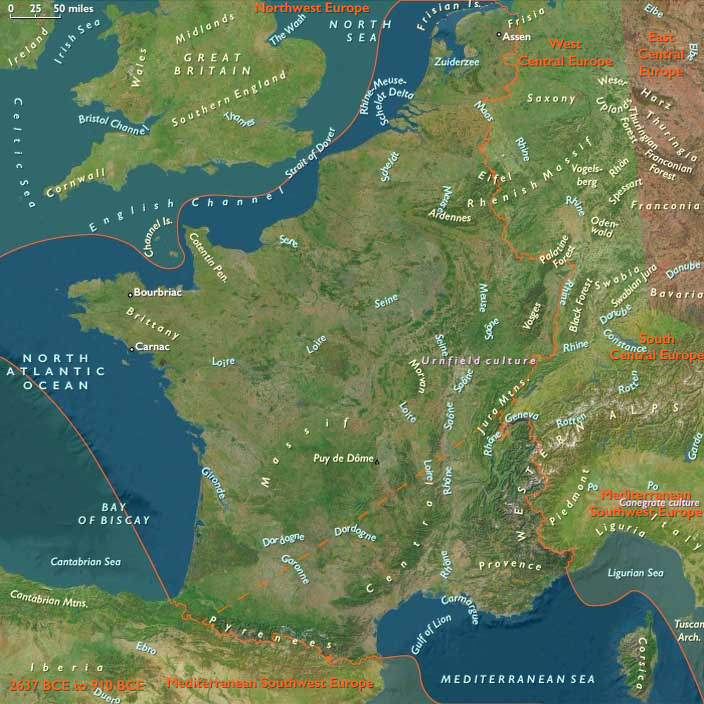
Mediterranean West Europe—including southern France, Monaco, Corsica, and the French Pyrenees—was a region where rugged mountains met fertile river valleys and an indented Mediterranean coastline. The Pyrenees formed a formidable natural barrier between the Iberian Peninsula and the rest of Europe, while the Rhone Valley provided a major corridor linking the Mediterranean to the European interior. Coastal plains along the Gulf of Lion offered rich agricultural land, and Corsica’s mountainous interior created sharp ecological contrasts between coastal fishing zones and upland herding areas.
Agriculture, Herding, and Fishing
By the mid–third millennium BCE, communities in the lowlands cultivated wheat, barley, olives, and grapes, while upland and mountain zones practiced transhumant herding of sheep, goats, and cattle. Seasonal movement of livestock between summer alpine pastures and winter lowlands ensured efficient use of varied grazing zones.
Fishing and shellfish gathering were staples for coastal and island populations, with seasonal abundance in bays, lagoons, and river mouths.
Technological and Cultural Developments
The region saw the spread of copper and bronze metallurgy, producing weapons, tools, and ornaments that supplemented or replaced stone and bone implements. Pottery styles varied, with burnished wares in the Rhone corridor, incised designs in the Pyrenean foothills, and influences from the Beaker culture evident in coastal and riverine settlements.
Inland megalithic monuments—dolmens and standing stones—served both funerary and territorial purposes, while some coastal sites show evidence of planned layouts and defensive features.
Trade and Exchange Networks
Maritime and overland trade integrated Mediterranean West Europe into a wider network stretching from North Africato the Atlantic. The Rhone corridor allowed the movement of goods such as obsidian, amber, metals, and ceramics deep into continental Europe. Corsica, strategically placed between Italy and France, acted as both a waypoint and a resource hub, with timber, stone, and possibly metals exchanged across the Tyrrhenian and Ligurian seas.
Cultural and Symbolic Expressions
Burial practices ranged from communal megalithic tombs in the Pyrenean foothills to stone-lined graves in the Rhone Valley, often accompanied by pottery, beads, weapons, and ornaments. Artistic motifs included geometric engravings, solar symbols, and depictions of weapons—possibly reflecting warrior identity or status.
Rock carvings and petroglyphs in upland areas suggest ceremonial significance tied to both agricultural and herding cycles.
Environmental Adaptation and Resilience
Communities adapted to diverse environments by integrating farming, herding, fishing, and foraging. Irrigation channels and terracing supported agriculture in dry summers, while mobility in pastoral systems allowed adaptation to fluctuating pasture conditions. Coastal settlements diversified subsistence with marine resources, providing stability in years of poor harvest.
Transition to the Early First Millennium BCE
By 910 BCE, Mediterranean West Europe had emerged as a vital link between the western Mediterranean and the European interior. Its fertile valleys, strategic mountain passes, and maritime routes fostered cultural exchange, economic growth, and technological diffusion, laying the groundwork for increasingly interconnected societies in the centuries to follow.
Groups
Topics
- Neolithic Europe
- Subboreal Period
- Abrolhos Transgression
- 4.2 kiloyear BP aridification event
- Subatlantic Period
- Younger Subboreal Period
- Iron Age Europe
- Subatlantic Period
Commodoties
Subjects
Regions
Subregions

Years: 2637BCE - 910BCE
Groups
Topics
- Neolithic Europe
- Subboreal Period
- Abrolhos Transgression
- 4.2 kiloyear BP aridification event
- Subatlantic Period
- Younger Subboreal Period
- Iron Age Europe
- Subatlantic Period
Commodoties
Subjects
Regions
Subregions