
Atlantic West Europe (40–51 CE): Turbulent Reign …
Years: 40 - 51
Atlantic West Europe (40–51 CE): Turbulent Reign of Caligula, Restoration under Claudius, and Provincial Growth
From 40 to 51 CE, Atlantic West Europe—including Aquitaine, the Atlantic coast, northern and central France, Alsace, and the Low Countries—experienced a period of political instability under the later reign of Caligula, followed by renewed stability and provincial expansion under Emperor Claudius. Urban and economic growth resumed after initial uncertainty, deepening Roman integration and regional prosperity.
Political and Military Developments
Turmoil under Caligula (40–41 CE)
-
Emperor Caligula (r. 37–41 CE), increasingly erratic and tyrannical, created uncertainty within the empire, briefly unsettling regional governance and raising concerns among the provincial elite.
-
The Rhine frontier faced heightened tensions, although substantial Roman military presence prevented any major incursions into Atlantic West Europe.
Stability Restored by Claudius (41–51 CE)
-
The assassination of Caligula in 41 CE led to the accession of Emperor Claudius (r. 41–54 CE), who rapidly restored imperial stability and administration.
-
Claudius reinforced provincial governance by granting greater autonomy and citizenship rights to prominent local elites, significantly improving regional stability.
Claudian Conquest of Britain (43 CE)
-
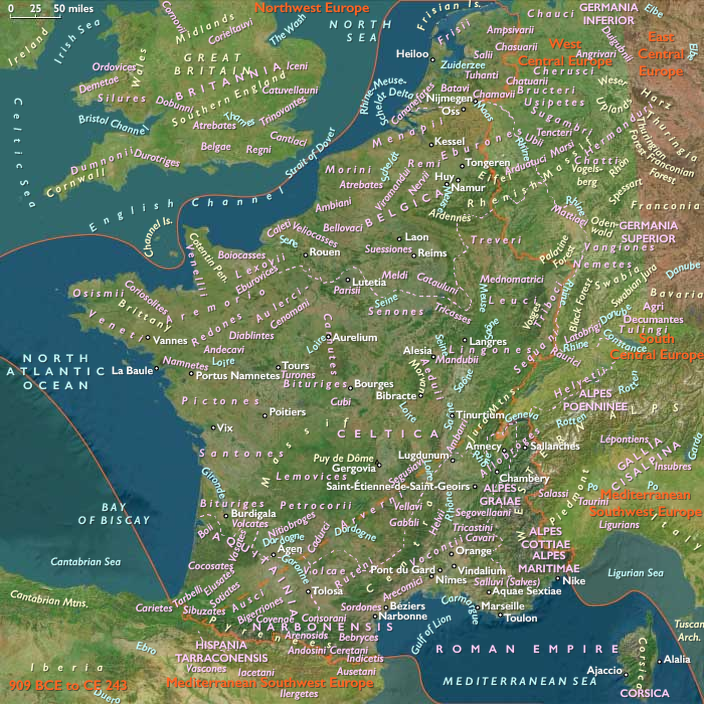
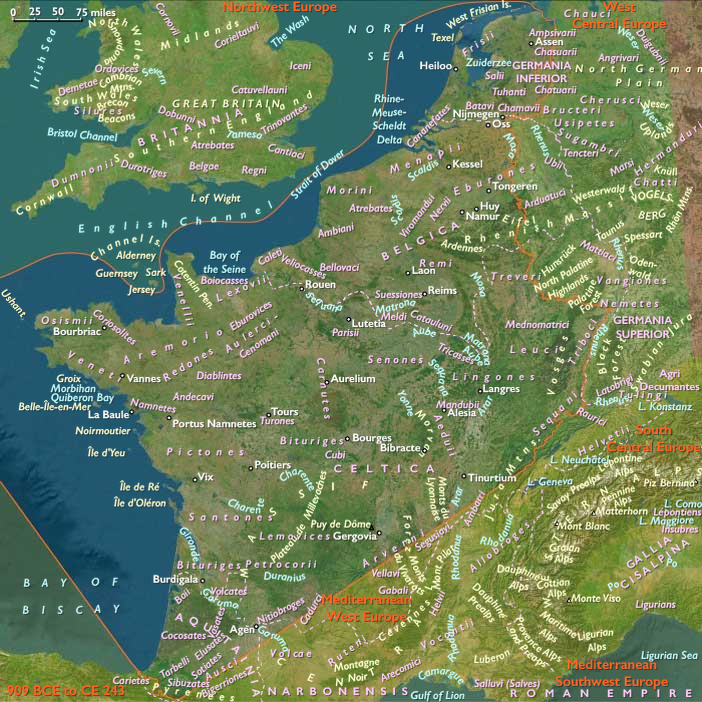
In 43 CE, Claudius launched a successful invasion of Britain, significantly affecting Atlantic West Europe by increasing regional trade, enhancing military presence, and boosting the economies of port cities such as Gesoriacum (Boulogne) and coastal towns along the English Channel.
Economic and Social Developments
Trade Expansion and Urban Growth
-
The successful conquest of Britain boosted trade and commerce along the Atlantic coast, dramatically benefiting ports in northern Gaul.
-
Burdigala (Bordeaux) strengthened its position as a significant trade hub, exporting wine and agricultural products to newly conquered Britain and distant provinces of the empire.
-
Urbanization accelerated under Claudius, with cities such as Augustodunum (Autun), Lutetia (Paris), Durocortorum (Reims), and Argentoratum (Strasbourg) benefiting from renewed imperial investment and expanded trade networks.
Infrastructure Development
-
Claudius invested heavily in provincial infrastructure, further enhancing the Roman road system, improving transportation efficiency, and facilitating rapid troop movements and commerce across Atlantic West Europe.
-
Major aqueducts, public baths, theaters, and administrative centers expanded, reflecting increased urban prosperity.
Cultural and Religious Developments
Romanization and Provincial Identity
-
Gallo-Roman identity continued to deepen as elites actively participated in imperial governance and adopted Roman cultural norms, Latin language, and urban lifestyles.
-
Prominent provincial families increasingly gained citizenship and entered Roman administrative positions, further integrating regional interests into imperial structures.
Religious Syncretism and Imperial Cult
-
Worship of Roman and indigenous deities remained widespread, highlighting religious syncretism in cities and rural areas.
-
Imperial cults expanded notably under Claudius, reinforcing loyalty to the emperor and Rome, particularly after the instability of Caligula’s reign.
Key Figures and Events
-
Caligula (d. 41 CE): His turbulent reign created temporary instability before his assassination in 41 CE.
-
Claudius (from 41 CE): Established firm control, restored stability, granted citizenship to provincial elites, and expanded the empire into Britain, significantly impacting Atlantic West Europe's trade and economy.
Long-Term Significance
By 51 CE, Atlantic West Europe had emerged stronger following a brief period of uncertainty:
-
Claudius’s policies and Britain’s conquest greatly stimulated regional trade and urban prosperity.
-
Gallo-Roman elites became increasingly central to provincial administration and Roman imperial integration.
-
The renewed stability under Claudius laid essential groundwork for further economic growth, cultural assimilation, and provincial importance within the Roman Empire.
People
Groups
- Polytheism (“paganism”)
- Gallo-Roman culture
- Gallia Lugdunensis (Roman province)
- Gallia Aquitania (Roman province)
- Gallia Belgica (Roman province)
- Roman Empire (Rome): Julio-Claudian dynasty
Topics
Commodoties
Subjects
Regions
Subregions
Years: 40 - 51
People
Groups
- Polytheism (“paganism”)
- Gallo-Roman culture
- Gallia Lugdunensis (Roman province)
- Gallia Aquitania (Roman province)
- Gallia Belgica (Roman province)
- Roman Empire (Rome): Julio-Claudian dynasty
Topics
Commodoties
Subjects
Regions
Subregions