
Atlantic West Europe, 760–771: The Transition from …
Years: 760 - 771
Atlantic West Europe, 760–771: The Transition from Pepin to Charlemagne
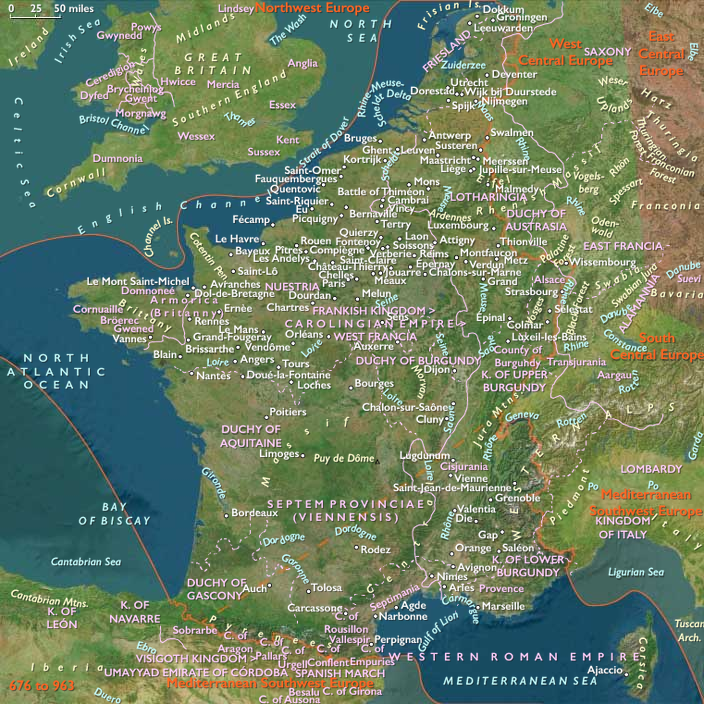
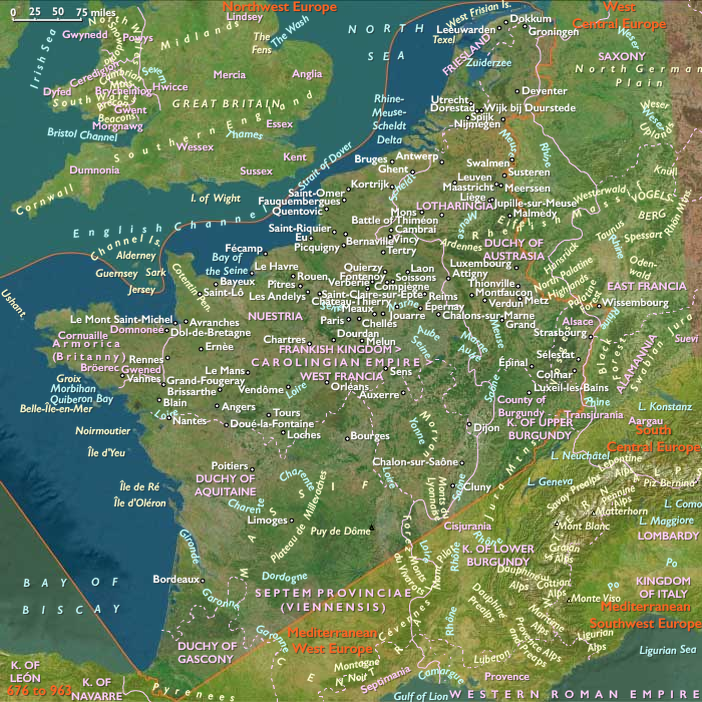
From 760 to 771, Atlantic West Europe experienced a decisive transition as Pepin III ("the Short") concluded his reign, firmly establishing Carolingian legitimacy, and passing his authority to his sons, particularly Charlemagne, who inherited and expanded the Frankish legacy. This era marked the stabilization of political authority, intensified expansionist efforts, and laid critical foundations for future cultural and religious transformation.
Political and Military Developments
-
Final Consolidation Under Pepin III (760–768)
- Pepin the Short continued consolidating Frankish rule across western France, Burgundy, and Aquitaine, firmly establishing Carolingian authority and significantly diminishing the power of regional ducal rivals.
- The subjugation of Aquitaine accelerated, with decisive victories over Duke Waifar in the late 760s (Waifar killed in 768), effectively integrating Aquitaine into the Frankish kingdom and ending prolonged resistance.
-
Succession and Division (768–771)
- Upon Pepin's death in 768, his kingdom was divided between his sons, Charlemagne and Carloman I. Charlemagne assumed control of Neustria, Aquitaine, and most of western Francia, while Carloman inherited territories centered in Austrasia and Burgundy.
- Tensions quickly arose between the two brothers, but open conflict was averted by Carloman’s sudden death in December 771. This left Charlemagne as the undisputed ruler of a reunified Frankish kingdom.
Economic and Social Developments
-
Economic Stability and Growth
- Enhanced stability under Pepin and subsequent Carolingian rule promoted economic revival in Aquitaine, Neustria, and Burgundy. Agricultural productivity increased with continued land clearances and improved farming techniques.
- Regional commerce benefited from secure trade routes, particularly along major waterways and coastal towns such as Nantes, Bordeaux, and Rouen, encouraging gradual urban recovery and commercial growth.
-
Reorganization of Land and Governance
- Carolingian administrative restructuring improved local governance, securing greater royal control and effective tax collection across Atlantic West Europe.
- Feudal arrangements evolved, granting loyal aristocrats land in exchange for military and administrative services, laying foundations for the later medieval feudal system.
Religious and Cultural Developments
-
Strengthening Ecclesiastical Authority
- Pepin actively supported ecclesiastical reform, seeking greater control over monasteries and bishoprics to bolster royal authority and religious unity.
- Charlemagne continued these reforms, further standardizing liturgical practices and church administration, setting the stage for later Carolingian religious unity and the educational renaissance.
-
Growth of Monasticism and Learning
- Monastic centers in Burgundy, Aquitaine, and along the Loire increasingly became prominent cultural and intellectual hubs, with growing networks of scriptoria that preserved classical and Christian texts.
Intellectual and Artistic Developments
- Early Carolingian Cultural Foundations
- Artistic and scholarly activity flourished in monastic and ecclesiastical contexts, notably in the production of illuminated manuscripts and religious artifacts, foreshadowing the full flowering of the Carolingian Renaissance.
- Emerging educational institutions, though still limited in scope, began attracting scholars and intellectuals, preparing the ground for the greater cultural revival under Charlemagne.
Long-Term Significance
The period 760–771 was pivotal, bridging Pepin III's successful reign with Charlemagne's transformative era. Pepin's final consolidation of power, the resolution of Aquitaine’s independence, and Charlemagne’s subsequent sole rule created political stability and territorial unity. These developments facilitated significant cultural, religious, and economic advances that would reach their peak in the ensuing Carolingian Renaissance, shaping the trajectory of Atlantic West Europe for centuries to come.
People
Groups
- Franks
- Christianity, Chalcedonian
- Aquitaine, (Frankish) Duchy of
- Burgundy, Frankish Kingdom of
- Francia (Carolingians)
Topics
Commodoties
Subjects
Regions
Subregions
Years: 760 - 771
People
Groups
- Franks
- Christianity, Chalcedonian
- Aquitaine, (Frankish) Duchy of
- Burgundy, Frankish Kingdom of
- Francia (Carolingians)
Topics
Commodoties
Subjects
Regions
Subregions