
Atlantic West Europe (892–903): Decline of Carolingian …
Years: 892 - 903
Atlantic West Europe (892–903): Decline of Carolingian Authority and Rise of Regional Powers
Between 892 and 903, Atlantic West Europe experienced the rapid disintegration of Carolingian authority, the solidification of regional principalities such as Brittany, Flanders, Anjou, and Upper and Lower Burgundy, and significant shifts driven by ongoing Viking invasions.
Political and Military Developments
-
West Francia: Struggle Between Carolingian and Robertian Dynasties
- King Odo of Paris (r. 888–898), despite his initial popularity and military successes, struggled to assert royal authority amid rising noble independence and ongoing Viking incursions.
- Upon Odo’s death, Charles the Simple (r. 898–922), a Carolingian descendant, regained the throne, though royal power was severely limited and regional nobility increasingly autonomous.
-
Flanders: Growth of Territorial Strength
- Count Baldwin II of Flanders (r. 879–918) continued consolidating his power, fortifying towns like Bruges and Ghent against Viking threats, and reinforcing Flemish political autonomy and economic stability.
-
Brittany: Defiance and Autonomy
- Under Duke Alain I (r. 877–907), Brittany resisted Viking attacks effectively, asserting its independence from Frankish domination and strengthening regional identity.
-
Anjou: Expansion of Comital Power
- The Counts of Anjou consolidated local authority along the Loire Valley, fortifying territories against Viking incursions and enhancing political and economic stability.
-
Upper and Lower Burgundy: Independent Kingdoms
- Upper Burgundy under Rudolph I (r. 888–912) firmly established itself as an independent entity (future Franche-Comté region).
- Lower Burgundy (Provence) maintained its independence under King Louis the Blind (r. 887–928), navigating between Carolingian and Imperial spheres of influence.
Economic and Social Developments
-
Viking Raids and Urban Fortification
- Frequent Viking raids along rivers such as the Seine and Loire compelled communities to construct defensive fortifications, enhancing the emergence of local strongholds and fortified towns like Paris and Tours.
- These fortifications stimulated local economies and increased autonomy for town-based elites.
-
Agricultural Stability and Local Economies
- Despite instability, regional economies in areas such as Flanders, Anjou, and Aquitaine remained resilient, with agricultural production sustaining modest urban growth and local trade.
Religious and Cultural Developments
- Monasticism and Manuscript Culture
- Monastic institutions like Saint-Martin of Tours, despite occasional disruptions by Viking incursions, remained essential in preserving Latin learning, manuscript culture, and religious reform.
- Cultural life, though strained, persisted in monasteries and cathedral schools across the region.
Legacy and Significance
By 903, Atlantic West Europe had undergone significant transitions:
- The authority of the Carolingian monarchy in West Francia had been irreversibly weakened, facilitating the rise of regional dynasties and local autonomy.
- Robust territorial principalities, notably Flanders, Brittany, Anjou, and the two Burgundies, emerged clearly defined and increasingly independent.
- Viking incursions accelerated the militarization and fortification of urban centers, laying the groundwork for medieval town structures.
- Despite widespread disruption, monastic centers maintained essential continuity in cultural and religious life.
This era represented a pivotal shift from centralized Carolingian rule toward localized power structures, significantly shaping the feudal landscape of medieval Atlantic West Europe.
People
- Alan I of Brittany
- Baldwin II
- Boso of Provence
- Charles the Simple
- Louis the Blind
- Odo of France
- Rudolph I of Burgundy
Groups
- Christianity, Chalcedonian
- Aquitaine, (Carolingian) Kingdom of
- Frankish, or Carolingian (Roman) Empire
- Brittany, Kingdom of
- Francia Occidentalis (West Francia, or France), Kingdom of
- Burgundy, Upper, Kingdom of
- Lotharingia, Kingdom of
- Flanders, County of
- Anjou, County of
- Burgundy, Lower, Kingdom of
Topics
Subjects
Regions
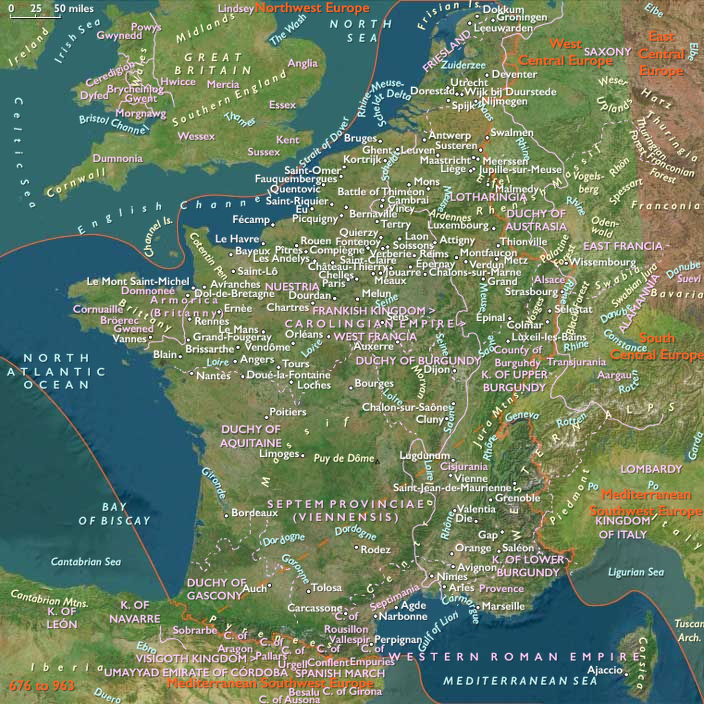
Subregions
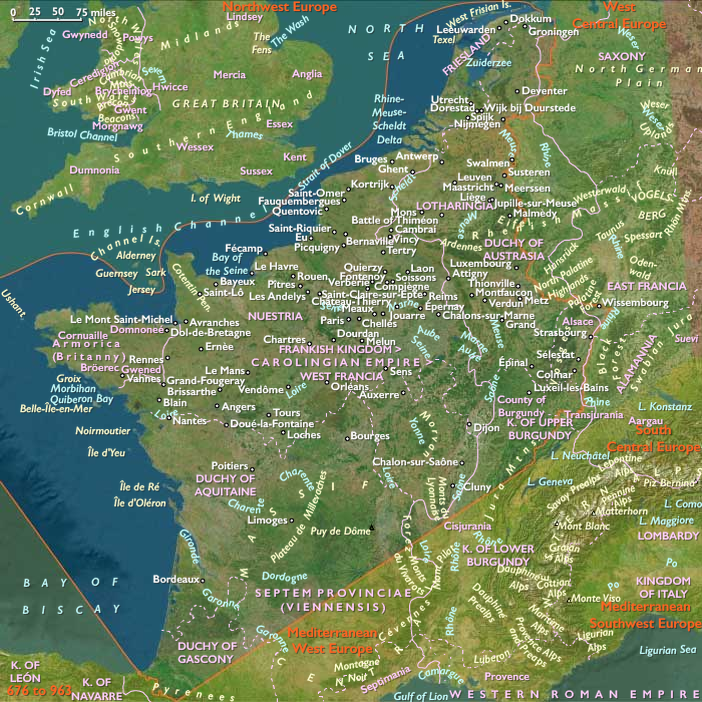
Years: 892 - 903
People
- Alan I of Brittany
- Baldwin II
- Boso of Provence
- Charles the Simple
- Louis the Blind
- Odo of France
- Rudolph I of Burgundy
Groups
- Christianity, Chalcedonian
- Aquitaine, (Carolingian) Kingdom of
- Frankish, or Carolingian (Roman) Empire
- Brittany, Kingdom of
- Francia Occidentalis (West Francia, or France), Kingdom of
- Burgundy, Upper, Kingdom of
- Lotharingia, Kingdom of
- Flanders, County of
- Anjou, County of
- Burgundy, Lower, Kingdom of
Topics
Subjects
Regions
Subregions