August Kekulé's most famous work is on…
1865 CE
August Kekulé's most famous work is on the structure of benzene.
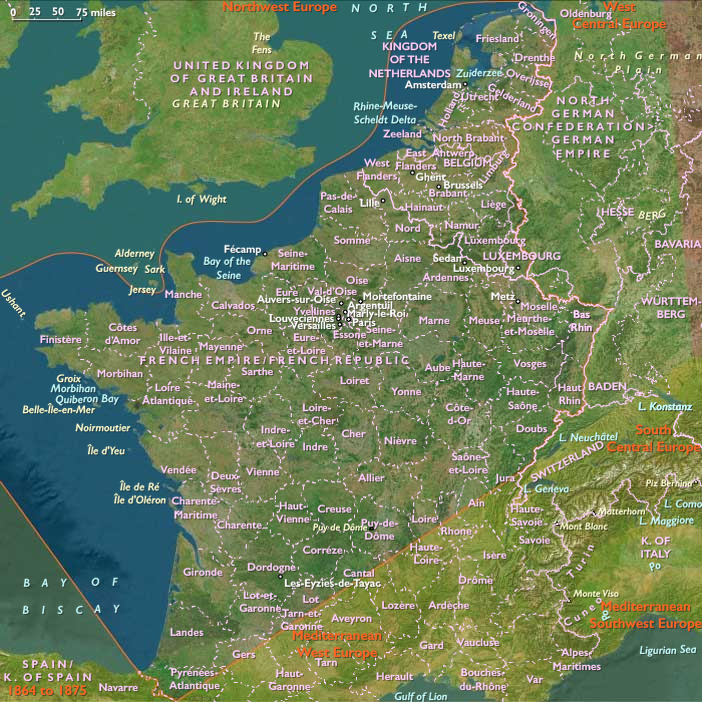
In 1865, he publishes a paper in French (for he is at this time still in Francophone Belgium) suggesting that the structure contains a six-membered ring of carbon atoms with alternating single and double bonds.
The empirical formula for benzene had been long known, but its highly unsaturated structure was a challenge to determine.
Archibald Scott Couper in 1858 and Joseph Loschmidt in 1861 had suggested possible structures that contained multiple double bonds or multiple rings, but the study of aromatic compounds was in its earliest years, and too little evidence was then available to help chemists decide on any particular structure.
More evidence is available by 1865, especially regarding the relationships of aromatic isomers.
Kekulé argues for his proposed structure by considering the number of isomers observed for derivatives of benzene.
Kekulé was born in Darmstadt, the son of a civil servant.
After graduating from secondary school, in 1847, he had entered the University of Giessen, with the intention of studying architecture.
After hearing the lectures of Justus von Liebig, he had decided to study chemistry.
Following his education in Giessen, he took postdoctoral fellowships in Paris (1851–52), in Chur, Switzerland (1852–53), and in London (1853–55), where he had been decisively influenced by Alexander Williamson.
In 1856, Kekulé had became Privatdozent at the University of Heidelberg.
In 1858, he had been hired as full professor at the University of Ghent.
Basing his ideas on those of predecessors such as Williamson, Edward Frankland, William Odling, Auguste Laurent, Charles Adolphe Wurtz and others, Kekulé is the principal formulator of the theory of chemical structure (1857–58).
This theory proceeds from the idea of atomic valence, especially the tetravalence of carbon (which Kekulé had announced late in 1857) and the ability of carbon atoms to link to each other (announced in a paper published in May 1858), to the determination of the bonding order of all of the atoms in a molecule.
Archibald Scott Couper had independently arrived at the idea of self-linking of carbon atoms (his paper appeared in June 1858), and had provided the first molecular formulas where lines symbolize bonds connecting the atoms.
For organic chemists, the theory of structure has provided dramatic new clarity of understanding, and a reliable guide to both analytic and especially synthetic work.
As a consequence, the field of organic chemistry had developed explosively from this point.
Among those who are most active in pursuing early structural investigations are, in addition to Kekulé and Couper, Frankland, Wurtz, Alexander Crum Brown, Emil Erlenmeyer, and Aleksandr Mikhailovich Butlerov.
People
Groups
Regions

West Europe
View →Subregions