Event
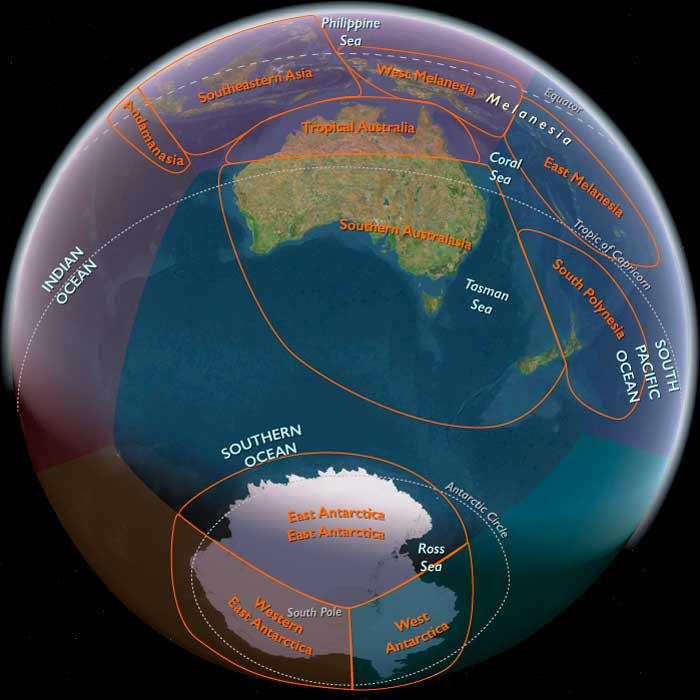
Southern Australasia (7,821–6,094 BCE): Drowned Straits, River…
Southern Australasia (7,821–6,094 BCE): Drowned Straits, River Worlds, and the Foresting Southern Islands.
During the Early Holocene, Southern Australasia encompassed central and southern Australia, Tasmania, New Zealand’s South Island and southwestern North Island margin, Stewart Island/Rakiura, and the subantarctic island groups farther south. The subregion contained two fundamentally different human worlds. Australia and Tasmania had been inhabited for tens of thousands of years, while New Zealand and the southern oceanic islands remained entirely without humans.
Across southern mainland Australia, communities lived within landscapes still being reorganized by postglacial climate and rising seas. River systems, lakes, floodplains, dry basins, woodlands, grasslands and coasts supported varied hunting, fishing and plant-gathering economies. In the Murray–Darling basin, people continued a very long history of exploiting freshwater and terrestrial resources as channels and wetlands changed through the Early Holocene. The present Darling River system developed during this broad period, creating new aquatic habitats and shifting the locations of productive floodplains and waterholes.
Along the southern coasts, marine transgression steadily drowned low coastal plains and altered estuaries, bays and river mouths. Older shorelines disappeared beneath the sea, while new tidal flats, lagoons and shellfish habitats formed farther inland. Communities adjusted their seasonal movement and coastal use to these changing margins rather than occupying a fixed modern shoreline.
Tasmania had already been separated from mainland Australia by the flooding of Bass Strait. Its people therefore entered this period as an island population with a deep local history but increasingly limited direct contact with mainland communities. Forests expanded through many wetter districts after the colder Late Glacial period, while eastern woodlands, grasslands, inland valleys, alpine country and coasts retained distinct ecological characters. Hunting, plant gathering, fishing and coastal foraging varied among these environments.
The islands of Bass Strait preserved fragments of the drowned Bassian landscape. Some had been occupied when they formed part of the wider land bridge and continued to be used during stages of marine fragmentation. As the sea rose, overland routes disappeared and the human geography of the region became increasingly insular.
Across the Tasman Sea, New Zealand’s South Island remained wholly uninhabited. Alpine glaciers had retreated far from their Late Glacial limits but remained substantial in the Southern Alps. Their earlier retreat left moraine systems, lakes, gravel plains and braided rivers across the lowlands. Forest expanded through many valleys and slopes, especially in the wetter west, while drier eastern basins retained more open scrub and shrubland.
The South Island’s interior did not yet resemble the later tussock landscapes created and enlarged by human burning. In places such as the Mackenzie Basin and Central Otago, early-Holocene shrub and low woody vegetation occupied ground later transformed into more open grassland. Moa browsed within forests, scrub and open country, while Haast’s eagle and other endemic birds occupied a terrestrial ecosystem without introduced mammalian predators.
Stewart Island/Rakiura formed another cool, wet, forested component of this unpeopled New Zealand world. Its streams, bogs, forests and rocky coasts supported abundant birdlife, while surrounding waters sustained seabirds, seals and other marine animals.
Farther south, the Auckland Islands had already lost their major Late Glacial ice. Peat accumulated across saturated ground, and grassland, bog and shrub communities dominated much of the landscape. Woody species were spreading gradually, but tall forest had not yet reached the extent it would attain later in the Holocene. Persistent cloud, wet soils and strong oceanic exposure limited forest development despite relatively mild temperatures.
Campbell Island was still more open. Extensive peatlands, grassland, rushes and large-leaved herb communities covered much of the island, with woody scrub remaining limited through most of the period. Westerly winds and saturated soils shaped vegetation and erosion, while seabirds occupied cliffs, slopes and coastal ground.
The smaller southern islands—including the Snares, Antipodes and Bounty groups—remained entirely beyond human settlement. Their histories were dominated by wind, waves, seabird colonies, marine mammals and localized vegetation suited to severe oceanic conditions.
Across Southern Australasia, climate did not move in a single uniform direction. Forest expansion, changing rainfall, strengthening southern westerlies, continuing sea-level rise and local drying or wetting produced different outcomes across continental interiors, temperate islands and subantarctic coasts. Human communities in Australia and Tasmania responded to these changes through mobility and flexible use of terrestrial and aquatic resources, while the lands farther east and south continued to evolve without human influence.
Legacy of the Age
By 6,094 BCE, Southern Australasia had become more sharply divided by sea and ecology. Tasmania was fully isolated from mainland Australia, while rising seas continued to reshape southern Australian coasts and river mouths. Aboriginal communities remained deeply established across mainland and Tasmanian landscapes, adapting to changing wetlands, channels, forests and coastal margins. Across New Zealand’s South Island and the southern oceanic islands, no humans had yet arrived: alpine glaciers had retreated, forests and scrub expanded unevenly, peatlands matured, and subantarctic grasslands and bogs developed under increasingly strong oceanic winds. The defining history of the age was therefore both human and environmental—ancient communities adjusting to a newly fragmented southern continent while neighboring island worlds continued their independent postglacial transformation.

-
{# Image navigates to the detail page; the magnifying-glass chip is the only Fancybox lightbox trigger (kept a separate sibling — anchors can't nest). #}
 Southern Oceania
World
-
{# Image navigates to the detail page; the magnifying-glass chip is the only Fancybox lightbox trigger (kept a separate sibling — anchors can't nest). #}
 Australasia
Region
-
{# Image navigates to the detail page; the magnifying-glass chip is the only Fancybox lightbox trigger (kept a separate sibling — anchors can't nest). #}
 Southern Australasia
Subregion