Diplomatic cooperation with Prussian-dominated Germany contributes to…
1864 CE to 1875 CE
Exclusion from a united Germany is a psychological shock for German Austrians because their claim to leadership in the Habsburg Empire had rested in part on their leadership of the German
nation.
Cut off from Germany, they become just one of many national groups in the Habsburg Empire and constitute only slightly more than one-third of Austria's population.
Had Prussia remained hostile, Austria-Hungary's German population might have been the excuse for Prussian territorial ambitions similar to those harbored by the other nation-states that surround Austria-Hungary.
Aligned with Austria-Hungary, however, Prussia distances itself from German nationalists in Austria-Hungary, and the annexation movement remains politically insignificant.
But, because German Austrians no longer have their majority status guaranteed by participation in the larger German nation, many feel increasingly vulnerable and threatened.
German Austrians thus become open to a nationalism based on ethnic fear and hostility
that contrasts with the self-confident Liberal nationalism of earlier decades.
Locations
Groups
Commodities
Subjects
Regions
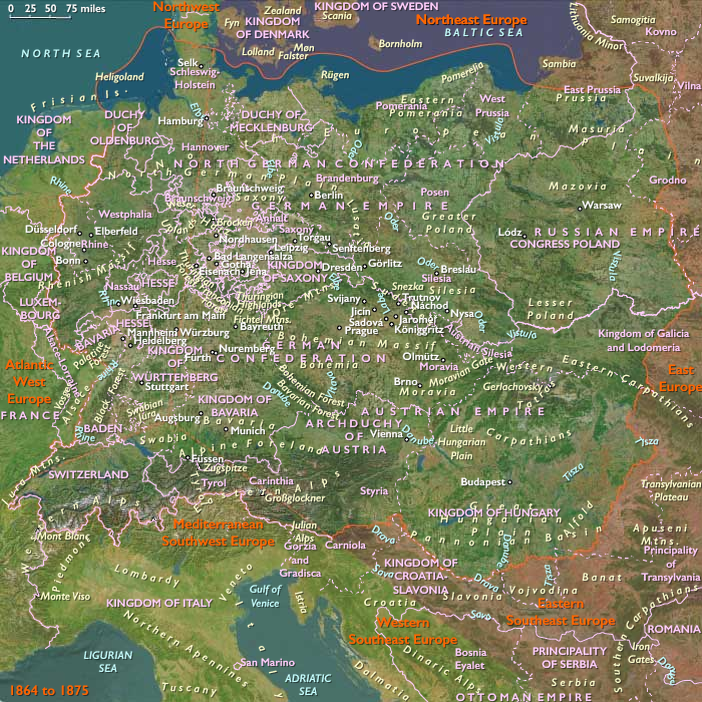
Central Europe
View →Subregions