
Silla in particular, however, develops a flourishing …
Years: 748 - 759
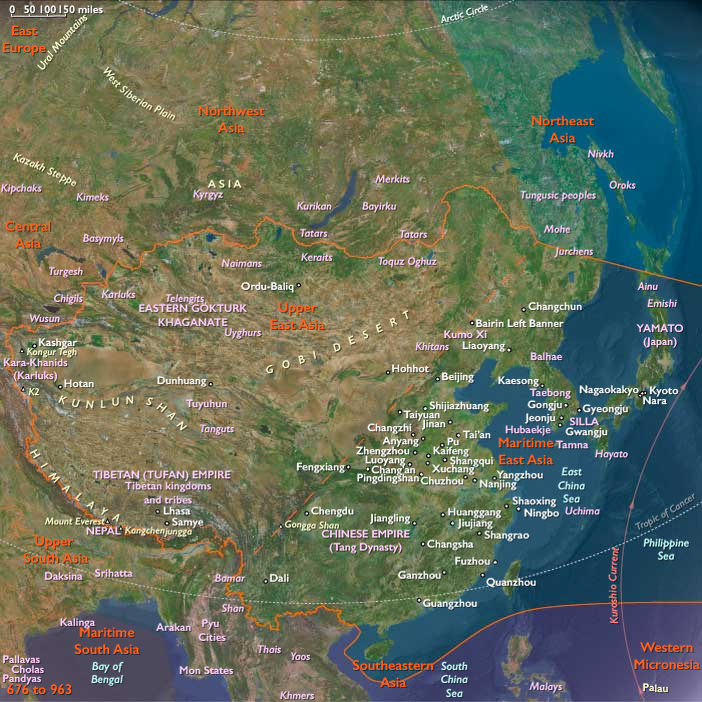
Silla in particular, however, develops a flourishing indigenous civilization that is among the most advanced in the world.
Its capital at Gyeongju is renowned as the "city of gold," where the aristocracy pursued a high culture and extravagant pleasures.
Tang historians write that elite officials possesses thousands of slaves, with like numbers of horses, cattle, and pigs.
The wives of such senior officials wear gold tiaras and earrings of delicate and intricate filigree.
Silla scholars study the Confucian and Buddhist classics, advance state administration, and develop sophisticated methods for astronomy and calendrical science.
The Dharani Sutra, recovered in Gyeongju, dates as far back as 751 and is the oldest example of woodblock printing yet found in the world.
"Pure Land" Buddhism unites the mass of common people, who can become adherents through the repetition of simple chants.
The crowning glories of this "city of gold" are the Pulguksa Temple in Kyongju and the nearby Sokkuram Grotto, both built around 750 and home to some of the finest Buddhist sculpture in the world.
The grotto, atop a coastal bluff near Gyeongju, boasts a great stone Sakyamuni Buddha in the cave's inner sanctum, poised such that the rising sun over the sea strikes him in the middle of the forehead.
Locations
Groups
- Korean people
- Buddhism
- Confucianists
- Chinese (Han) people
- Chinese Empire, Tang Dynasty
- Silla, Unified or Later
- Balhae (Bohai, or Pohai), Kingdom of
Commodoties
Subjects
Regions
Subregions

Years: 748 - 759
Locations
Groups
- Korean people
- Buddhism
- Confucianists
- Chinese (Han) people
- Chinese Empire, Tang Dynasty
- Silla, Unified or Later
- Balhae (Bohai, or Pohai), Kingdom of
Commodoties
Subjects
Regions
Subregions