Friedrich Nietzsche’s illness drives him to find…
1882 CE
Friedrich Nietzsche’s illness drives him to find climates more conducive to his health.
He travels frequently, and will therefore live until 1889 as an independent author in different cities.
He spends many summers in Sils Maria, near St. Moritz in Switzerland, and many winters in the Italian cities of Genoa, Rapallo and Turin and in the French city of Nice.
In 1881, when France occupied Tunisia, he had planned to travel to Tunis to view Europe from the outside, but later abandoned that idea (probably for health reasons).
While in Genoa, Nietzsche's failing eyesight had prompted him to explore the use of typewriters as a means of continuing to write.
He is known to have tried using the Hansen Writing Ball, a contemporary typewriter device.
Nietzsche occasionally returns to Naumburg to visit his family, and, especially during this time, he and his sister have repeated periods of conflict and reconciliation.
He lives on his pension from Basel, but also receives aid from friends.
A past student of his, Peter Gast (born Heinrich Köselitz), has become a sort of private secretary to Nietzsche.
In 1876, Koselitz had transcribed the crabbed, nearly illegible handwriting of Nietzsche for the first time with Richard Wagner in Bayreuth.
He has gone on to both transcribe and proofread the galleys for almost all of Nietzsche's works.
On at least one occasion, February 23, 1880, the usually broke Koselitz had received two hundred marks from their mutual friend, Paul Ree.
Koselitz is one of the very few friends Nietzsche allows to criticize him.
In responding most enthusiastically to Zarathustra, Koselitz does feel it necessary to point out that what ware described as "superfluous" people are in fact quite necessary.
He goes on to list the number of people Epicurus, for example, had to rely on—even with his simple diet of goat cheese.
To the end of his life, Gast and Overbeck will remain consistently faithful friends.
Malwida von Meysenbug remains like a motherly patron even outside the Wagner circle.
Soon Nietzsche had made contact with the music-critic Carl Fuchs.
Nietzsche stands at the beginning of his most productive period.
Beginning with Human, All Too Human in 1878, Nietzsche will publish one book (or major section of a book) each year until 1888, his last year of writing, during which he will complete five.
In 1882, Nietzsche publishes the first part of The Gay Science.
This year he also meets Lou Andreas Salomé, through Malwida von Meysenbug and Paul Rée.
Nietzsche and Salomé spend the summer together in Tautenburg in Thuringia, often with Nietzsche's sister Elisabeth as a chaperone.
Nietzsche, however, regards Salomé less as an equal partner than as a gifted student.
Salomé reported that he had asked her to marry him and that she had refused, though the reliability of her reports of events has come into question.
Nietzsche's relationship with Rée and Salomé breaks up in the winter of 1882/1883, partially because of intrigues conducted by Nietzsche's sister Elisabeth.
Amidst renewed bouts of illness, living in near isolation after a falling-out with his mother and sister regarding Salomé, Nietzsche flees to Rapallo.
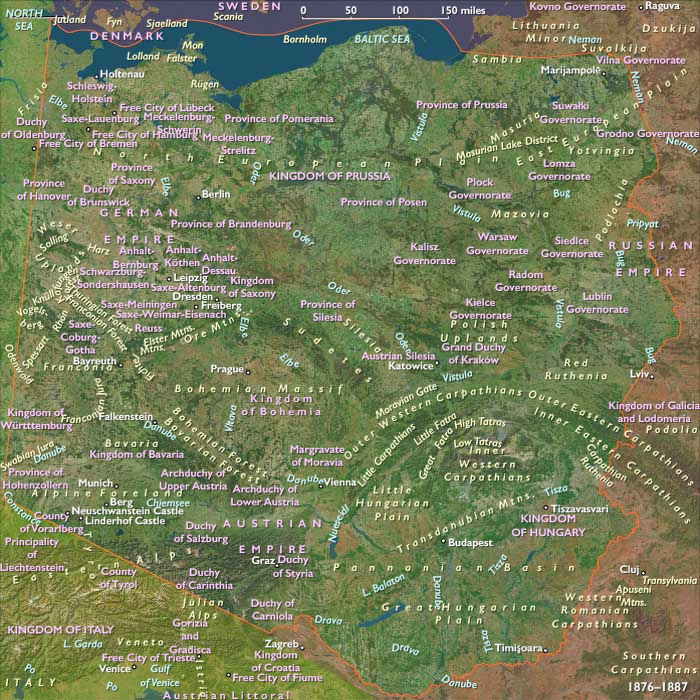
Locations
Regions
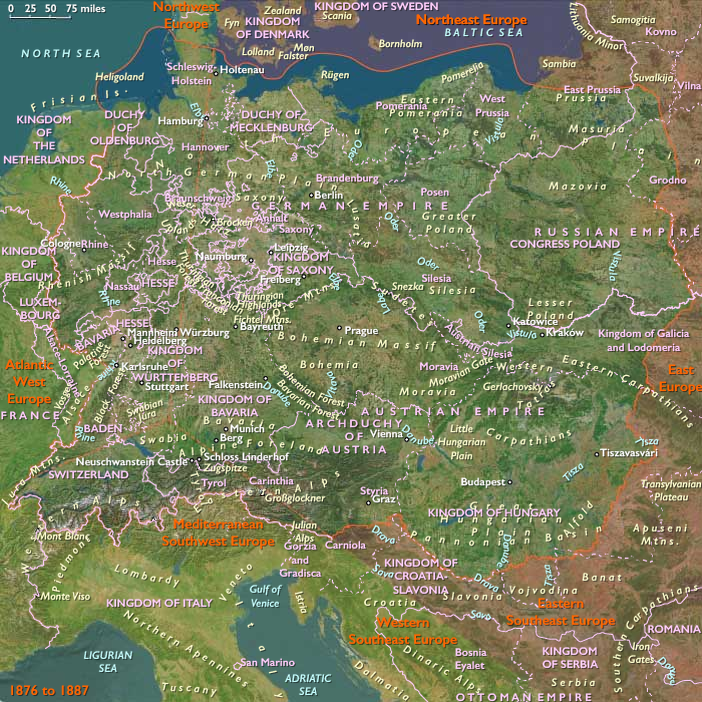
Central Europe
View →Subregions