
Filters:
Henry, Otto, and the later Saxon kings …
Years: 820 - 975
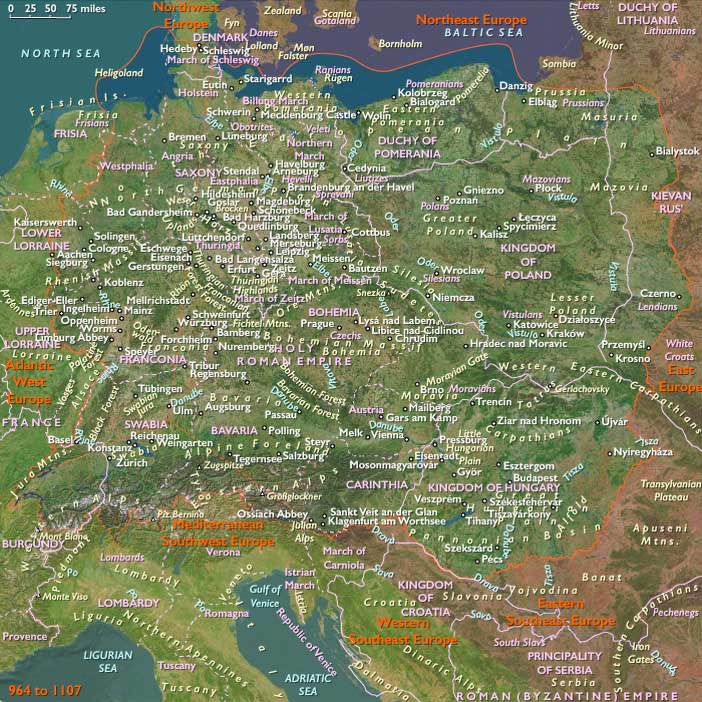
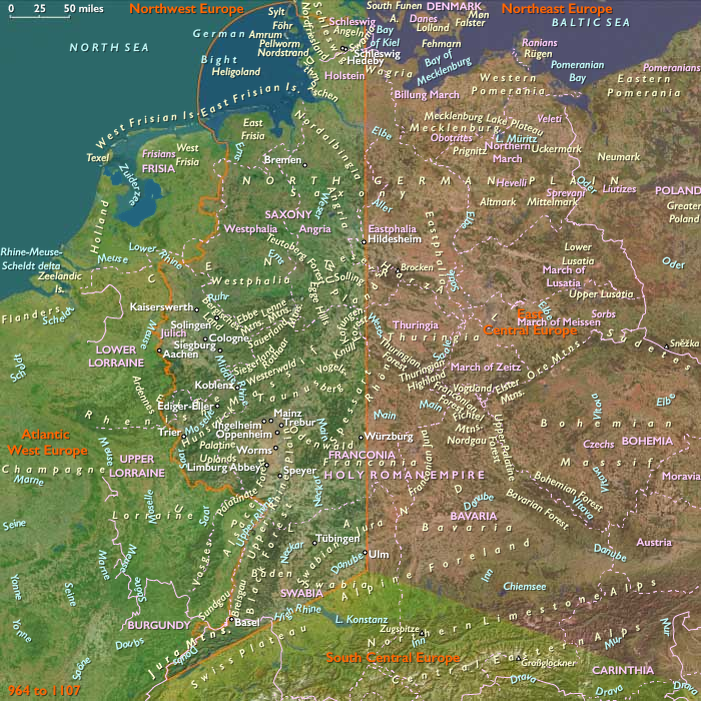
Henry, Otto, and the later Saxon kings also encourage eastward expansion and colonization, thereby extending German rule to parts of the Slavic territories of Poland and Bohemia.
The Magyars' westward expansion is halted by Otto in 955 at the Battle of Lechfeld in southern Ger- many.
In 962 Otto, who has also gained control of the Middle Kingdom, is formally crowned king of the Romans.
The possessor of this title will, in time, be known as the Holy Roman Emperor.
The coronation comes to be seen as the founding of the Holy Roman Empire, an institution that will last until 1806 and profoundly influence the course of German history.
The coronation of Otto is a moment of glory for the German monarchy, but its long-term consequences are not beneficial because as German kings seek to exercise the offices of the empire they become involved in Italian affairs, often to such an extent that they neglect the governing of Germany.
Because German kings will so often be in Italy, the German nobility will become stronger.
In addition, the presence of German kings in Italy as emperors will soon cause them to come into conflict with the papacy, which will not hesitate to seek allies in Italy or Germany to limit imperial power.
A last problem is that the succession to the German throne will often be uncertain or be hotly contested because it is not inheritable, but can only be attained through election by the German dukes.
This circumstance makes the formation of an orderly or stable central government nearly impossible.
In the opinion of some historians, Otto's triumph in Rome in 962 ultimately is disastrous for Germany because it delays German unification by centuries.
The Magyars' westward expansion is halted by Otto in 955 at the Battle of Lechfeld in southern Ger- many.
In 962 Otto, who has also gained control of the Middle Kingdom, is formally crowned king of the Romans.
The possessor of this title will, in time, be known as the Holy Roman Emperor.
The coronation comes to be seen as the founding of the Holy Roman Empire, an institution that will last until 1806 and profoundly influence the course of German history.
The coronation of Otto is a moment of glory for the German monarchy, but its long-term consequences are not beneficial because as German kings seek to exercise the offices of the empire they become involved in Italian affairs, often to such an extent that they neglect the governing of Germany.
Because German kings will so often be in Italy, the German nobility will become stronger.
In addition, the presence of German kings in Italy as emperors will soon cause them to come into conflict with the papacy, which will not hesitate to seek allies in Italy or Germany to limit imperial power.
A last problem is that the succession to the German throne will often be uncertain or be hotly contested because it is not inheritable, but can only be attained through election by the German dukes.
This circumstance makes the formation of an orderly or stable central government nearly impossible.
In the opinion of some historians, Otto's triumph in Rome in 962 ultimately is disastrous for Germany because it delays German unification by centuries.
People
Groups
- Franks
- Germans
- Bavaria, Carolingian Duchy of
- Frankish, or Carolingian (Roman) Empire
- Saxony, Duchy of
- Francia Occidentalis (West Francia, or France), Kingdom of
- Francia Orientalis (East Francia), Kingdom of
- Francia Media (Middle Francia), Kingdom of
- Lotharingia, Duchy of
- Franconia, Duchy of
- Bavaria, Luitpolding Duchy of
- Swabia, Duchy of
- German, or Ottonian (Roman) Empire
- Italy, Kingdom of (Holy Roman Empire)
Subjects
Regions
Subregions
Related Events
Showing 6 events out of 6 total
Years: 820 - 975
People
Groups
- Franks
- Germans
- Bavaria, Carolingian Duchy of
- Frankish, or Carolingian (Roman) Empire
- Saxony, Duchy of
- Francia Occidentalis (West Francia, or France), Kingdom of
- Francia Orientalis (East Francia), Kingdom of
- Francia Media (Middle Francia), Kingdom of
- Lotharingia, Duchy of
- Franconia, Duchy of
- Bavaria, Luitpolding Duchy of
- Swabia, Duchy of
- German, or Ottonian (Roman) Empire
- Italy, Kingdom of (Holy Roman Empire)
Subjects
Regions
Subregions