
Bern, founded in 1191 by Berthold V,…
1218 CE
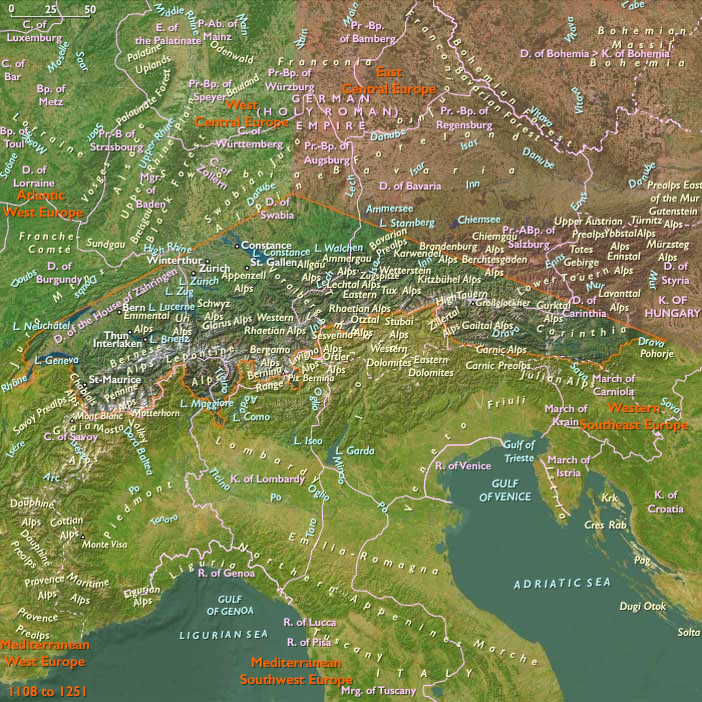
Bern, founded in 1191 by Berthold V, Duke of Zähringen, is made a free imperial city by the Goldene Handfeste of Holy Roman Emperor Frederick II in 1218 after after Berthold dies without an heir.
Locations
Subjects
Regions
Central Europe
View →Subregions
South Central Europe
View →Related Events
No active filters.
Showing 10 events out of 47252 total
Genghis Khan, having conquered the Jin capital of Beijing, interrupts his fighting with the Jin conquest to come to the aid of Muslim Turks opposed in Kara-Khitai by the usurper Kuchlug, the former king of the Naimans, deposed earlier in the century.
After two Mongol divisions liberate Kara-Khitai in 1218, Genghiz Khan sends a peaceful Mongol trade mission to the ambitious and oppressive shah of Khwarezm, a Turkish Muslim principality to the west of Kara-Khitai.
Having only recently conquered two-thirds of what will one day be China, Genghis is looking to open trade relations, but the Shah, having heard exaggerated reports of the Mongols, believes this gesture is only a ploy to invade his land.
Genghis sends emissaries to Khwarezm (reports vary—one stating a group of one hundred Muslim merchants with a single Mongol leading them, others state four hundred and fifty) to emphasize his hope for a trade road.
The caravan sent by Genghis Khan is robbed of its rich goods upon arrival in Otrar in accordance with orders by Shah Muhammed to Inalchik Kair-khan, the governor of the town.
He thinks spies are secreted in the caravan.
Genghis, trying to maintain diplomacy, sends an envoy of three men to the Shah, to give him a chance to disclaim all knowledge of the governor's actions and hand him over to the Mongols for punishment.
The shah executes the envoy (again, some sources claim one man was executed, some claim all three were), and then immediately has the Mongol merchant party (Muslim and Mongol alike) put to death.
Ivan Asen II is a son of Ivan Asen I, one of the two founders of the Asen dynasty and the Second Bulgarian Empire, and Elena.
After the death of his uncle Kaloyan in 1207, Ivan Asen's cousin, Boril, had usurped the throne and forced him to flee to the Rus principality of Galicia-Volhynia.
Bulgaria’s alliance with the Latin Empire, the Kingdom of Hungary, and the Despotate of Epirus had dragged Boril into a war against Serbia, in which Boril has made little headway, especially after the murder of his brother Strez in 1215.
With the death of Henry in 1216 and the departure of Andrew II on the Fifth Crusade, Boril had been left essentially without strong supporters.
In 1217 or 1218 Ivan Asen, Boril's cousin, returns from exile with the support of Galicia-Volhynia and defeats Boril, who locks himself up in Tărnovo.
After a siege of perhaps seven months (rather than the "seven years" of the Byzantine sources), Boril flees the capital, which surrenders to Ivan Asen.
Boril is captured during his escape, and is blinded and relegated to a monastery.
Having established himself on the throne, Ivan Asen II sets about recovering the losses sustained by Bulgaria during the reign of Boril.
A good soldier and administrator, Ivan restores law and order, controlling the boyars.
Kaykaus I, Sultan of Rum, has subjugated Cilician Armenia, but …
…he is not as successful in his efforts to dominate the Ayyubid descendants of the great Muslim hero Saladin in Syria and is forced to withdraw from Aleppo in 1218.
Stefan Nemanja's son and successor has transformed Serbia into a stable state, friendly with Rome but with religious loyalty to Constantinople.
Known as Stefan Prvovencani (the “First-Crowned”), he receives from Pope Honorius III in 1217-1218 the title of king of Raska, and is crowned by a papal legate.
Zurich becomes an Imperial immediacy (Reichsunmittelbar or Imperial free city) in 1218 with the extinction of the main line of the Zähringer family and attains a status comparable to statehood.
Albigensian leader Count Raymond VI of Toulouse, defeated five years earlier by Simon de Montfort’s forces at the Battle of Muret, withstands Montfort’s siege of Toulouse in 1218, then regains territory lost to the northern French “crusaders.”
Castile’s young new king immediately sets about subduing the towns supporting the monarchial Castilian count.
When Ferdinand’s father, King Alfonso IX of León, learns of his estranged wife Berengaria’s abdication in favor of her son, he invades Castile with the intention of unifying both kingdoms under his rule.
Finding scant support when the Castilian nobles flock instead to Ferdinand’s banner, he withdraws and reaches an amicable accord with his son, who retains the crown of Castile.
The University of Salamanca Gains Royal Recognition (1218)
Originally established in 1134 as a Cathedral School, the University of Salamanca grew into a leading center of learning in Iberia. In 1218, King Alfonso IX of León formally recognized it as a "General School of the Kingdom", granting it royal patronage and elevating its status within Leonese and Christian Iberian society.
This recognition marked a significant step in the development of higher education in the Iberian Peninsula, solidifying Salamanca’s reputation as a scholarly and intellectual hub. Over the following centuries, the university would become one of Europe’s most prestigious institutions, attracting students and scholars from across Christendom.