
…Bethel, the two extremities of his kingdom,…
933 BCE to 922 BCE
…Bethel, the two extremities of his kingdom, "golden calves," which he sets up as symbols of God, enjoining the people not any more to go up to worship at Jerusalem, but to bring their offerings to the shrines he had erected.
Thus he became distinguished as the man "who made Israel to sin."
This policy would be followed by all the succeeding kings of Israel.
Jeroboam appointed non-Levites as his priests: his decision to pass over the Mushite priests of Shiloh, the original cult-center for Israel, deeply offended the Shiloh priesthood and seems to lie behind much of the animosity directed at Jeroboam and the golden calf, which probably emanated from the Mushite priestly clan.
Locations
Groups
Regions
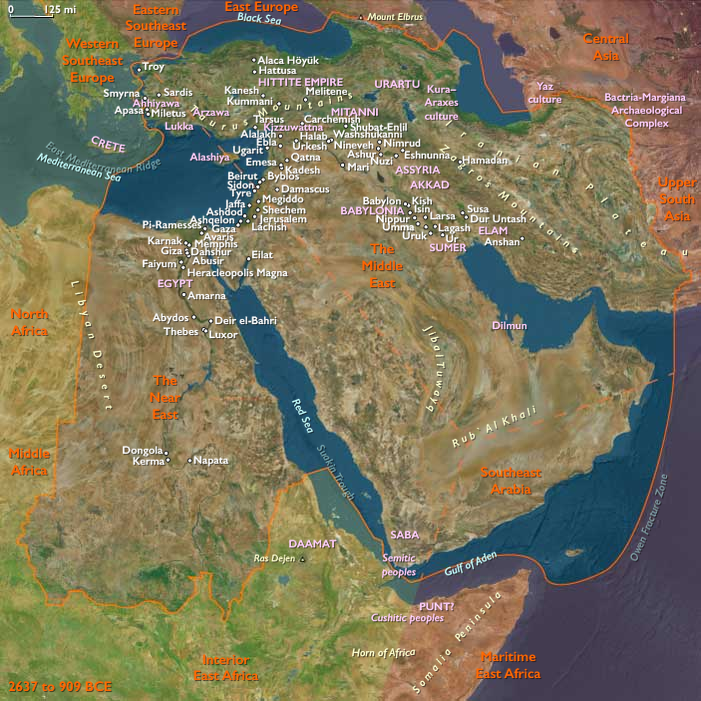
The Near and Middle East
View →Subregions
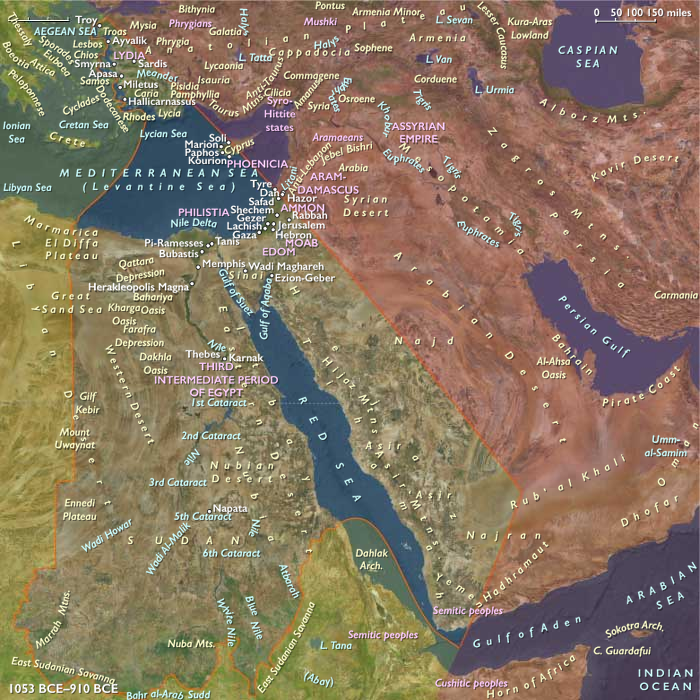
Near East
View →Related Events
No active filters.
Showing 10 events out of 66881 total
Shoshenq’s campaign in the east is attested, in part, by the discovery of a statue base bearing his name from the Lebanese city of Byblos.
Rehoboam, Solomon's son, is forty-one years old when he ascends the throne, according to 1 Kings.
Under his father, the people had been taxed heavily to pay for all the building projects undertaken during his reign.
Solomon's act of building a place over the Millo, formerly an open area providing convenient access to the Temple for those coming from the north, may have been perceived as apathy for the tribes of the north.
Therefore, there was great unease immediately after the death of Solomon, people being afraid that he would pursue a high-taxation, (supposedly) pro-southern policy like his father.
Solomon had also accumulated several prominent enemies during his later reign, notably Hadad, the Egyptian-backed heir to the Edomite throne; Rezon, the son of an Aramaean army captain, now the de facto ruler of Damascus; and Jeroboam, a rising young Ephraimite who, encouraged by the prophet Ahijah, was increasingly outspoken against Solomonic policy.
The nation demands that the coronation ceremony be held at Shechem, a decidedly pro-northern stronghold, to crown Rehoboam.
The weak Rehoboam complies, and the people immediately demands relief from heavy tax burdens.
Rehoboam asks and is granted three days to receive counsel before announcing his decision to the masses.
The elder counselors formerly of Solomon's kingship advise that he lower taxes to gain favor among the people, while the younger counselors, cronies of the new king, exhort that he raise taxes to express his authority.
Rehoboam sides with the young counselors and says to the people, "my father also chastised you with whips, but I will chastise you with scorpions."
As a result, the northerners retract their recognition of the legitimacy of the rule of the House of David and declare independence.
Jeroboam is appointed as king over them, and their breakaway state becomes known as the Kingdom of Israel.
Jerusalem becomes the capital of the Kingdom of Judah while the Kingdom of Israel locates its capital at Shechem in Samaria when the Kingdom of Judah splits from the larger Kingdom of Israel (which the Bible places near the end of the reign of Solomon in about 930 BCE, although Israel Finkelstein and others dispute the very existence of a unified monarchy to begin with.
Thomas L. Thompson argues that it only became a city and capable of acting as a state capital in the middle of the seventh century.
Rehoboam, not taking seriously the secession of the northerners, dispatches Adoram (possibly identical with the Adoniram of Solomon's reign), the chief tax collector, to collect taxes from the north.
Adoram is stoned, and Rehoboam, who had apparently followed him throughout his journey, has to flee in haste to Jerusalem.
Rehoboam returns to Jerusalem and organizes a sizable army to suppress what he still sees as a rebellion against the crown.
Its size is given as one hundred and eighty thousand men by I Kings and by II Chronicles.
Shemaiah the prophet proclaims that it is God's will that the United Monarchy be divided, and Rehoboam immediately abandons his plans.
Rehoboam will nevertheless skirmish against the forces of Jeroboam throughout the remainder of his reign.
A vast majority of the Levites depart the Kingdom of Israel for the Kingdom of Judah because they are being recruited as pagan priests by Jeroboam.
King Solomon, a figure described in Middle Eastern scriptures as a wise ruler of an empire centered on the united Kingdom of Israel, was supposedly born in Jerusalem about 1000 BEC and reigned over Israel from 971 BCE 931 BCE.
The scriptural accounts identify Solomon as the son of David.
He is also called Jedidiah in the Tanakh (Old Testament), and is described as the third king of the United Monarchy, and the final king before the northern Kingdom of Israel and the southern Kingdom of Judah split; following the split his patrilineal descendants ruled over Judah alone.
The Bible accredits Solomon as the builder of the First Temple in Jerusalem and portrays him as great in wisdom, wealth, and power.
Solomon is the subject of many other later references and legends.
The association of Solomon with the city of Jerusalem may have preceded this period.
The name Jerusalem, attested since the time of Ebla, 2350 BCE, by some etymologies means "The City of Solomon" (=Uru Sholom/Shalim).
The Ugaritic texts refer to "Shalim and Shachar", as two beneficent Gods, sons of El and Asherah, divine figures of the sunset and sunrise respectively.
They were associated with two mountains that were located on the Eastern and Western rim of the world, respectively.
According to the Bible, Solomon entered into an alliance with Hiram I, king of Tyre, who in many ways greatly assisted him in his numerous undertakings.
For some years before his death David was engaged in the active work of collecting materials for building a temple in Jerusalem as a permanent abode for the Ark of the Covenant; Solomon is described as completing its construction, with the help of an architect, also named Hiram, and other materials, sent from Hiram king of Tyre.
The description of the temple is remarkably similar to that of surviving remains of Phoenician temples of the time, and it is certainly plausible, from the point of view of archaeology, that the temple was constructed to the design of Phoenicians.
After the completion of the temple, Solomon is described as erecting many other buildings of importance in Jerusalem; for the long space of thirteen years he was engaged in the erection of a royal palace on Ophel (a hilly promontory in central Jerusalem); Solomon also constructed great works for the purpose of securing a plentiful supply of water for the city, and the Millo (Septuagint, Acra) for the defense of the city.
However, excavations of Jerusalem have shown a distinct lack of monumental architecture from the era, and remains of neither the Temple nor Solomon's palace have been found (although it should be noted that a number of significant but politically sensitive areas have not been extensively excavated, including the site that the Temple is traditionally said to have been located).
Although the Old Testament describes Solomon as surrounding himself with all the luxuries and the external grandeur of an Eastern monarch, some archaeologists consider the kingdom of Israel at the time of Solomon to have been little more than a small city state.
According to the Hebrew scriptures, Solomon is also an author and a patron of literature (although many of the writings attributed to him—for example, the “Book of Proverbs,” “Ecclesiastes,” and the “Song of Solomon”—are not his work).
Rehoboam fortifies Bethlehem after the division of the state between Israel and Judah. (II Chronicles 11)
Jeroboam, according to 1 Kings 11:26-39, was born the son of Nebat an Ephrathite of Zereda whose mother's name was Zeruah (who later became a widow, and could have been leprous as her name translates).
While still young, he had been promoted by Solomon to be chief superintendent of the "burnden", i.e., the bands of forced laborers.
Influenced by the words of the prophet Ahijah, he began to form conspiracies with the view of becoming king of the ten tribes; but these having been discovered, he fled to Egypt (1 Kings 11:29-40), where he remained for a length of time under the protection of Shoshenq.
On the death of Solomon, the ten tribes, having revolted, send to invite him to become their king and he is accordingly proclaimed "king of Israel" (1 Kings 12:1-20).
He rebuilds and fortifies Shechem as the capital of his kingdom.
He at once adopts means to perpetuate the division thus made between the two parts of the kingdom, and ...
…erects at Dan and …
Egypt’s pharaoh Shoshenq, presumed to be the biblical Shishak, who had become king of Egypt about 935, had come from a line of princes or sheikhs of Libyan tribal descent whose title was “great chief of the Meshwesh” and who appear to have settled in Heracleopolis in Middle Egypt, although another tradition placec the line in Bubastis in the eastern Nile River delta.
Shoshenq probably had ascended the throne without a struggle, making Bubastis his residence and marrying his son Osorkon to a daughter of Psusennes II, the last king of the previous dynasty.
Challenging Rehoboam’s claim to kingship over the Israelites, Shoshenq supports the pretender Jeroboam instead.
Shoshenq pursues an aggressive foreign policy in the adjacent territories to the east towards the end of his reign.
According to the Bible, in the fifth year of Rehoboam's reign, Pharaoh ‘Shishak’ and his allies, including the Ethiopians, invade.
The entire Kingdom of Judah (as opposed to the Kingdom of Israel, made up of all except tribes Judah and Benjamin, in the north) is looted, even the Temple and the royal palace, and the decorative gold shields made by Solomon are taken.
Rehoboam replaces them with bronze ones.
A remarkable memorial of this invasion has been discovered at …