
Bishop William of Wykeham, who in 1379…
1382 CE
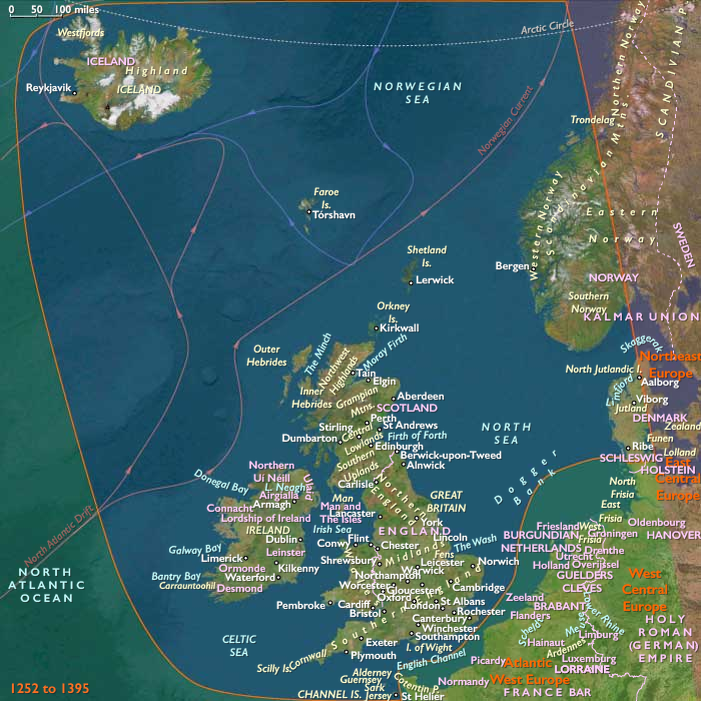
Bishop William of Wykeham, who in 1379 had founded New College, Oxford,, also founds in 1382 the first independent school in England: Winchester College, a school for boys in Winchester, Hampshire.
People
Subjects
Regions

North Europe
View →Subregions
Northwest Europe
View →Related Events
No active filters.
Showing 10 events out of 43675 total
Tokhtamysh has reunified the Mongol lands from Crimea to Lake Balkhash in just six years.
Having united the Blue and White Hordes into a single state, known to history as the Golden Horde, Tokhtamysh leads a successful campaign against Muscovy in 1382 as a punishment for the Kulikovo defeat and to to force the resumption of their payment of Mongol levies that had been ended in 1380 by the victory of Dmitri, who is now known as Dmitri Donskoi, or Dmitri of the Don.
Timur lends armed support to Tokhtamysh against the Russians.
Tokhtamysh besieges Moscow on August 23, but Muscovites repel the attack, using firearms for the first time in Russian history.
On August 26, two sons of Tokhtamysh's supporter Dmitry of Suzdal, dukes of Suzdal and Nizhny Novgorod Vasily and Semyon, who are present in Tokhtamysh's forces, persuade Muscovites to open the city gates, promising that the attacking forces will not harm the city.
This act allows Tokhtamysh's troops to burst in and destroy Moscow, killing twenty-four thousand people and leaving the city in ashes.
Tokhtamysh next sends a reconnaissance force into the northern principalities to determine Lithuania's influence.
Lithuanian ruler Kestutis, viewing this as a possible prelude to invasion, attacks and defeats the force.
Lithuanian ruler Algirdas had died in 1377, predeceasing his co-ruler, Kestutis, by five years.
Civil strife erupts in 1382 in Lithunaia following Kestutis’s death.
Hungary has experienced a cult of knightly virtues under the rule of the Angevin dynasty’s second king, the well-regarded Louis I, called Louis the Great, who can be said to typify the so-called knightly ruler.
With his successful wresting of Dalmatian territory from Venice, Louis, ruling from his brilliant and highly civilized court at Buda, has become eastern Europe’s most powerful ruler, wearing the crowns of Hungary and—since 1370—Poland, and reigning as sovereign over surrounding dependencies in the Balkans, Galicia and elsewhere.
Louis’s expansive foreign policy has gained him considerable success in the Balkans; he has acquired for Hungary Dalmatia, Serbia, Bulgaria, and Wallachia, but papal opposition has doomed his efforts to gain control over the Kingdom of Naples, whence his family originated.
The male Angevin line in eastern Europe ends on September 10, 1382 on Louis’ death.
His older surviving daughter, Maria, inherits his throne, but Charles III of Naples promotes his own candidacy for the Hungarian crown.
The Ottomans seize Monastir, in the Bulgarian west, in 1382, and seize also central Bulgaria (including Sofia).
Timur, having conquered Khorezm by 1381, had initiated a successful onslaught against the rulers and peoples of the Middle East and Transcaucasia, although he has been diverted several times by military threats from Tokhtamysh, his former ally and khan of the Golden Horde.
Since the death of Abu Sa'id, ruler of the Ilkhanid Dynasty, in 1335, there has been a power vacuum in Persia.
Timur initiates his military conquest of the area with the capture of Tabriz in 1382.
The Mamluk Bahri dynasty has ruled Egypt and Syria since 1250, its rulers having been mostly of Turkish ethnic origin, but in 1377 a revolt had broken out in Syria and spread to Egypt, and the government has been taken over by the Circassians Barakah and Barkuk.
Barkuk is proclaimed sultan in 1382, ending the Bahri dynasty.
From this point, the majority of the Mamluk rulers will generally be of Circassian origin.
Portuguese monarch Ferdinand, following the death of Henry II of Castile in 1379, had renewed his alliance with England, whose forces had joined those of Ferdinand in a 1381 invasion of Castile.
This war having proved disastrous for Ferdinand, he concludes a peace at Badajoz in August, 1382.
The question of the marriage of his only surviving child, Princess Beatrice, is the major political issue of the day, since it will determine the future of the kingdom.
Several political factions lobby for possible husbands, which include English and French princes.
The king, who is dying, finally settles for his wife's first choice, King John I of Castile, thus to secure the ultimate union of the crowns.
The city of Trieste, located at the head of the Gulf of Trieste on the Adriatic Sea, had developed into a free commune at the end of the twelfth century.
The burghers of Trieste, after two centuries of war against the nearby major power, the Republic of Venice (who had occupied Trieste briefly from 1369 to 1372), petition Leopold III von Habsburg, Duke of Austria, to become part of his domains.
The agreement of cessation is signed in October 1382, at the St. Bartholomew's church in the village of Šiška (apud Sisciam), today one of the city quarters of Ljubljana.
The citizens, however, will maintain a certain degree of autonomy well until the seventeenth century.
Florence’s replacement government had abolished the “ciompi” guild in 1378, but rioting and unrest has persisted, resulting in the killing or exile of the revolt’s leaders.
Salvestro, who has been crucial to the counter-revolution of the major and minor guilds, has ruled in effect as a dictator until his exile in 1382, at which time the Guelph faction regains power and renews the admonitions.