
Some of the Hausa states—such as those …
Years: 1396 - 1539
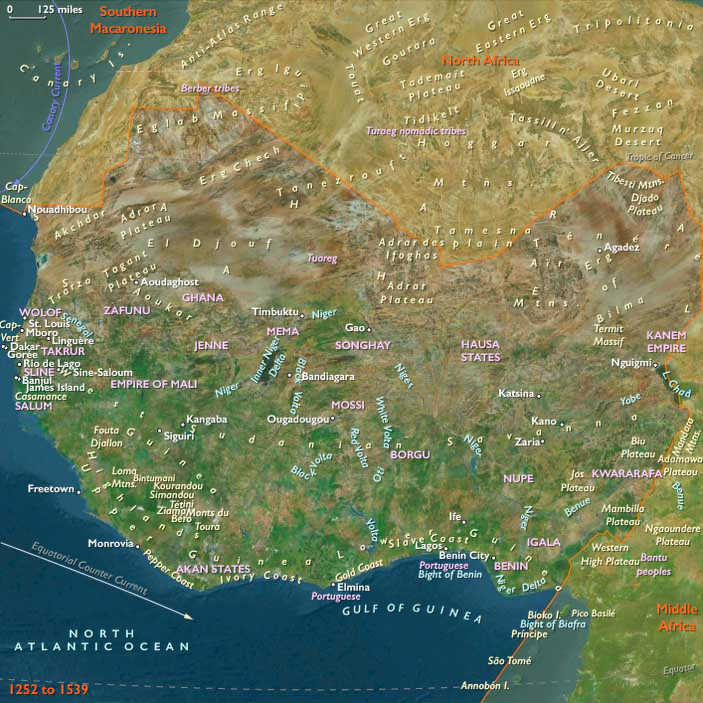
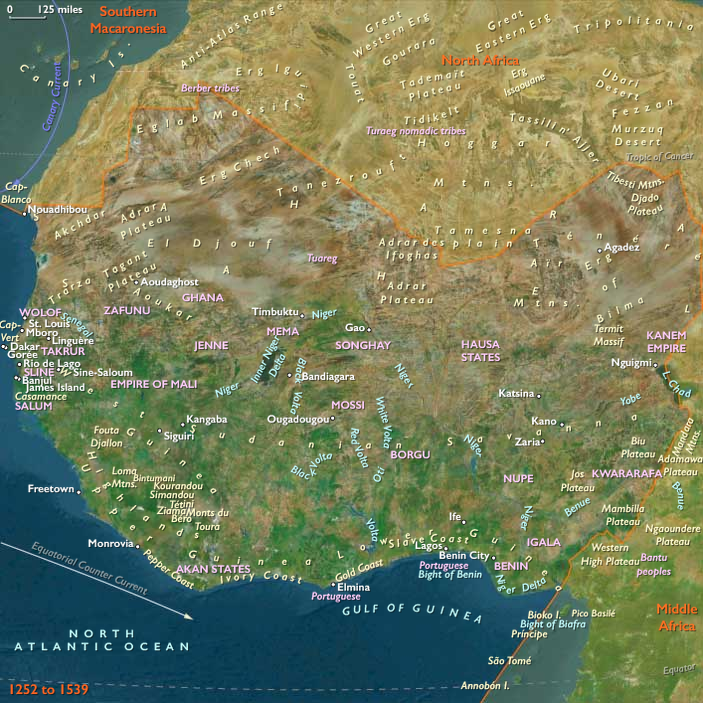
Some of the Hausa states—such as those at Kano, Katsina, and Gobir—had developed by the eleventh century into walled towns that engaged in trade and serviced caravans as well as manufactured cloth and leather goods.
Millet, sorghum, sugarcane, and cotton were produced in the surrounding countryside, which also provides grazing land for cattle.
Until the fifteenth century, the small Hausa states were on the periphery of the major empires of the era.
According to tradition, the Hausa rulers descend from a "founding hero" named Bayinjida, supposedly of Middle Eastern origin, who became sarki (king) of Daura after subduing a snake and marrying the queen of Daura.
Their children founded the other Hausa towns, which traditionally are referred to as the Hausa bakwai (Hausa seven).
Wedged in among the stronger Sudanic kingdoms, each of the Hausa states has acquired special military, economic, or religious functions.
No one state dominates the others, but at various times different states assume a leading role.
They are under constant pressure from Songhai to the west and Kanem-Borno to the east, to which they pay tribute.
Armed conflict usually is motivated by economic concerns, as coalitions of Hausa states mount wars against the Jukun and Nupe in the middle belt to collect slaves, or against one another for control of important trade routes.
Commerce is in the hands of commoners.
Within the cities, trades are organized through guilds, each of which is self-regulating and collects taxes from its members to be transmitted to the sarki as a pledge of loyalty.
In return, the king guarantees the security of the guild's trade.
The surrounding countryside produces grain for local consumption and cotton and hides for processing.
Islam was introduced to Hausaland along the caravan routes.
The famous Kano Chronicle records the conversion of Kano's ruling dynasty by clerics from Mali, demonstrating that the imperial influence of Mali extended far to the east.
Acceptance of Islam was gradual and was often nominal in the countryside, where folk religion continues to exert a strong influence.
Non-Islamic practices also are retained in the court ceremonies of the Hausa kings.
Nonetheless, Kano and Katsina, with their famous mosques and schools, come to participate fully in the cultural and intellectual life of the Islamic world.
Locations
Groups
- Polytheism (“paganism”)
- Hausa Kingdoms, the
- Hausa people
- Islam
- Kanembu people
- Kanuri people
- Mali Empire
- Jukun people (West Africa)
- Songhai (Songhay) Empire
- Bornu, Kingdom of
- Nupe, Kingdom of the
Topics
- Islamization of the Sudan region
- Sub-Saharan Africa, Medieval
- Interaction with Subsaharan Africa, Early European
Commodoties
Subjects
Regions
Subregions
Years: 1396 - 1539
Locations
Groups
- Polytheism (“paganism”)
- Hausa Kingdoms, the
- Hausa people
- Islam
- Kanembu people
- Kanuri people
- Mali Empire
- Jukun people (West Africa)
- Songhai (Songhay) Empire
- Bornu, Kingdom of
- Nupe, Kingdom of the
Topics
- Islamization of the Sudan region
- Sub-Saharan Africa, Medieval
- Interaction with Subsaharan Africa, Early European
Commodoties
Subjects
Regions
Subregions