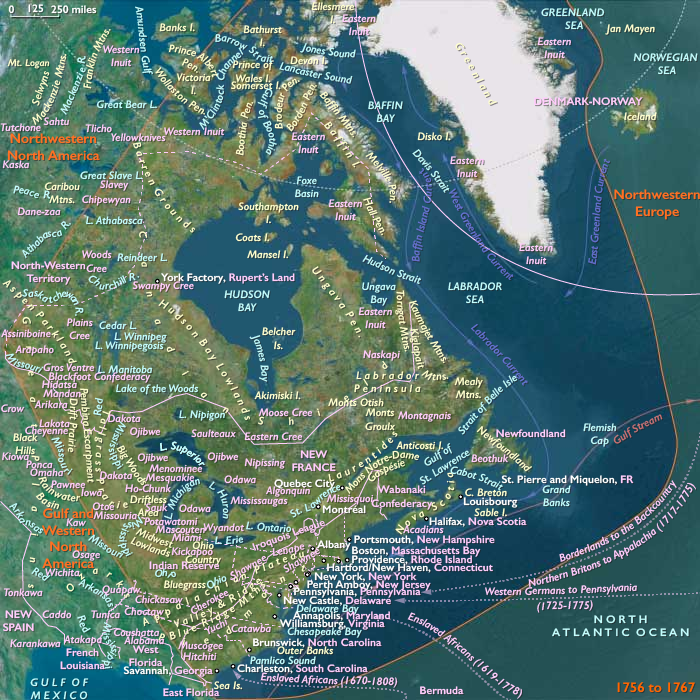
In total, Montcalm has thirteen thousand three…
September 1759 CE
Many of the militia are inexperienced; the Acadian, Canadian, and indigenous irregulars are more used to guerilla warfare.
By contrast, the British seventy-seven hundred troops are almost all regulars.
On the morning of September 13, Wolfe's army form a line first with their backs to the river, then spread out across the Plains with its right anchored by the bluff along the St. Lawrence and its left by a bluff and thick wood above the St. Charles River.
While the regular French forces are approaching from Beauport and Quebec, the Canadian militia and native sharpshooters engage the British left flank, sheltering in the trees and scrub; the militia hold these positions throughout the battle and fall back on this line during the general retreat, eventually holding the bridge over the St. Charles River.
Of the British troops, approximately thirty-three hundred form into a shallow horseshoe formation that stretches across the width of the Plains, the main firing line being roughly one kilometer long.
Two battalions are deployed, facing north, to cover the left flank and a further two form a reserve.
In order to cover the entire plain, Wolfe is forced to array his soldiers two ranks deep, rather than the more conventional three ranks.
On the left wing, regiments under Townshend exchange fire with the militia in the scrub and capture a small collection of houses and gristmill to anchor the line.
The defenders push the British from one house, but are repelled and, in retreat, light several houses on fire to keep them out of enemy hands.
Smoke from these fires winds up masking the British left, and may have confused Montcalm as to the width of the lines.
As Wolfe's men wait for the defenders, the steady fire becomes intense enough that Wolfe orders his men to lie down amid the high grass and brush.
As French troops arrive from Beauport, Montcalm, one of few mounted men on the field, decides that a swift assault is the only way to dislodge the British from their position.
Accordingly, he deploya the forces immediately available in and near Quebec City and prepares an immediate attack, without waiting for further reinforcements from the Beauport shore.
He arrays his approximately thirty-five hundred soldiers into place, his best regulars three deep, others six deep and his poorest regiment in column.
At approximately 10 a.m., Montcalm, riding his dark horse and waving his sword to encourage his men, orders a general advance on the British line.
As a European-trained military leader, Montcalm's instinct is for large, set-piece battles in which regiments and soldiers move in precise order.
Such actions require a disciplined soldiery, painstakingly drilled for as long as eighteen months on the parade ground, trained to march in time, change formation at a word, and retain cohesion in the face of bayonet charges and musket volleys.
Though his regular regiments (the "troupes de terre" or "metropolitans") are adept at such formal warfare, in the course of the campaign their ranks have been replenished by less professional militiamen, whose talents at forest warfare emphasize the individual: they tend to fire early, then drop to the ground to reload, thus reducing the effect of concentrated fire at close range.
People
François-Charles de Bourlamaque
View →
James Cook
View →
James Wolfe
View →
Jeffery Amherst, 1st Baron Amherst
View →
Louis-Antoine de Bougainville
View →
Louis-Joseph de Montcalm
View →
Pierre de Rigaud de Vaudreuil de Cavagnal, Marquis de Vaudreuil
View →
Robert Rogers
View →
Thomas Gage
View →
William Johnson, 1st Baronet
View →
William Pitt
View →
Groups
Topics
Commodities
Regions
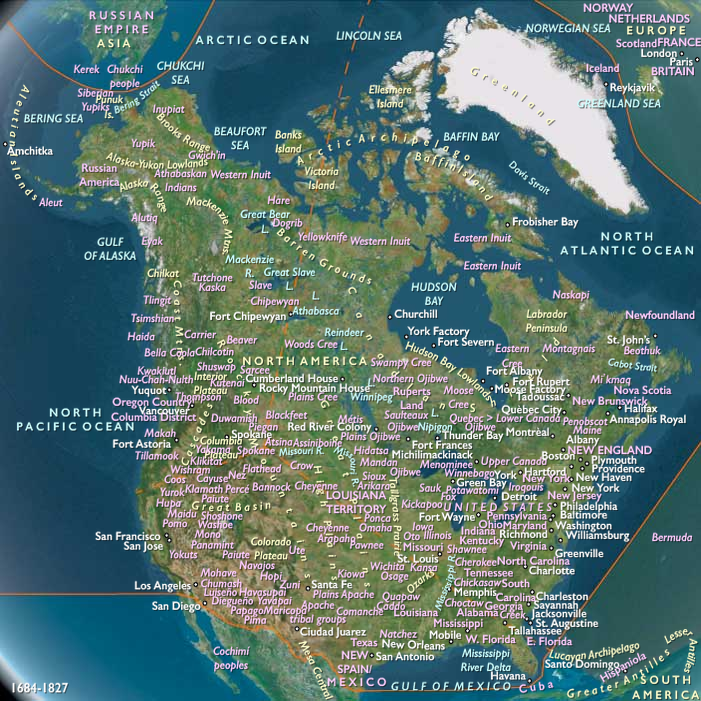
Northern North America
View →Subregions