
Bremen, a prosperous trading town by the…
1358 CE
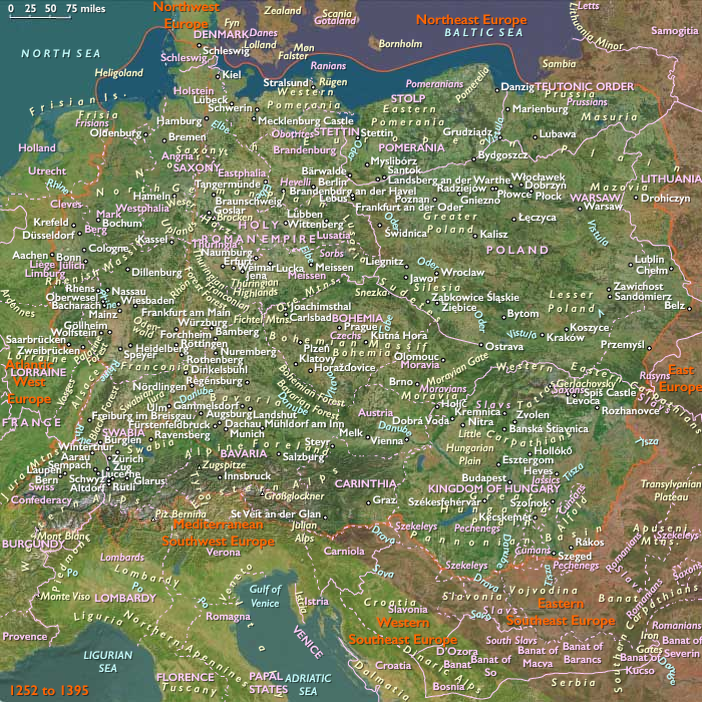
Bremen, a prosperous trading town by the thirteenth century, becomes in 1358 a member of the Hanseatic League.
Locations
Groups
Regions
Central Europe
View →Subregions

West Central Europe
View →Related Events
No active filters.
Showing 10 events out of 44089 total
Louis, seeking to restore his kingdom to great power status in the Balkans, had next turned his attention to Venetian-held Dalmatia, where his second war against Venice (1357-58) is more successful than his first venture.
Schwerin becomes a part of the Duchy of Mecklenburg in 1358, making it the seat of the dukedom from now on.
Lübeck, having developed as an important economic and cultural center for the entire Baltic area, is chosen in 1358 as the administrative headquarters for the Hanseatic League.
Mézières is made chancellor when Peter accedes to the throne of Cyprus in 1358, and the two set off for Europe to win support for a new Crusade.
Most of the Venetians' Dalmatian towns go to Hungary under the Treaty of Zara, concluded in February 1358, including Zara and …
…the Republic of Dubrovnik (Ragusa), formerly under Serbian control, which in 1358 accepts Hungarian sovereignty.
Isabella of Majorca is the daughter of James III and his first wife, Constance of Aragon.
Her maternal grandparents are Alfonso IV of Aragon and his first wife Teresa d'Entença.
Her paternal grandparents are Ferdinand of Majorca and his wife Isabelle de Sabran.
After the death of her mother, Isabella's father had remarried to Violante of Vilaragut, who gave Isabella a half-sister named Esclaramunda, who died young.
Her father had lost the kingdom of Majorca in 1343 and died two years later in the Battle of Llucmajor fighting against the forces of Peter IV of Aragon.
Isabella had been captured with her brother and stepmother by her uncle King Peter after the battle in which her father was killed, and confined to the convent of the Clarissans at Valencia with her stepmother.
She is freed in late 1358, thanks to the efforts of her stepmother, on the condition that she renounce her rights to Majorca.
On September 4, 1358, Isabella marries John II, Marquess of Montferrat, in Montpellier.
Her marriage is arranged by her stepmother, who is at this time living at the Court of Monferrato.
The Great Company, one of the many “bands of adventure” of roving German and Hungarian mercenaries hired in 1351 by the league of Italian Guelph princes fighting Ghibelline-allied Milan, resorts to plundering and terrorizing the entire Italian peninsula, when the league can no longer meet the salary demands of the company
Florence, refusing to grant the marauders passage into Tuscany, closes the mountain passes and organizes the mountain people to defeat the mercenaries on July 24, 1358.
Paolo and Giovanni Veneziano sign and date their Veneto-Byzantine Coronation of the Virgin in 1358.
The Aftermath of Poitiers and the Causes of the Jacquerie Revolt (1356–1358)
Following the Battle of Poitiers (September 1356) and the capture of King John II ("the Good"), France descended into chaos, plagued by political instability, economic collapse, and social unrest. The chronicler Jean de Venette, a Carmelite friar, vividly describes the period as one of lawlessness, corruption, and suffering, blaming both the French nobility and the roaming mercenary bands known as the "Companies" (routiers).
Jean de Venette’s Account: France in Ruins
Jean de Venette provides a firsthand account of the devastation, writing:
"...From that time on all went wrong with the Kingdom and the state was undone.
Thieves and robbers rose up everywhere in the land.
The nobles despised and hated all others and took no thought for the mutual usefulness and profit of lord and men.
They subjected and despoiled the peasants and the men of the villages.
In no wise did they defend their country from enemies.
Rather did they trample it underfoot, robbing and pillaging the peasants' goods."
- His criticism is directed not only at the nobility, who exploited and abandoned their subjects, but also at the routiers—mercenary bands left unchecked in the wake of the war.
- With the monarchy leaderless, local warlords and nobles took advantage, taxing the peasants heavily while failing to provide protection from external threats.
Political Instability and the Estates-General’s Failure
- With King John II in captivity, power fractured between:
- The Estates-General, which proved too divided to govern effectively.
- Charles II of Navarre, who sought his own advantage.
- The Dauphin, later Charles V, who struggled to assert control.
- This lack of leadership left France vulnerable, as nobles pursued their own interests rather than defending the country.
- The prestige of the nobility, already tarnished by defeats at Courtrai (1302) and Crécy (1346), reached a new low after they failed to protect France at Poitiers.
Economic Hardships and the Peasantry’s Growing Resentment
- To fund ransoms, military campaigns, and personal expenses, the privileged classes (nobles, clergy, and merchants) increased taxes on peasants.
- The taille (a direct land tax) was raised to unbearable levels, while the corvée (forced labor) forced peasants to rebuild war-damaged noble estates—without pay.
- A new law requiring peasants to defend châteaux (noble castles) became the final spark that ignited the Jacquerie rebellion.
- Many commoners already blamed the nobility for their failures at Poitiers and now questioned why they should continue working for a ruling class that could not even provide protection.
Mercenaries and the Breakdown of Order
- The countryside was overrun by routiers (unemployed mercenaries and brigands)—including English, Gascon, German, and Spanish troops, many of whom had fought for the English before being left without pay or leadership.
- These roving bands looted, raped, and burned villages, pillaging the land almost at will, while the Estates-General proved powerless to stop them.
- Many peasants faced a double threat:
- Noble exploitation through high taxes and forced labor.
- Uncontrolled mercenary violence that the nobility failed to suppress.
The Jacquerie Revolt (1358): A Violent Peasant Uprising
- In May 1358, these tensions erupted into the Jacquerie, a violent peasant rebellion in northern France.
- The revolt was short-lived but extremely bloody, with peasant mobs attacking nobles, burning estates, and killing aristocrats.
- Although the Jacquerie was brutally crushed by June 1358, it left a lasting impact, exposing deep class tensions that would continue to shape France’s social and political struggles.
Long-Term Consequences
- The failure of the nobility to defend France and its people in the 1350s permanently damaged the feudal system.
- The Jacquerie foreshadowed later peasant revolts, including:
- The English Peasants' Revolt (1381).
- The French Revolution (1789).
- France’s internal divisions further weakened the country’s ability to resist English advances in the Hundred Years’ War.
The years after Poitiers (1356–1358) were among the darkest in medieval France, as the absence of strong leadership, economic suffering, and unchecked mercenaries led to mass discontent and violent peasant uprisings.