
The idea of both a pre-paid stamp…
1837 CE
In the House of Lords the Postmaster, Lord Lichfield, a Whig, denounces Hill's "wild and visionary schemes."
William Leader Maberly, Secretary to the Post Office, also a Whig, denounces Hill's study: "This plan appears to be a preposterous one, utterly unsupported by facts and resting entirely on assumption".
Merchants, traders and bankers view the existing system as corrupt and a restraint of trade, and form a "Mercantile Committee" to advocate for Hill's plan and push for its adoption.
Hill had first started to take a serious interest in postal reforms in 1835.
In 1836 Robert Wallace, MP, had provided Hill with numerous books and documents, which Hill describes as a "half hundred weight of material".
Hill had commenced a detailed study of these documents and this led him to the publication, in early 1837, of a pamphlet called Post Office Reform its Importance and Practicability.
He had submitted a copy of this to the Chancellor of the Exchequer, Thomas Spring Rice, on January 4, 1837.
This first edition, marked "private and confidential", is not released to the general public.
The Chancellor summons Hill to a meeting in which the Chancellor suggests improvements, asks for reconsiderations and requests a supplement, which Hill duly produces and supplies on January 8, 1837.
Hill's pamphlet, Post Office Reform: its Importance and Practicability, referred to above, is privately circulated in 1837.
The report calls for "low and uniform rates" according to weight, rather than distance.
Hill's study reports his findings and those of Charles Babbage that most of the costs in the postal system are not for transport, but rather for laborious handling procedures at the origins and the destinations.
Costs can be reduced dramatically if postage is prepaid by the sender, the prepayment to be proven by the use of prepaid letter sheets or adhesive stamps (adhesive stamps have long been used to show payment of taxes, on documents for example).
Letter sheets are to be used because envelopes are not yet common; they are not yet mass-produced, and in an era when postage is calculated partly on the basis of the number of sheets of paper used, the same sheet of paper will be folded and serve for both the message and the address.
In addition, Hill proposes to lower the postage rate to a penny per half ounce, without regard to distance.
Commodities
Regions
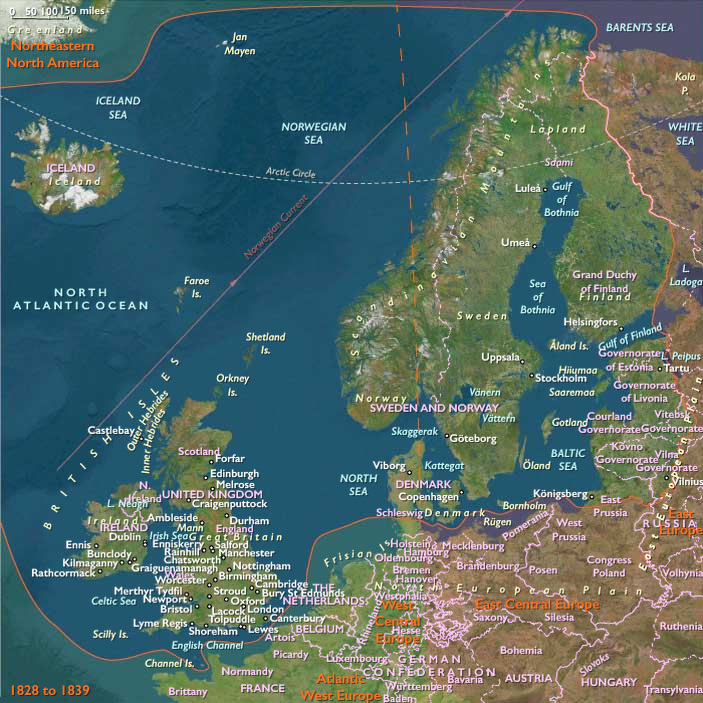
North Europe
View →Subregions
