
British naval officer William Bligh, in the…
1789 CE
British naval officer William Bligh, in the company of eighteen loyal crew members set adrift in an open boat following the mutiny on his ship, HMS Bounty, skillfully navigates more than thirty-six hundred miles (fifty-eight hundred kilometers) to Timor, charting part of the northeast coast of New Holland (Australia) en route.
Locations
People
Topics
Regions

Southeast Asia
View →Subregions
Southeastern Asia
View →Related Events
Showing 10 events out of 23 total
Dutch opium commerce on Java has fostered both a vast state enterprise and a large illicit traffic.
The Dutch East India Company, or VOC, having developed a large clientele of native Javanese opium smokers, has imported an average of fifty-six tons of opium annually from 1640 to 1799.
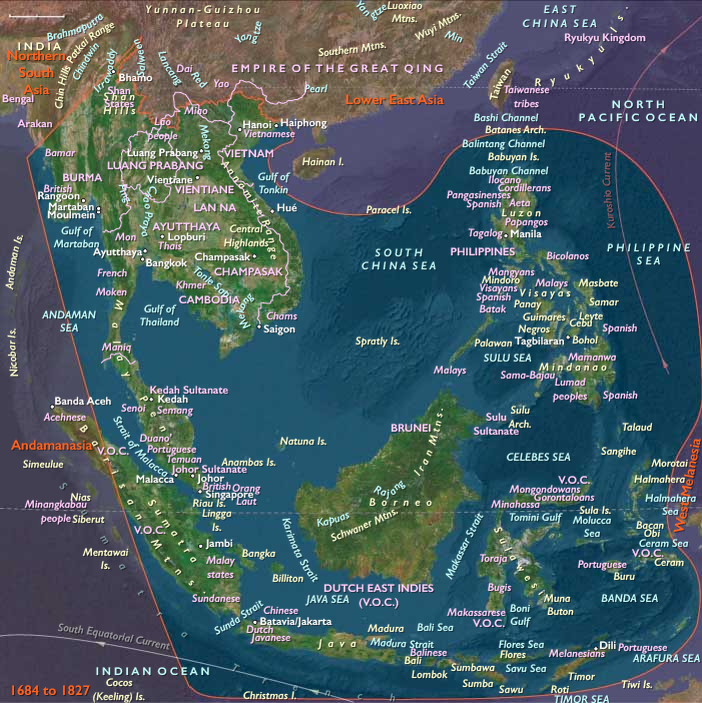
The Netherlands regains responsibility in 1816 for the East Indies—actually a welter of mostly coastal territories, some controlled directly and many others engaged through varying treaties—but the way forward is uncertain.
The growth of trade with Sulawesi and the establishment of plantation economies, especially those producing sugar (eastern and central Java) and coffee (western Java and western Sumatra) have begun to loosen customary ties and introduce elites to new sources of both riches and indebtedness.
In Java, the general population increases and grows more prosperous but, on the other hand, falls victim to increasing crime, heavier taxation, and exploitation by local Chinese, especially in their roles of tax farmers, tollkeepers, and leasers of plantation lands.
The legitimacy of ruling elites is questioned more widely.
Both traditionalists and Muslims feel their ways of life threatened by changes they tend to identify with growing European influence.
A Dutch decision in 1823 to end what it views as the abusive leasing of land and labor among central Java's aristocracy alienates many who had begun to adjust to the new circumstances and pushes them to support rebellion.
The general atmosphere of restlessness in a time of change that few understand also becomes charged with superstition and millennial expectations in reaction to crop failures, outbreaks of disease, and, near Yogyakarta, a destructive eruption of the Mount Merapi volcano.
These changes initially threaten Aceh's integrity, but a new sultan Tuanku Ibrahim, who controls the kingdom from 1838 to 1870, reasserts power over nearby ports.
The Dutch continue their eastward creep in Indonesia with the 1828 takeover of the western half of New Guinea as Netherlands New Guinea, the first European claim on the island.
Java is experiencing liberalist and nationalist risings against the Dutch occupation.
The jihad invoked by Prince Pangeran Diponegoro, called the Great Java War, has seen large losses on the side of the Dutch, due to their lack of coherent strategy and commitment in fighting Diponegoro's guerrilla warfare.
Ambushes are continually set up, and food supplies are denied to the Dutch troops.
Diponegoro also enjoys popular support among the population of Central Java.
The struggle takes a turn against the Javanese rebels when the Dutch, led by General De Cock, win a major encounter in 1828 and then establish several strongholds around the country.
The conflict is fated to be the final resistance of the Javanese aristocracy to Dutch rule.
Diponegoro’s war effort had been further crippled by the surrender of two of top aides to the Javanese Dutch puppet government in 182.
The Dutch, finally beginning to look like winners in the Great Java War after losing some fifteen thousand soldiers to guerilla warfare, invite Diponegoro to negotiate on March 28, 1830.
He accepts but is placed under arrest while meeting under the auspices of negotiation in 1830 and exiled by the Dutch to Makassar.
After three years of siege, the Dutch finally manage to sack Bonjol on August 16, 1837.
Through a negotiation ruse, the Dutch again capture Tuanku and exile him, first to Cianjur in West Java, then to Ambon, and later to Manado in Sulawesi.
With the victory, the Dutch tighten their hold on West Sumatra.
The Padri War (also called the Minangkabau War) between the indigenous Islamist population of West Sumatra and Dutch troops, whose resources had been stretched thin by the Diponegoro resistance in Java, can be said to have begun as early as 1803, prior to Dutch intervention, and is a conflict that had broken out in Minangkabau country when the Padris started to suppress what they saw as unislamic customs, i.e. the adat.
"Padris" are Muslim clerics from Sumatra who, inspired by Wahabism and after returning from Hajj, want to impose Sharia in Minangkabau country in West Sumatra, Indonesia.
"Adats" comprise the Minangkabau nobility and traditional chiefs.
After occupation of the Pagaruyung Kingdom by Tuanku Pasaman, one of Padri leaders in 1815, on February 21, 1821, the Minangkabau nobility had made a deal with Dutch in Padang to help them to fight the Padris.
The signing of the Masang Agreement in 1824 had ended ending hostilities with the state of Bonjol, founded by Tuanku Imam Bonjol.
Subsequently, however, once the Diponegoro resistance was suppressed, the Dutch had attacked the state of Pandai Sikat in a renewed effort to gain control of West Sumatra.
Despite valiant fighting by the Indonesians (by this time the traditionalists had realized they didn't want to be ruled by the Dutch either and had joined forces with the Padris in their resistance), the overwhelming power of the Dutch military eventually prevails.
Tuanku had been captured in 1832 but escaped after three months to continue the struggle from his tiny fortress in Bonjol.
Dutch businessmen set up large, profitable plantations.
Dutch finances had been severely affected by the cost of the Java and Padri Wars, despite increasing returns from the Dutch system of land tax, and the Dutch loss of Belgium in 1830 had brought the Netherlands to the brink of bankruptcy.
In 1830, a new Governor-General, Johannes van den Bosch, had been appointed to make the Indies pay their way through Dutch exploitation of its resources.
With the Dutch achieving political domination throughout Java for the first time in 1830, it had become possible to introduce an agricultural policy of government-controlled forced cultivation
Termed cultuurstelsel (cultivation system) in Dutch and tanam paksa (forced plantation) in Indonesian, farmers had been required to deliver, as a form of tax, fixed amounts of specified crops, such as sugar or coffee.
Much of Java has become a Dutch plantation and revenues have risen continually through the nineteenth century, which have been reinvested into the Netherlands to save it from bankruptcy.
Between 1830 and 1870, one billion guilders have been taken from Indonesia, on average making up twenty-five per cent of the annual Dutch government budget.
The Cultivation System, however, has brought much economic hardship to Javanese peasants, who had suffered famine and epidemics in the 1840s.
Critical public opinion in the Netherlands leads to much of the Cultivation System's excesses being eliminated under the agrarian reforms of the "Liberal Period".
The British government hires Henry Wickham in 1876 to begin transporting seeds of the Brazilian Para rubber tree to be germinated in the Royal Botanic Gardens, Kew, London, then shipped as saplings to Ceylon, Malaysia and Singapore: these are to become the ancestors of ninety percent of the late-twentieth century world’s rubber production.
The ensuing decades of research in selecting highly productive and disease resistant rubber trees notwithstanding, many commercial rubber trees throughout the world today are descended from the seeds Wickham took to Joseph Dalton Hooker in London.
Wickham is labeled as a "bio-pirate" in Brazil, for his role in stealing the rubber seeds that broke the Brazilian monopoly.
No Brazilian law would have prevented Wickham's collection of the seeds in 1876, but he may have misrepresented his cargo as dead botanical material destined for the herbarium in order to obtain an export license in Belém.
Wickham was born in Hampstead, north London; his father, a solicitor, died when young Wickham was only four years old.
He had traveled at age twenty to Nicaragua in the first of several trips to Latin America and South America.
Returning to England, he had married Violet Carter, whose father will publish Wickham's later writings.
His first book, Rough Notes of a Journey Through The Wilderness from Trinidad to Pará, Brazil, by way of the Great Cateracts of the Orinoco, Atabapo, and Rio Negro, had been published by W. H. J. Carter in 1872.
He had eventually taken the entire family to Santarém, Brazil, where his mother, sister Harriette, and the mother-in-law to his brother John had all died by 1876.
Nicholas Miklouho-Maclay is one of first anthropologists to refute polygenism and scientific racism, the view that the different races of mankind belong to different species and that some human races are inferior, on the basis of his comparative anatomical research.
Miklouho-Maclay’s humanist views lead him to actively campaign against the slave trade and blackbirding carried on between the islands of Melanesia and plantations in Queensland, Fiji, Samoa and New Caledonia.
In November 1878, the Dutch government informs him that on his recommendations it is checking the slave traffic at Ternate and Tidore.
Miklouho-Maclay was born in a temporary workers camp in Novgorod Governorate (currently Okulovsky District of Novgorod Oblast) in Russia, a son of a civil engineer working on the construction of the Moscow-Saint Petersburg Railway.
His Ukrainian father was descended from Stepan Myklukha, a Zaporozhian Cossack, who was awarded the title of noble of the Empire by Catherine II for his military exploits during the Russo-Turkish War (1787–1792), which included the capture of the Ochakov fortress.His mother, Ekaterina Semenovna, née Bekker, was of German and Polish descent (her three brothers had taken part in the January Uprising of 1863).
After 1873, the Miklouho-Maclay family owned a country estate in Malyn, one hundred and fifty kilometers (ninety-three miles) northwest of Kiev.
Nicholas had attended a German Lutheran school, a course at the Second Saint Petersburg Gymnasium, but only spent two months at St. Petersburg University, due to being expelled and debarred from tertiary education in Imperial Russia for "breaking the rules".
He thus had had to complete his studies in German universities; this had provided an opportunity to study and to work with leading European scientists.
He had studied humanities at Heidelberg, medicine at Leipzig, and zoology at the University of Jena, where he had come under the influence of the great German scholar Ernst Haeckel, who has a profound influence on his future.
Miklouho-Maclay's brilliant student records had attracted the attention of Haeckel, who made him his assistant as part of a field expedition to the Canary Islands in 1866.
There, Miklouho-Maclay had taken an interest in sharks and sponges and discovered a new sponge species, which he named Guancha blanca, in tribute to the Guanches, the original inhabitants of the Canary Islands who had been exterminated by European invaders.
He had also become a close friend of the biologist Anton Dohrn, with whom he had helped conceive the idea of research stations while staying with him at Messina, Italy.
Miklouho-Maclay had left St. Petersburg for Australia on the steam corvette Vityaz, arriving in Sydney on July 18, 1878.
A few days after arriving, he had approached the Linnean Society and offered to organize a zoological center.
In September 1878, his offer is approved.
In scientific and anthropological circles during the 1850s and 1860s, there had been much discussion connected with the study of human races and the interpretation of racial peculiarities.
Some anthropologists, like Samuel Morton, had tried to prove that not all human races are of equal worth, and that "white people" are predestined by "natural selection" to rule over the "colored" races.
This attitude had been used to justify slavery and colonialism.
Scientists like Ernst Haeckel, a teacher of Nicholas Miklouho-Maclay as a young anthropologist, relegate what they regard as culturally "backward" people like Papuans, Bushmen and others to the role of 'intermediate links' between Europeans and their animal ancestors.
While adhering to Darwin's theory of evolution, Miklouho-Maclay diverges from these racist concepts, and it is this question that leads Miklouho-Maclay to gather scientific facts and to study the dark-skinned inhabitants of New Guinea.