
Brown trout are introduced into the upper…
1890 CE
The first introductions into the U.S. had started in 1883 when Fred Mather, a New York pisciculturist and angler, under the authority of the U.S. Fish Commissioner, Spencer Baird, obtained brown trout eggs from a Baron Lucius von Behr, president of the German Fishing Society.
The von Behr brown trout came from both mountain streams and large lakes in the Black Forest region of Baden-Württemberg.
The original shipment of "von Behr" brown trout eggs were handled by three hatcheries, one on Long Island, the Cold Spring Hatchery operated by Mather, one in Caledonia, New York, operated by pisciculturalist Seth Green, and other hatchery in Northville, Michigan.
Additional shipments of "von Behr" brown trout eggs had arrived in 1884.
Brown trout eggs from Loch Leven, Scotland, arriving in New York in 1885, had been distributed to the same hatcheries.
Additional eggs from Scotland, England, and Germany had been shipped to U.S. hatcheries over the next few years.
Behnke (2007) believed all life forms of brown trout—anadromous, riverine, and lacustrine—were imported into the U.S. and intermingled genetically to create what he calls the American generic brown trout and a single subspecies the North European brown trout (S. t. trutta). (Behnke, Robert J.; Williams, Ted (2007). "Brown Trout-Winter 1986". About Trout: The Best of Robert J. Behnke from Trout Magazine. Guilford, CT: Globe Pequot. pp. 45–50.)
In April 1884, the U.S. Fish Commission had released forty-nine hundred brown trout fry into the Baldwin River, a tributary of the Pere Marquette River in Michigan.
This was the first release of brown trout into U.S. waters. Between 1884 and 1890, brown trout are introduced into suitable habitats throughout the U.S.
By 1900, thirty-eight states and two territories will have received stocks of brown trout.
Their adaptability will result in most of these introductions establishing wild, self-sustaining populations.
Groups
Commodities
Subjects
Regions
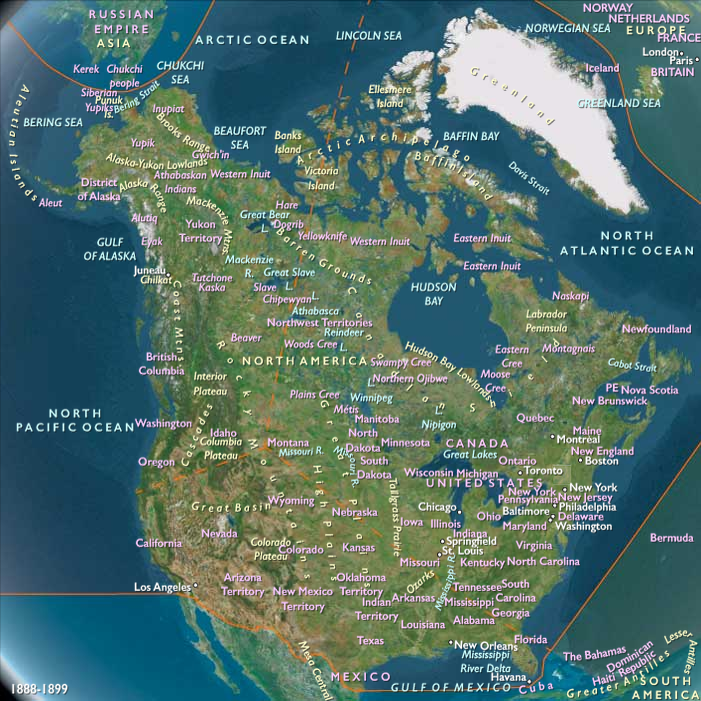
Northern North America
View →Subregions
