
Bubonic plague, an acute infection in humans …
Years: 1347 - 1347
August
Bubonic plague, an acute infection in humans and various species of rodents, caused by the bacterium Yersinia pestis (formerly called Pasteurella pestis) is spread by fleas that have fed on the blood of infected rodents, usually rats.
The first signs of illness in humans bitten by infected fleas appear suddenly, within about a week.
In a few hours, the body temperature rises to about 104°F (40°C), and the victim becomes gravely ill, experiencing vomiting, muscular pain, mental disorganization, and delirium.
The lymph nodes throughout the body, particularly those in the groin and the thighs, become enlarged and extremely painful.
The inflamed lymph nodes, called buboes (from which the disease derives its name), become filled with pus, and the disease travels through the body by way of the infected bloodstream and the lymphatic system.
In sixty to ninety percent of cases-for which, in the mid-fourteenth century, there is no treatment-death occurs within a few days.
The same bacteria causes plague pneumonia, or pneumonic plague, which is acquired by inhaling infected droplets from the lungs of someone whose plague infection has spread to the respiratory system.
This is the most contagious form of the disease and the form that progresses most rapidly, with death usually occurring in less than three days in virtually all cases.
The lethal plague is known as the Black Death because of the black spots that appear on the bodies of the victims.
It appears that movement by the Mongols and merchant caravans inadvertently brought the plague from China and inner Asia to the Middle East and Europe.
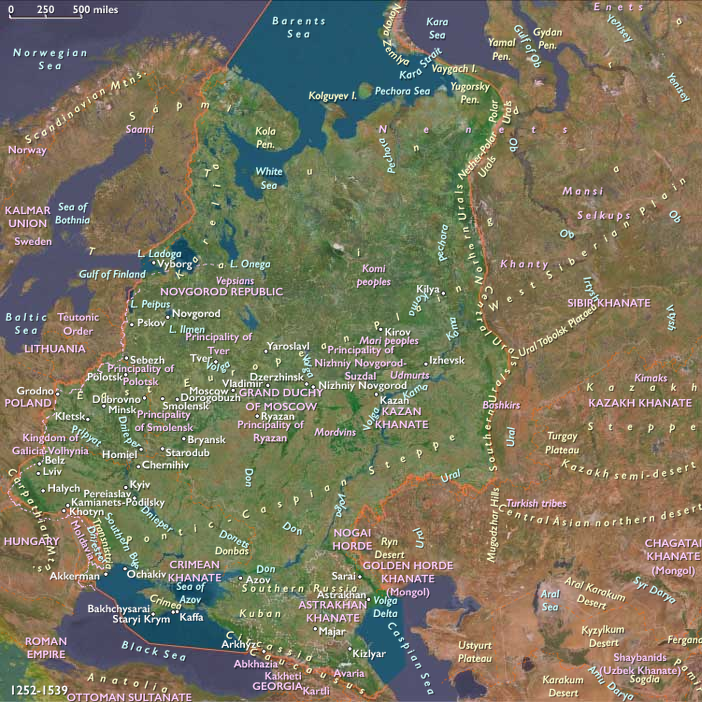
The plague is transmitted to Europeans in 1347 when an army of Kipchaks or Crimean Tatars under the command of one Janibeg and backed by Venetian forces besieging the Genoese possession of Caffa, a cathedral city and seaport on the Crimean peninsula in modern day Ukraine, catapult plague-infested corpses into the town; their objective the disruption of the trading empire Genoa has established in Caffa.
According to accounts, so many die that the survivors have little time to bury them and bodies are stacked like cords of firewood against the city walls.
Although the Tatar/Venetian alliance breaks off the siege, the disease has already spread through the city.
Genoese ships purportedly carry the bacillus to Europe, loosing the massive epidemic known as the Black Death.
Locations
People
Groups
- Tatars
- Genoa, (Most Serene) Republic of
- Venice, (Most Serene) Republic of
- Golden Horde, Khanate of the (Mongol Khanate)
Topics
Subjects
Regions

Subregions
Years: 1347 - 1347
August
Locations
People
Groups
- Tatars
- Genoa, (Most Serene) Republic of
- Venice, (Most Serene) Republic of
- Golden Horde, Khanate of the (Mongol Khanate)
Topics
Subjects
Regions
Subregions