
Bubonic plague has swept Iceland between 1402…
1404 CE
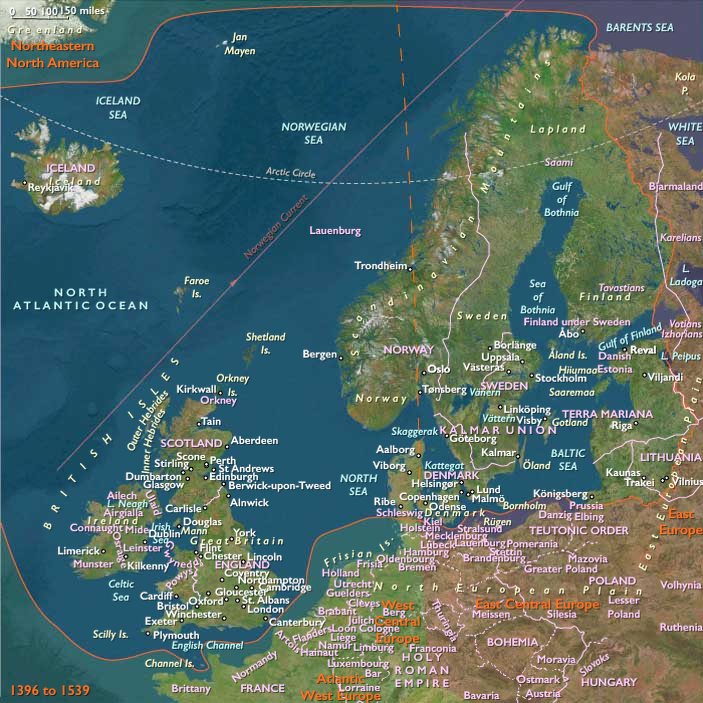
Bubonic plague has swept Iceland between 1402 and 1404, killing approximately half the population.
Infertile soil, volcanic eruptions, and an unforgiving climate make for harsh life in a society whose subsistence depends almost entirely on agriculture.
Iceland in the ensuing centuries will become one of the poorest countries in Europe.
Locations
Regions
North Europe
View →Subregions

Northwest Europe
View →Related Events
No active filters.
Showing 10 events out of 42628 total
China’s Ming Dynasty sends Admiral Zheng He to Japan in 1404 on a diplomatic mission, naming Yoshimitsu "The King of Japan" and presenting to him a seal with this title, which the shogun accepts.
Yoshimitsu replies in a letter ending with "The King of Japan, your vassal Yoshimitsu.”
Timur wishes to restore the Mongol Empire, and eventually plans to conquer China.
After Mongol khan Enkh sends his grandson Ulzitumur, also known as Buyanshir, as an emissary to Timur’s court, Timur makes an alliance with the Mongols and prepares stations all the way to Bukhara.
In December 1404, Timur initiates military campaigns against the Ming Dynasty.
Yury promises to bequeath his possessions to Vasily, but the Muscovite ruler hesitates to accept this flattering proposal, until the boyars of Smolensk open the city gates to Vytautas and surrender Yury's capital to his old enemy in 1404.
thus lost to Russians for more than a century.
As Vasily is eager to accuse Yury of short-sightedness, the latter leaves Moscow and …
…proceeds with his son to Novgorod, where he is treated honorably and is given an appanage of thirteen towns, including Porkhov and Tiversk.
The combined Lithuanian-Polish forces have captured the cities of Kiev and …
…Smolensk, courtesy of the weakening Golden Horde.
The Salynas treaty is repeated, in essence, with the signing of another treaty in 1404: Samogitia is transferred to the Teutonic Knights.
Poland promises not to support Lithuania in case of another war.
The knights promise to support Vytautas in the east and not to support any Gediminid who could have claims to the Grand Duke of Lithuania title.
The treaty does not solve the problems, however, and all the parties prepare for a war.
The war ends in defeat for Wladyslaw.
He accedes on May 22, 1404, in the Treaty of Raciąż, to most of the Order's demands, including the formal cession of Samogitia, and agrees to support the Order's designs on Pskov; in return, Konrad von Jungingen undertakes to sell Poland the disputed Dobrzyń Land and the town of Złotoryja, once pawned to the Order by Wladyslaw Opolski, and to support Vytautas in a revived attempt on Novgorod.
Both sides have practical reasons for signing the treaty at this point: the Order needs time to fortify its newly acquired lands, the Poles and Lithuanians to deal with territorial challenges in the east and in Silesia.
Also in 1404, Wladyslaw holds talks at Vratislav (Wroclaw) with Wenceslaus IV of Bohemia, who offers to return Silesia to Poland if Wladyslaw will support him in his power struggle within the Holy Roman Empire.
Wladyslaw, unwilling to burden himself with new military commitments in the west, turns the deal down with the agreement of both Polish and Silesian nobles.