
India’s population is two hundred million by…
1803 CE
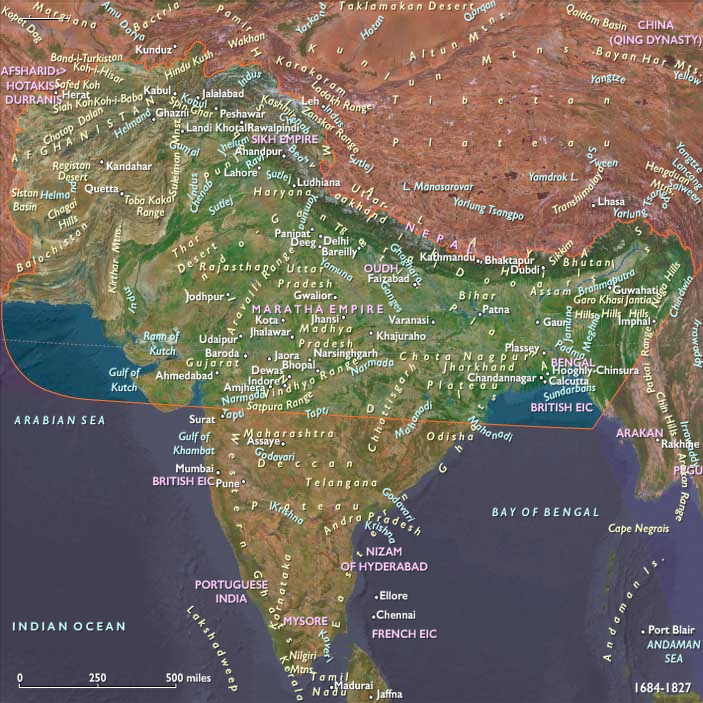
India’s population is two hundred million by 1803.
Subjects
Regions

South Asia
View →Subregions
Upper South Asia
View →Related Events
No active filters.
Showing 10 events out of 22569 total
Kamehameha tries again in 1803 to conquer the western Hawaiian Islands, but this time, disease breaks out among his warriors; Kamehameha himself falls ill, though he later recovers.
During this time, Kamehameha is amassing the largest armada Hawaiʻi has ever seen: foreign-built schooners and massive war canoes, armed with cannon and carrying his vast army.
Another new earth, from the mineral later named gadolinite in Gadolin's honor, is reported independently in the literature in 1803 by several chemists, including Martin Heinrich Klaproth and, working together, Jöns Jakob Berzelius, and Wilhelm Hisinger.
The asteroid Ceres, which had just been discovered two years before, lends its name, as ceria, to the newly obtained earth.
Researchers refer to yttria and ceria as the rare earths, because they have been discovered in a rare mineral, and closely resemble other known earths.
The elements of which yttria and ceria were the oxides then receive the names yttrium and cerium, respectively.
Sometimes referred to in English as the Final Recess or the Imperial Recess of 1803, the resolution, passed by the Reichstag (Imperial Diet) of the Holy Roman Empire on March 24, 1803, is ratified by the Emperor Francis II and becomes law on April 27.
It will prove to be the last significant law enacted by the Empire before its dissolution in 1806.
The resolution, approved by an Imperial Delegation (Reichsdeputation) on February 25 and submitted to the Reichstag for acceptance, is based on a plan agreed in June 1802 between France and Russia, and broad principles outlined in the Treaty of Lunéville of 1801.
The law secularizes nearly seventy ecclesiastical states and abolishes forty-five imperial cities to compensate numerous German princes for territories to the west of the Rhine that had been annexed by France as a result of the French Revolutionary Wars.
Napoleon claims Northern Italy in 1803.
In the ensuing peace, France keeps its gains and Germany reorganizes its states.
Sa'ud's father is assassinated in 1803, soon after the return of his son from the capture of Mecca, by a Shi'ite in the mosque of Ad-Dir'iyah in revenge for the desecration of Karbala'.
Arthur Wellesley, the French-trained younger brother of Governor-General Richard Wellesley, breaks the power of the Marathas at Assaye in 1803.
Mahmud sues for peace after Shoja' occupies the capital in 1803, and Shah Shoja' ascends the Afghan throne.
The 1803 treaty of Amiens restores Dutch control over the Cape.