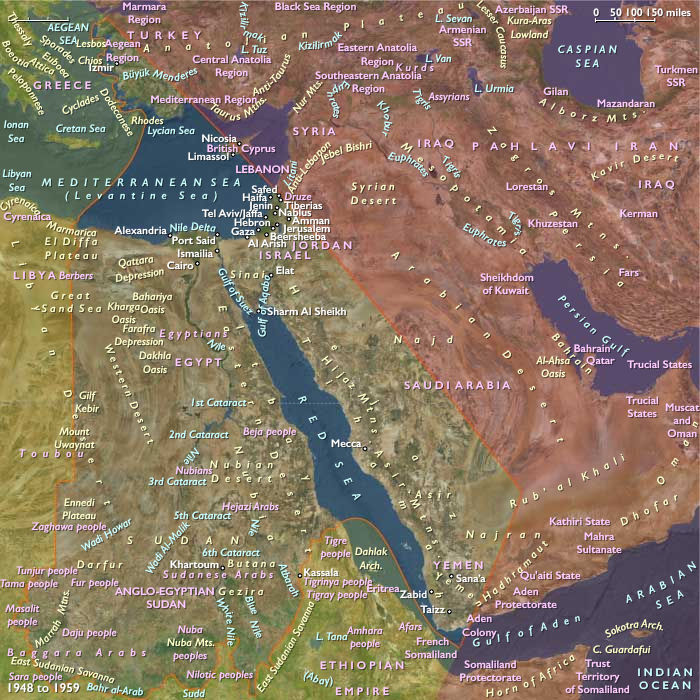
The Israelis have managed to occupy all…
January 1949 CE
The Israelis have managed to occupy all of the Negev up to the former Egypt-Palestine frontier, except for the Gaza Strip, by early 1949. (The 1948 war is Israel's costliest to date: more than six thousand Jewish fighters and civilians are killed and thirty thousand wounded out of a population of only seven hundred and eighty thousand.)
There had been about one million, three hundred thousand Arabs in all of Palestine in 1947, according to British Mandate Authority population figures.
Between seven hundred thousand and nine hundred thousand of the Arabs live in the region eventually bounded by the 1949 Armistice line, the so-called Green Line.
By the time the fighting stops, there are only about one hundred and seventy thousand Arabs left in the new State of Israel, which has in the course of the war obtained more land than had been provided by the UN resolution, and has driven out eight hundred thousand Arabs who become displaced persons known as Palestinians.
Thus, fifty years after the first Zionist congress and thirty years after the Balfour Declaration, Zionism has achieved its aim of establishing a Jewish state in Palestine, but Israel's victory in the war does not bring peace.
The Arabs, who are humiliated by defeat and still bitterly divided, refuse to recognize the Jewish state.
In early 1949, the Arab nations announce a state of war with Israel and organize an economic and political boycott of the country.
At the war's end in 1949, the fledgling state is burdened with a number of difficult problems.
These include reacting to the absorption of hundreds of thousands of new immigrants and to a festering refugee problem on its borders, maintaining a defense against a hostile and numerically superior Arab world, keeping a war-torn economy afloat, and managing foreign policy alignments.
Faced with such intractable problems, David Ben-Gurion seeks to ensure a fluid transition from existing pre-state institutions to the new state apparatus.
Locations
People
Regions
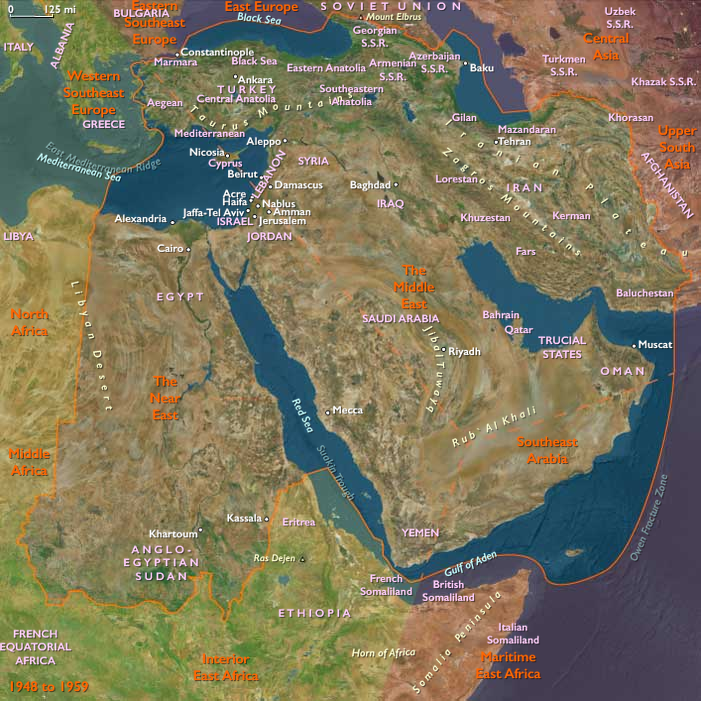
The Near and Middle East
View →Subregions