
Thomas Carlyle had begun his first major…
June 1834 CE
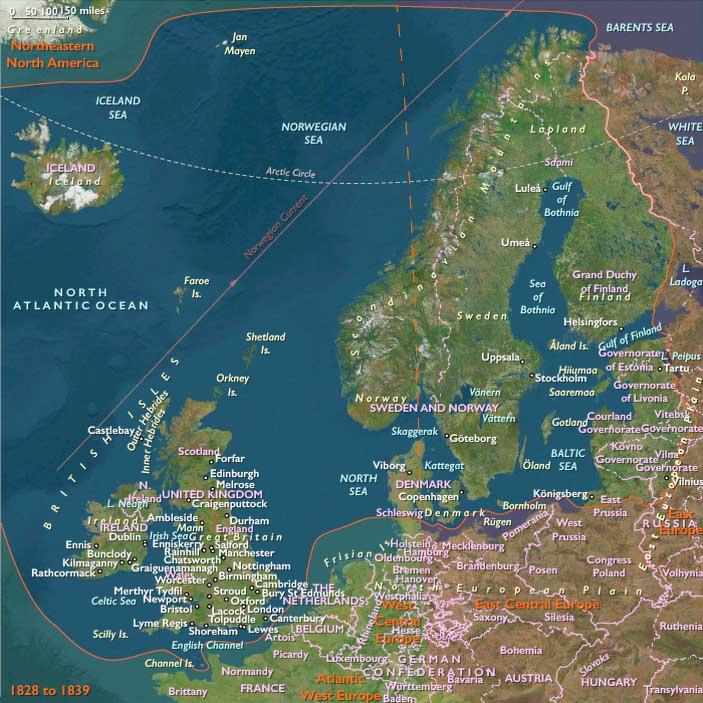
Thomas Carlyle had begun his first major work, Sartor Resartus ("The Tailor Retailored") in 1831 at his home (provided for him by his wife Jane Baillie Welsh, from her estate), Craigenputtock, and is intended to be a new kind of book: simultaneously factual and fictional, serious and satirical, speculative and historical.
It ironically comments on its own formal structure, while forcing the reader to confront the problem of where 'truth' is to be found.
Sartor Resartus is first published periodically in Fraser's Magazine from 1833 to 1834.
Carlyle was born in Ecclefechan in Dumfriesshire.
His parents had determinedly afforded him an education at Annan Academy, Annan, where he had been bullied and tormented so much that he left after three years.
In early life, his family's (and his nation's) strong Calvinist beliefs powerfully influenced the young man.
After attending the University of Edinburgh, Carlyle became a mathematics teacher, first in Annan, then in Kirkcaldy, where Carlyle had become close friends with the mystic Edward Irving. (Confusingly, there is another Scottish Thomas Carlyle, born a few years later and also connected to Irving, through his work with the Catholic Apostolic Church.
Carlyle had returned in 1819–1821 to the University of Edinburgh, where he had suffered an intense crisis of faith and conversion that would provide the material for Sartor Resartus ("The Tailor Retailored"), which first brought him to the public's notice.
By 1821, Carlyle had abandoned the clergy as a career and focused on making a life as a writer.Carlyle had developed a painful stomach ailment, possibly gastric ulcers (which pseudo-medicine of the time attributes to this "crisis of faith"), that will remain throughout his life and contribute to his reputation as a crotchety, argumentative, and somewhat disagreeable personality.
His prose style, famously cranky and occasionally savage, helps cement a reputation of irascibility.His first attempt at fiction was Cruthers and Jonson, one of several abortive attempts at writing a novel.
He began reading deeply in German literature, and his thinking had been heavily influenced by German Idealism, in particular the work of Johann Gottlieb Fichte.
He had established himself as an expert on German literature in a series of essays for Fraser's Magazine, and by translating German writers, notably Goethe (the novel Wilhelm Meister's Apprenticeship); he also wrote Life of Schiller in 1825.
Following his work on the Goethe translation, he has come to distrust the form of the realistic novel and so works on developing a new form of fiction.
In addition to his essays on German literature, he had branched out into wider ranging commentary on modern culture in his influential essays Signs of the Times and Characteristics.
In 1826, Carlyle married Jane Baillie Welsh, herself a writer, whom he had met in 1821, during his period of German studies; she has become his invaluable research assistant.
His home in residence for much of his early life, after 1828, is a farm in Craigenputtock, a house in Dumfrieshire, Scotland where he writes many of his works.
At the Craigenputtock farm, Carlyle also writes some of his most distinguished essays, and he begins a lifelong friendship with the American essayist Ralph Waldo Emerson.
On June 10, 1834, Carlyle moves to Cheyne Row in London.
Subjects
Regions
North Europe
View →Subregions
