The Rise of Charles Martel and the…
715 CE
The Rise of Charles Martel and the Coronation of Chilperic II
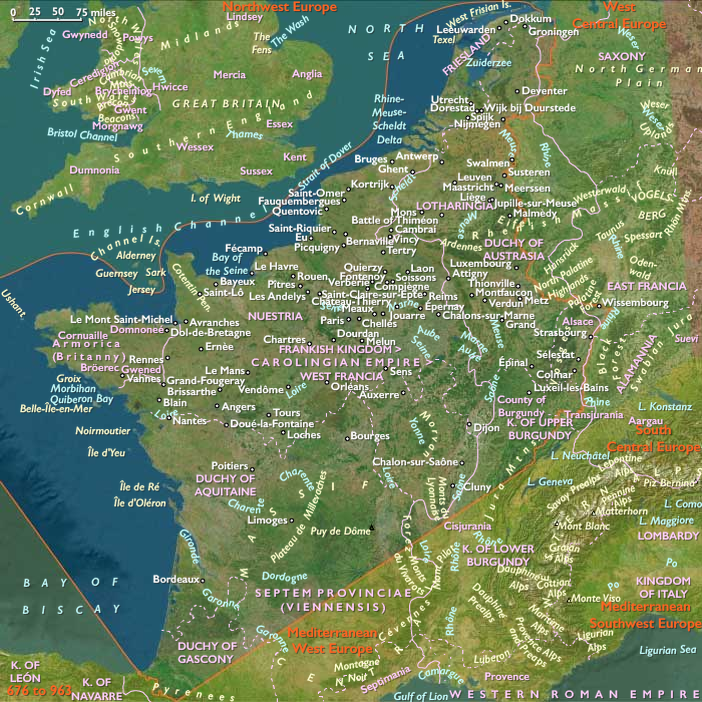
As Neustrian forces press their attacks against Austrasia, the nobles of the eastern Frankish kingdom find themselves leaderless—until Charles Martel, the illegitimate son of Pepin of Herstal, escapes from prison before the end of the year. Recognizing his strength and leadership, the Austrasian nobles acclaim him Mayor of the Palace, placing their hopes in him to defend their lands against Neustrian aggression.
Meanwhile, in Neustria, the death of Dagobert III leaves the throne vacant. Seeking a ruler of their own, the Neustrian aristocracy disregards broader Frankish unity and proclaims Chilperic II as king, without the support of the Austrasian or Burgundian factions.
Chilperic II: A King from the Monastery
Born as Daniel, the youngest son of Childeric II, Chilperic II had been taken to a monastery as an infant, a common practice to protect royal children from the violent dynastic struggles of the Merovingian court. For over four decades, he lived as a monk, far removed from the intrigues of Frankish politics. However, with the death of Dagobert III, the Neustrian warriors retrieve him from monastic life, raising him on the shield in the traditional Frankish acclamation ceremony, marking his accession to the throne.
Taking the regnal name Chilperic, he presents a striking contrast to his infamous predecessor, Chilperic I. Unlike the earlier king, known for his ruthlessness and political cunning, Chilperic II’s monastic upbringing shapes him into a different kind of ruler, one who must quickly adapt to the realities of power in a fractured kingdom.
His reign, however, will soon be challenged, as Charles Martel consolidates his position in Austrasia, setting the stage for a decisive power struggle between the two factions vying for control of the Frankish realm.
Locations
People
Groups
Commodities
Subjects
Regions
West Europe
View →Subregions