
Charles the Great, the ruthless King of…
784 CE to 795 CE
Charles the Great, the ruthless King of the Franks from 768 to 814, known to posterity as Charlemagne, is described by a contemporary, Einhard, as having the red hair and blue eyes of his tribe.
Einhard notes that the ambitious, powerfully built monarch is able to work longer and harder than his commanders or his secretaries.
People
Groups
Topics
Commodities
Subjects
Regions
Central Europe
View →Subregions

West Central Europe
View →Related Events
No active filters.
Showing 10 events out of 55038 total
Buddhism begins to spread, despite such machinations, throughout Japan during the ensuing Heian period (794-1185) primarily through two major esoteric sects, Tendai (Heavenly Terrace) and Shingon (True Word).
Tendai originated in China and is based on the Lotus Sutra.
Shingon is an indigenous sect with close affiliations to original Indian, Tibetan, and Chinese Buddhist thought founded by Kukai (also called Kobo Daishi), who greatly impresses the emperors following Emperor Kanmu (782-806) and generations of Japanese, not only with his holiness, but also with his poetry, calligraphy, painting, and sculpture.
Kanmu himself is a notable patron of the otherworldly Tendai sect, which will rise to great power over the ensuing centuries.
A close relationship develops between the Tendai monastery complex on Mount Hiei and the imperial court in its new capital at the foot of the mountain and, as a result, Tendai emphasizes great reverence for the emperor and the nation.
Factional fighting at the imperial court continues throughout the Nara period.
Imperial family members, leading court families, such as the Fujiwara, and Buddhist priests all contend for influence.
In the late Nara period, financial burdens on the state increase, and the court begins dismissing nonessential officials.
In 792 universal conscription is abandoned, and district heads are allowed to establish private militia forces for local police work.
Decentralization of authority becomes the rule despite the reforms of the Nara period.
Eventually, to return control to imperial hands, the capital is moved in 784 to Nagaoka and in 794 to Heiankyo (Capital of Peace and Tranquility) or Heian, about twenty-six kilometers north of Nara.
By the late eleventh century, the city will popularly be called Kyoto (Capital City), the name it will have ever since.
Kammu moves the capital to Heian (Kyoto), which will remain the imperial capital for the next thousand years, doing so not only to strengthen imperial authority but also to improve his seat of government geopolitically.
Kyoto has good river access to the sea and can be reached by land routes from the eastern provinces.
The early Heian period (794-967) continues Nara culture; the Heian capital is patterned on the Chinese capital at Chang' an, as is Nara, but on a larger scale.
Despite the decline of the Taika-Taiho reforms, imperial government is vigorous during the early Heian period.
Indeed, Kammu's avoidance of drastic reform decreases the intensity of political struggles, and he becomes recognized as one of Japan's most forceful emperors.
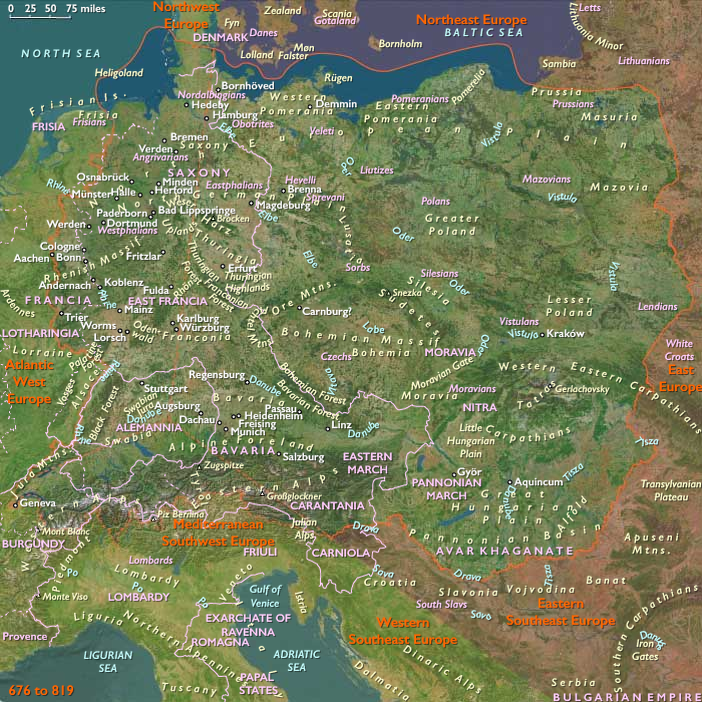
East Central Europe (784–795 CE): Carolingian Victory over Saxons, Intensified Slavic Statehood, and Rising Pressure on the Avars
Between 784 and 795 CE, East Central Europe—encompassing Poland, Czechia, Slovakia, Hungary, and those portions of Germany and Austria lying east of 10°E and north of a line stretching from roughly 48.2°N at 10°E southeastward to the Austro-Slovenian border near 46.7°N, 15.4°E—witnessed critical transformations shaped by the expanding power of Charlemagne’s Carolingian Empire. After prolonged conflict, Charlemagne decisively subdued the Saxons, incorporating much of their territory into his growing empire. The Slavic principalities of Bohemia and Moravia intensified their efforts to solidify political institutions and defenses, anticipating Carolingian expansion. Meanwhile, the Avar Khaganate faced mounting Carolingian pressure, foreshadowing dramatic shifts to come, and Thuringia's longstanding autonomy increasingly diminished under direct Carolingian influence.
Political and Military Developments
Carolingian Conquest of Saxony
-
By 785 CE, Charlemagne decisively ended the protracted Saxon resistance, incorporating substantial territories east of the Elbe into the Carolingian Empire. Saxon regions underwent forced Christianization and integration into Frankish governance structures.
Slavic State Consolidation
-
Bohemian and Moravian principalities rapidly strengthened political and military structures in response to the nearby Carolingian presence. These developments laid firm foundations for future statehood, enhancing their internal governance and external diplomatic capabilities.
Increasing Carolingian Influence in Thuringia and Bavaria
-
The autonomous duchy of Thuringia came under greater Carolingian political control, while Bavaria experienced heightened Frankish influence, gradually eroding its political independence and autonomy.
Avar Khaganate Under Pressure
-
The Avar Khaganate increasingly faced military and diplomatic threats from the expanding Carolingian Empire, prompting strategic shifts and internal concerns about their long-term viability.
Economic and Technological Developments
Economic Integration Under Carolingian Influence
-
Conquered Saxon territories experienced closer economic integration with Carolingian domains, facilitating trade expansion and the introduction of Frankish monetary systems, agricultural practices, and economic governance.
Continued Fortification and Defensive Infrastructure
-
Bohemian, Moravian, Bavarian, and remaining Saxon communities reinforced existing defensive structures and settlements, responding proactively to Carolingian expansion and regional instability.
Cultural and Artistic Developments
Carolingian Cultural Impact
-
Saxon territories rapidly absorbed Carolingian religious, artistic, and administrative influences, marked by increased Christianization, shifts in burial practices, and the spread of Frankish-style artifacts.
Continued Slavic Cultural Identity
-
Bohemian and Moravian Slavs maintained and further articulated distinct cultural identities through unique settlement patterns, artistic styles, ceramics, jewelry, and fortified constructions.
Avar Artistic and Cultural Continuity
-
Despite external pressures, the Avars maintained strong cultural traditions, continuing to influence regional artistic styles, especially evident in metalworking and decorative arts.
Settlement and Urban Development
Saxon Urban Transformation
-
Carolingian control accelerated urban development in Saxon territories, integrating them into Frankish administrative structures and establishing new fortified towns and economic centers.
Expansion of Slavic Political Centers
-
Bohemian and Moravian settlements expanded as political and economic hubs, consolidating their position as centers of regional governance, trade, and culture.
Stability in Bavarian and Thuringian Settlements
-
Bavarian and Thuringian urban and rural settlements continued to grow economically, though increasingly aligned with Carolingian political structures and trade networks.
Social and Religious Developments
Forced Christianization of Saxony
-
Carolingian dominance introduced aggressive missionary activities and enforced conversion among the Saxons, significantly reshaping Saxon society and religious practices.
Centralized Slavic Leadership
-
Slavic principalities in Bohemia and Moravia further centralized their leadership, strengthening governance structures and defensive capabilities amid increasing Carolingian presence.
Avar Societal Stability Amid Pressure
-
The Avars retained internal cohesion and stability, though increasingly aware of and responsive to growing external Carolingian threats.
Long-Term Consequences and Historical Significance
The era 784–795 CE dramatically reshaped the political landscape of East Central Europe, primarily through the decisive Carolingian victory over the Saxons. Intensified Slavic state-building, increased Carolingian dominance over Thuringia and Bavaria, and mounting pressures on the Avar Khaganate collectively foreshadowed the profound transformations that defined the subsequent medieval history of the region.
The Saxons, despite repeated setbacks, resist the Franks steadfastly, forever returning to raid Charlemagne's domains as soon as he turns his attention elsewhere.
Their main leader, Widukind, is a resilient and resourceful opponent, but eventually is defeated and baptized in 785.
The East Roman state, shrunken by the Slavic invasions and Islamic conquests of the seventh and eighth centuries, survives as a recognizable entity, grounded more firmly than ever in the Balkans and Asia Minor.
The Seventh Ecumenical Council, at the urging of Empress Irene, and with the support of Pope Adrian and Patriarch Nikephoros, representing seventeen-year-old Emperor Constantine VI, effectively ends the Eastern church's policy of iconoclasm in declaring that, whereas the veneration of images must be carefully distinguished from the worship due God alone, the practice is legitimate and the intercession of saints efficacious.
Eastern Southeast Europe (784–795 CE): Religious Restoration, Regional Stability, and Administrative Reorganization
Settlement and Migration Patterns
Stabilization and Territorial Consolidation
From 784 to 795 CE, Eastern Southeast Europe continued to solidify as a stable entity despite past territorial contractions from Slavic and Islamic incursions. The Byzantine state was now grounded firmly in the Balkans and Asia Minor, securing regional cohesion.
Political and Military Developments
Territorial Stability and Defense
The Byzantine state maintained its territorial integrity, anchored in the Balkans and Asia Minor despite previous losses from Slavic migrations and Islamic conquests. Continued investment in military infrastructure reinforced territorial defense and ensured sustained imperial security.
Administrative Reorganization: Formation of Thrace and Macedonia Themes
In response to the persistent instability resulting from Slavic incursions, the Byzantine Empire initially established the theme of Thrace in the late 7th century within the hinterlands of Thessaloniki. However, due to ongoing challenges, the Empire withdrew its defensive lines southward along the Aegean coast. Consequently, between 789 (or 797) and 801/802 CE, Empress Irene of Athens created the new theme of Macedonia from the older Thrace theme. Byzantine Macedonia primarily encompassed modern Southern Thrace, with Adrianople as its administrative center.
Economic and Technological Developments
Economic Stability and Growth
Ongoing peace and political stability facilitated continued economic prosperity, enhancing agricultural productivity and securing trade routes vital for regional economic resilience.
Continued Military and Defensive Innovations
Strategic defense initiatives and infrastructure investments, particularly in frontier areas, supported regional security and preparedness against external threats, contributing significantly to imperial stability.
Cultural and Artistic Developments
Flourishing Cultural Expression
Cultural and artistic activities thrived during this period, supported by sustained peace and stability. Investment in religious and cultural institutions continued to enrich regional artistic expression and identity.
Scholarly Continuity
Intellectual and educational institutions actively preserved and advanced classical and theological knowledge, ensuring cultural continuity and resilience.
Social and Religious Developments
Restoration of Religious Iconography
The Seventh Ecumenical Council, convened at the urging of Empress Irene and supported by Pope Adrian and Patriarch Nikephoros, ended the Eastern Church's official policy of Iconoclasm. The council clarified the veneration of images, distinguishing it from the worship reserved for God alone, declaring this practice legitimate and affirming the intercession of saints. This restoration had profound implications for Byzantine religious practice and cultural identity.
Strengthening of Eastern Orthodox Identity
The restoration of religious imagery significantly bolstered the influence and social cohesion fostered by Eastern Orthodox Christianity, reinforcing its central societal role and communal identity.
Long-Term Consequences and Historical Significance
The period from 784 to 795 CE was marked by significant religious restoration, territorial stability, and administrative reorganization. The establishment of the Macedonia theme, combined with the decisions of the Seventh Ecumenical Council, fundamentally shaped Byzantine religious practice and regional identity, leaving enduring legacies for Eastern Orthodox Christianity and influencing the subsequent historical trajectory of Eastern Southeast Europe.
The Middle East: 784–795 CE
Abbasid Power and Cultural Flourishing
Golden Age under Harun al-Rashid
The Abbasid Caliphate enters a period of remarkable strength and prosperity during the reign of Harun al-Rashid (786–809), whose early rule spans this era. Baghdad remains a vibrant center of culture, trade, and intellectual life, drawing scholars, poets, and artists from across the known world. Harun’s court becomes legendary for its opulence, scholarship, and patronage, setting the stage for the golden age of Islamic civilization.
Administrative Reforms and Stability
Harun al-Rashid strengthens imperial administration, improving efficiency and fiscal stability. Taxation and land reforms help bolster the empire's economy, supporting extensive infrastructure projects such as roads, bridges, and canals, further enhancing trade and agriculture.
Cultural and Scientific Advancement
Under Harun, the Abbasid court at Baghdad becomes an unparalleled center of learning. Libraries and educational institutions flourish, attracting scholars who translate significant Greek, Persian, and Indian works into Arabic. This wave of intellectual activity forms the basis for subsequent advances in mathematics, medicine, astronomy, and philosophy, profoundly influencing both the Islamic world and later European Renaissance.
Thus, between 784 and 795 CE, the Middle East witnesses an era of exceptional prosperity and intellectual ferment, positioning the Abbasid Caliphate at the pinnacle of its cultural and political influence.
Spain’s Umayyad emir Abd-ar-Rahman begins construction in 785 on the Great Mosque of Córdoba.
North Africa (784–795 CE)
Height of Muhallabid Influence, Rise of the Idrisids, and Continued Berber Autonomy
Between 784 and 795 CE, North Africa experiences a significant realignment of political power marked by the apex and subsequent decline of the Abbasid-appointed Muhallabid dynasty in Ifriqiya, the rise of the independent Arab-led Idrisid dynasty in Morocco, and the continued flourishing of indigenous Berber states.
Under Muhallabid rule, Ifriqiya, governed from the capital at Kairouan (Al Qayrawan), reaches its economic and cultural zenith. Muhallabid governors, particularly Yazid ibn Hatim al-Muhallabi (779–787 CE) and his successor, Dawud ibn Yazid al-Muhallabi (787–794 CE), significantly expand agricultural prosperity through ambitious irrigation projects and stable administrative governance. The region enjoys notable prosperity, becoming a critical hub for trade, agriculture, and intellectual life, with Kairouan thriving as a major urban center renowned for its scholarly and cultural achievements.
Despite their successful governance within Ifriqiya, the Muhallabids find their influence increasingly constrained. To the west, indigenous Berber polities, particularly the Rustamid Dynasty in Tahert (Tiaret), consolidate their independence, fostering a thriving center of Ibadi Kharijite religious scholarship and commerce. Further south, the influential city-state of Sijilmasa, strategically positioned along trans-Saharan trade routes managed primarily by powerful Tuareg tribes, continues to prosper independently, controlling significant trade in gold, ivory, salt, and slaves between sub-Saharan Africa and Mediterranean markets.
In Morocco, this era sees the emergence and rapid rise of the Arab-led Idrisid Dynasty. Founded by Idris ibn Abdallah (Idris I) in 788 CE, following his flight from Abbasid persecution in the east, the Idrisids swiftly establish their power base in the city of Volubilis and shortly thereafter in the newly founded city of Fez (Fès), which Idris I establishes as his dynasty’s capital in 789 CE. The Idrisid state blends Arab political traditions with indigenous Berber support, rapidly emerging as a powerful, independent Islamic kingdom—the first significant Muslim dynasty in Morocco.
Meanwhile, along the Atlantic coast, the distinctive Barghawata confederation solidifies its political and religious autonomy, maintaining a unique form of Islam infused with indigenous Berber elements, further exemplifying the period's cultural and religious diversity.
The Muhallabids, unable to assert effective control beyond the immediate vicinity of Kairouan and Ifriqiya, increasingly struggle to maintain influence amid the emergence of these powerful independent states. Their period of prosperity and influence eventually diminishes amid internal administrative weaknesses, external pressures from Berber states, and shifting Abbasid political interests.
By the close of 795 CE, North Africa clearly reflects a new political landscape, characterized by regional fragmentation, the ascendance of the independent Idrisid state in Morocco, robust Berber autonomy under the Rustamids, and the diminishing authority of Muhallabid governors in Ifriqiya. This era firmly establishes enduring patterns of political independence and cultural diversity that profoundly shape North Africa’s subsequent historical trajectory.