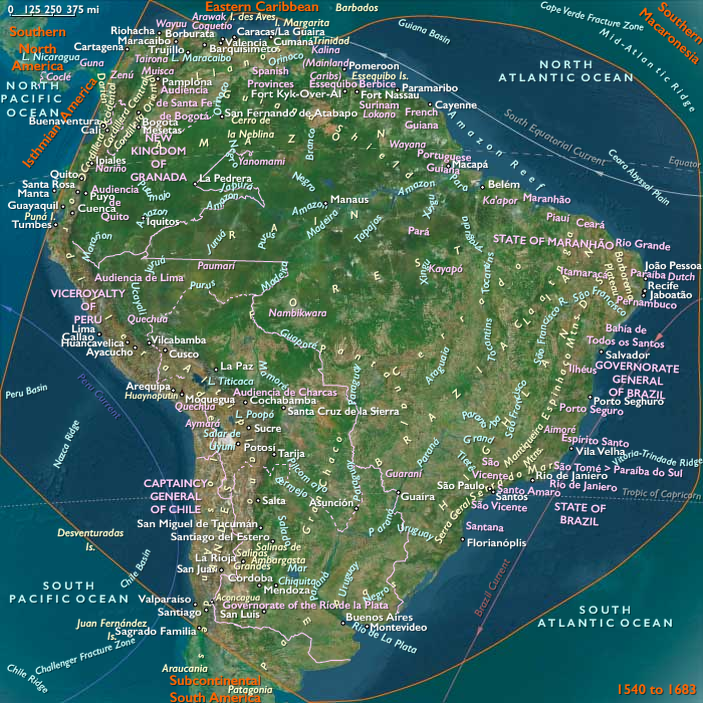
The settlement of Asunción has a population…
1540 CE to 1551 CE
The settlement of Asunción has a population of about fifteen hundred within twenty years of its founding.
Transcontinental shipments of silver pass through Asunción on their way from Peru to Europe.
Asunción subsequently becomes the nucleus of a Spanish province that encompasses a large portion of southern South America—so large, in fact, that it is dubbed "La Provincia Gigante de Indias."
Asunción also is the base from which this part of South America is colonized.
Spaniards move northwestward across the Chaco to found Santa Cruz in Bolivia; eastward to occupy the rest of present-day Paraguay; and southward along the river to refound Buenos Aires, which its defenders had abandoned in 1541 to move to Asunción.
Uncertainties over the departure of Pedro de Mendoza had led Charles V to promulgate a cedula (decree) that is unique in colonial Latin America.
The cedula had granted colonists the right to elect the governor of Rio de la Plata Province either if Mendoza had failed to designate a successor or if a successor had died.
Two years later, the colonists had elected Irala as governor.
His domain includes all of present-day Paraguay, Argentina, Uruguay, most of Chile, and large parts of Brazil and Bolivia.
In 1542 the province becomes part of the newly established Viceroyalty of Peru, with its seat in Lima.
Locations
Groups
Commodities
Regions
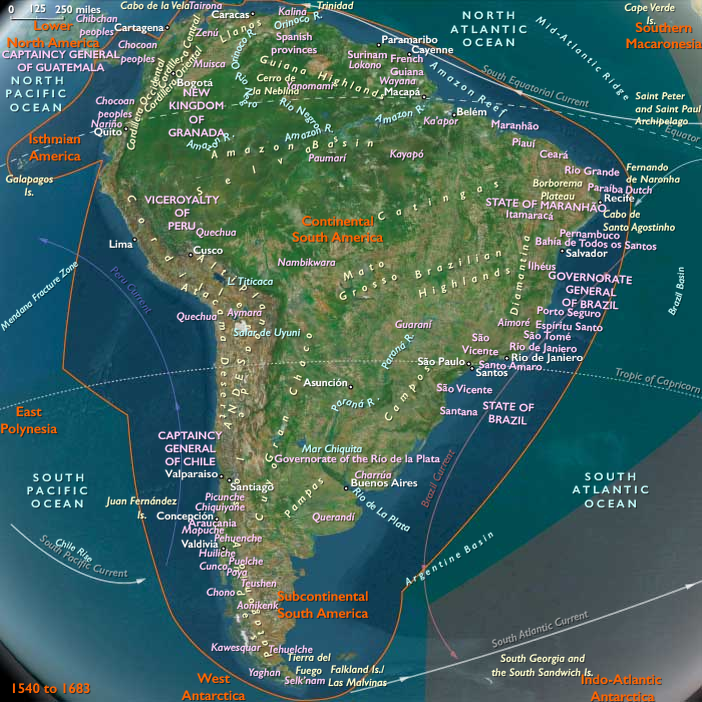
South America
View →Subregions