
Chen Hongshou, a native of Zhuji, ZheJiang…
1634 CE
Chen Hongshou, a native of Zhuji, ZheJiang province, had once trained under Lan Ying, and is skilled in painting peculiar human figures, landscapes, flower-and-bird.
He utilizes plump, profound brushwork and precise color, creating a unique style.
His two masterpieces,"Shui Hu Ye Zi" and "Bo Gu Ye Zi", are the rare examples among the Ming and the Qing dynasties.
Together with Cui Zizhong, who specializes in human figure painting, he is very famous at this time: the two painters are known colloquially as "Chen in South and Cui in North".
He also is skilled in calligraphy, poetry and prose.
Images
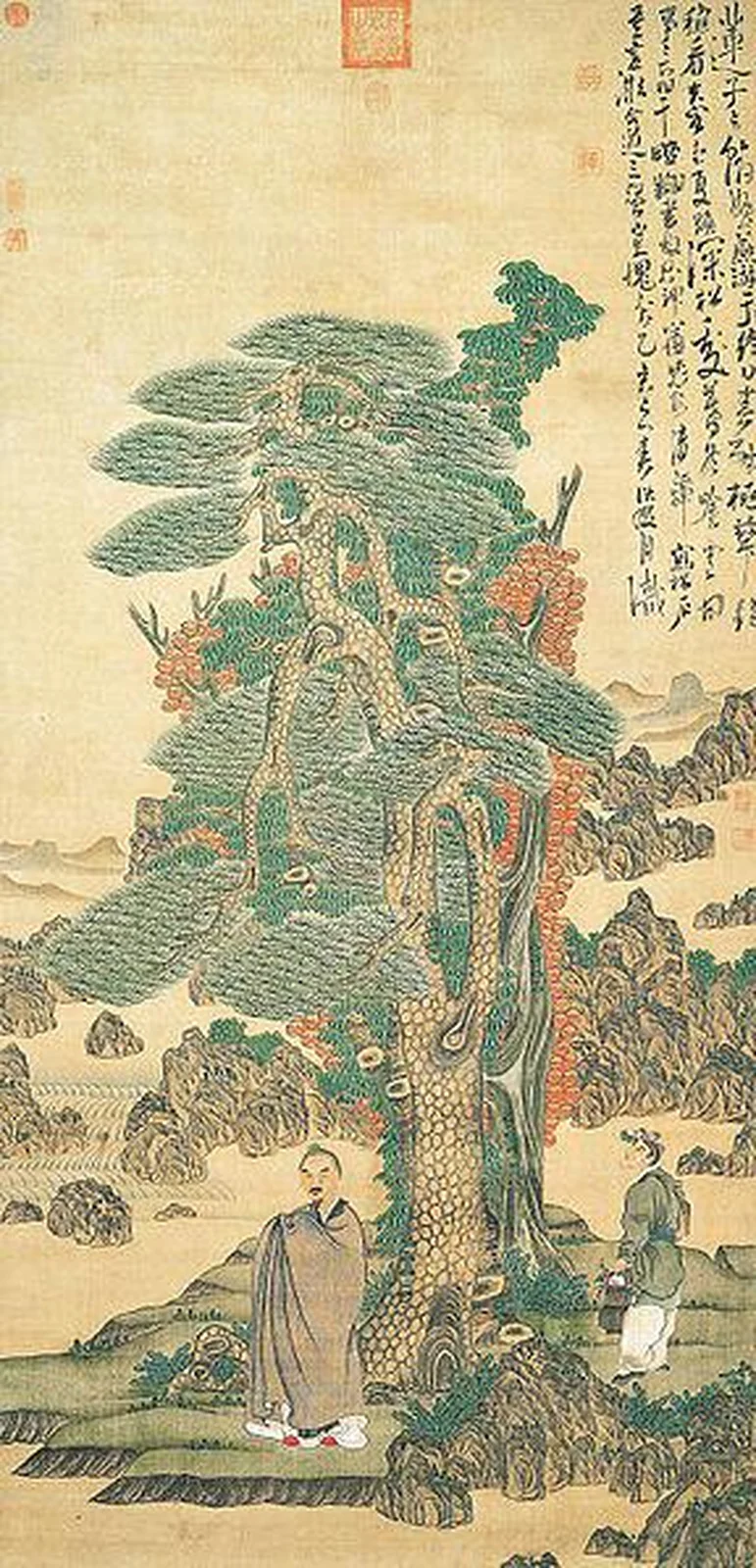
Chen Hongshou's self portrait, 1635
Locations
People
Subjects
Regions

East Asia
View →Subregions

Maritime East Asia
View →Related Events
No active filters.
Showing 10 events out of 32495 total
Iemitsu had been able to assume real power with the death of Hidetada in 1632.
Worried that his brother Tokugawa Tadanaga might assassinate him, however, he has ruled carefully until that brother's death by seppuku in 1633.
Hidetada had left his advisors, all veteran daimyo, to act as regents for Iemitsu.
He dismisses these men after his brother's death in 1633.
In place of his father's advisors, Iemitsu appoints his childhood friends, creating a strong, centralized administration with their help, Iemitsu.
This makes him unpopular with many daimyo, but Iemitsu simply removes his opponents.
Oslo has been destroyed several times by fire, and after the fourteenth calamity, in 1624, King Christian IV of Denmark (and Norway) had ordered it rebuilt at a new site across the bay, near Akershus Fortress and given the name Christiania, but the city had started long before this to establish its stature as a center of commerce and culture in Norway.
The part of the city built from 1624 is now often called Kvadraturen because of its orthogonal layout.
The Minim friars, a mendicant order of the Neudeck ob der Au cloister that resides in Neuhauser Straße in Munich, are part of the order that had been founded by Francis of Paola in the fifteenth century in Italy.
They begin brewing beer for their own use in 1634; the beer that is permitted to be sold on holidays is a Bock style which gains local fame.
This is the origin of name of the Paulaner brewery, which is today ranked among Germany's ten best selling breweries.
The residents of the town of Oberammergau in Bavaria had vowed that if God spared them from the effects of the bubonic plague ravaging the region, they would produce a play every ten years thereafter for all time depicting the life and death of Jesus.
The death rate among adults had risen from one in October 1632 to twenty in the month of March 1633, then had slowly subsided to one in the month of July 1633.
The villagers believe they have been spared after they keep their part of the vow when the play is first performed in 1634.
The Oberammergau Passion Play, now performed repeatedly over the course of five months during the first year of each decade, involves over two thousand performers, musicians, and stage technicians, all residents of the village.
The scene has been set, Olivares believes, for a renewed attack on the Dutch, but Olivares' strategy ultimately fails due to the entry of France into the war.
His handling of War of the Mantuan Succession, which had started to pitch France against the Habsburgs in northern Italy and will ultimately result in the French invasion of Spain, has been much criticized.
France, seeing the Spanish successes in Germany and the defeat of her Swedish allies by 1634, begins raising the political stakes, taking provocative military action on a small scale.
Rembrandt marries Hendrick's cousin, Saskia van Uylenburg,i n 1634.
Saskia comes from a good family: her father had been lawyer and burgemeester (mayor) of Leeuwarden.
When Saskia, as the youngest daughter, became an orphan, she lived with an older sister in Het Bildt.
They were married in the local church of St. Annaparochie without the presence of his relatives.
In the same year, Rembrandt became a burgess of Amsterdam and a member of the local guild of painters.
He also acquires a number of students, among them Ferdinand Bol and Govert Flinck.
Henry VIII, after the Dissolution of the Monasteries in 1539, had taken the land belonging to Westminster Abbey, including the convent garden, and granted it to John Russell, 1st Earl of Bedford.
The Earl had built Bedford House on the the Strand, with a large walled garden stretching back to run along the south side of the old convent garden.
The 4th Earl of Bedford, Francis Russell, in 1631 had commissioned Inigo Jones to design and build a church and three terraces of fine houses along the lines of an Italian piazza.
The Earl had felt obliged to provide a church and he warned Jones that he wanted to economize, telling him to simply erect a "barn"; Jones' oft-quoted response had been that his lordship would have "the finest barn in Europe".
The houses, along with the church, are completed in 1633.
The design of the square, known as Covent Garden, is new to London, and is to have a significant influence on modern town planning in London, acting as the prototype for the laying-out of new estates as London grows.
The houses initially attract the wealthy classes.
The first murmurs against the system put in place by the "Council" of the Governor's assistants had arisen when a tax was imposed on the entire colony in 1632, but Governor Winthrop had been able to quiet fears.
The issue of governance arises again in 1634, as deputies demand to see the charter that has been kept hidden from them.
They learn of the provisions that the general court should make all laws, and that all freemen should be members.
The group demands that the charter be enforced to the letter, but eventually reach a compromise with Winthrop.
They agree to a General Court made up of two delegates elected by each town, the Governor's council of advisors, and the Governor himself.
This Court is to have authority over "The raising up public stock" (taxes) and "what they should agree upon should bind all."
What Winthrop did not expect was that what they would "bind" themselves to include the election of the governor, and Thomas Dudley is elected.
The first revolution is complete: a trading company has become a representative democracy.
Jean Nicolet travels through the Great Lakes region in 1634, reaching the western end of Lake Huron and discovering the Sault Ste. Marie (which, though Nicolet doesn’t travel through it, leads to Lake Superior), and the Straits of Mackinaw.
Born in Cherbourg, Normandy, France, the son of Thomas Nicollet who was "messenger ordinary of the King between Paris and Cherbourg", and Marguerite de la Mer, had come to Quebec in 1618 as a clerk and to train as an interpreter for the Compagnie des Marchands, a trading monopoly owned by members of the French aristocracy.
As an employee, Jean Nicolet had been a devotee of the Roman Catholic Church and a faithful supporter of the Ancien Régime.
On his arrival in Quebec, in order that he learn their language, he had been sent to live with the Algonquins on Allumette Island, a friendly native settlement on the important fur trade route on the Ottawa River.
From a relationship with a Nipissing native, a woman named Elisabeth Manitoukoue une Sauvagesse de Nipissing (translation of the French "an native woman from Nipissing"), he had a daughter, Madeleine Euphrosine Nicolet, whom he later brought back with him to the colony.
When Quebec on July 19, 1629, fell to the Kirke brothers, who took control for England, Jean Nicolet had fled back into the safety of the Huron country and worked against English interests until the French were restored to power.
Traversing the straits, into ...
...the Green Bay area of Lake Michigan’s western shore, he meets the Siouan-speaking Winnebago, earlier described by the Hurons as the ‘flat-faced tribe beyond the great sweet waters.’ He concludes that these people must be from or near the Pacific Ocean and would provide a direct contact with China.
Nicolet becomes the ambassador to the Winnebago people, and wears brightly colored robes and carries two pistols, to show that he is in power; the Winnebago people respect him for this.
With some Winnebago guides, Nicolet ascends the Fox River, portages to the Wisconsin, and travels down it until it begins to widen.
So sure is he that he is near the sea, he stops and goes back to Quebec to report his discovery of a passage to the "South Sea," unaware that he has just missed finding the upper Mississippi.