Chief minister Li Si’s death in 208 …
Years: 208BCE - 208BCE
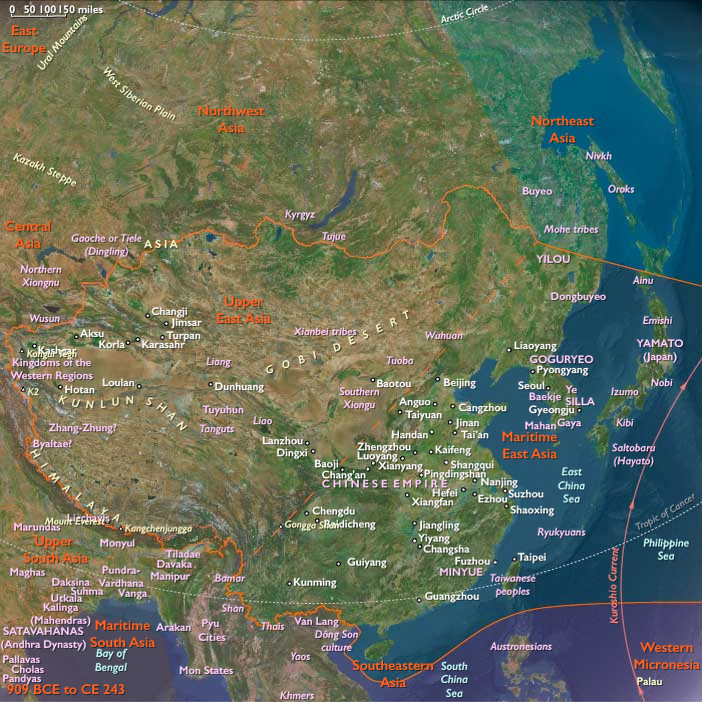
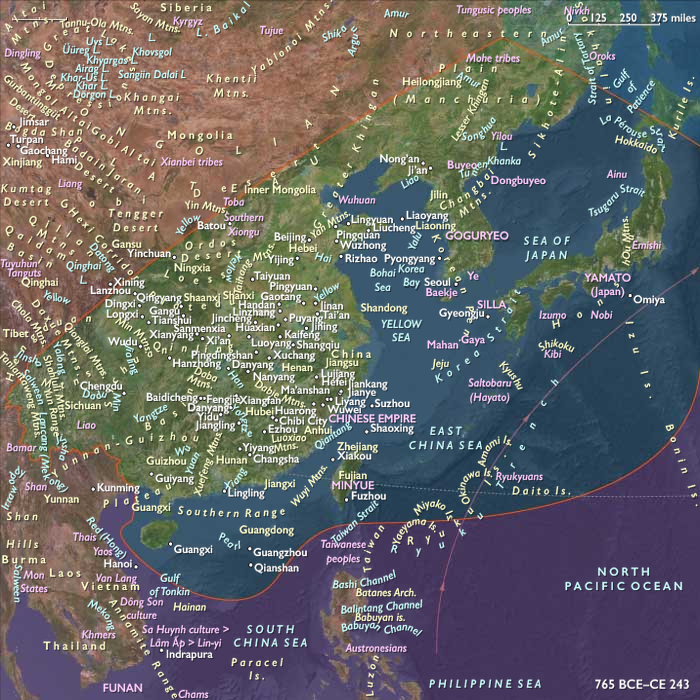
Chief minister Li Si’s death in 208 BCE deprives the new Qin ruler of invaluable counsel; the dynasty will soon collapse.
Locations
Groups
Topics
Commodoties
Subjects
Regions
Subregions
Related Events
Filter results
Showing 10 events out of 63598 total
Antiochus meets strong resistance at the frontier by the Bactrian cavalry.
Euthydemus, failing in his attempt to defend the line of the Arius (Harirud) River, had fallen back to his capital, Bactra (probably Balkh in northern Afghanistan), where he withstands a two-year siege.
Finally, Antiochus concludes a peace by which Euthydemus is to keep his kingdom while acknowledging Seleucid overlordship.
The Romans have meanwhile countered the moves of Philip V of Macedon by an alliance with the Greek cities of the Aetolian League, but Philip has effectively aided his allies.
The Romans in 207 withdraw their armies from Greece.
The neutral trading powers are still trying to arrange a peace.
Philip had met at Elateia with the same would be peacemakers from Egypt and Rhodes, who had been at the meeting in Heraclea, and again in the spring of 207 BCE, but to no avail.
Representatives of Egypt, Rhodes, Byzantium, Chios, Mytilene and perhaps Athens also meet again this spring with the Aetolians.
The war is going Philip's way, but the Aetolians, although now abandoned by both Pergamon and Rome, are not yet ready to make peace on Philip's terms.
Machanidas, Tyrant of Sparta, was originally, perhaps, the leader of a band of Tarentine mercenaries in the pay of the Spartan government.
The history of Lacedaemon at this period is so obscure that the means by which Machanidas obtained the tyranny are unknown.
He was probably at first associated with Pelops, son and successor of Lycurgus on the double throne of Sparta; but he eclipsed or expelled his colleague, and for his crimes and the terror he inspired he is termed emphatically "the tyrant." (tyrannus Lacedaemoniorum, Livy 27.29.9 )
Like his predecessor Lycurgus, Machanidas has no hereditary or plausible title to the crown, but, unlike him, he respects neither the ephors nor the laws, and rules by the swords of his mercenaries alone.
Argos and the Achaean League find him a restless and relentless neighbor, whom they cannot resist without the aid of Macedon.
Rome at this crisis, the eleventh year of the Second Punic War, is anxious to detain Philip V; and as usual, unscrupulous in the choice of its instruments, the republic employs him as an active and able ally.
Machanidas reveres the religious views of Greece as little as the political rights of his own subjects.
Towards the close of the Aetolian War, in 207 BCE, while the Greek states are negotiating the terms of peace, and the Eleans are making preparations for the next Olympic festival, Machanidas projects an inroad into the sacred territory of Elis.
The design is frustrated by the timely arrival of the king of Macedon in the Peloponnesus, and Machanidas withdraws precipitately to Sparta, but the project marks both the man and the era—an era equally void of personal, national, and ancestral faith.

Philopoemen, captain-general of the cavalry of the Achaean league, after eight months' careful preparation, in 207 BCE delivers Greece from Machanidas.
The Achaean and Lacedaemonian armies meet between Mantineia and Tegea.
Machanidas routs and chases from the field the mercenaries of Philopoemen.
They pursue, however, too eagerly and when Machanidas leads his men back to the battle the outnumbered Spartan infantry have been defeated and the Achaeans are strongly positioned behind a water-filled ditch.
Going back on to the attack, Machanidas is dismounted as he attempts to leap his horse over the ditch and is slain.
The Achaeans, allies of Macedonia, are victorious.
Hasdrubal, summoned to join his brother in Italy, had eluded Scipio by crossing the Pyrenees at their western extremity and safely made his way into Gaul in the winter of 208, waiting until the spring of 207 to make his way through the Alps and into Northern Italy.
Hasdrubal has made much faster progress than his brother had, partly due to the constructions left behind by Hannibal's army when he had passed via the same route a decade earlier, but also due to the removal of the Gallic threat that had plagued Hannibal during said expeditions.
The Gauls now fear and respect the Carthaginians, and not only is Hasdrubal allowed to pass through the Alps unmolested, his ranks are bolstered by many enthusiastic Gauls.
Hasdrubal, in the same fashion as his brother, succeeds in bringing his war elephants, raised and trained in Hispania.
It is not until Hasdrubal sends messengers to Hannibal that decisive measures are taken.
Hasdrubal wishes to meet with his brother in South Umbria, but this is not to be.
Hasdrubal's messengers are captured and he is ultimately checked by two Roman armies, and being forced to give battle is decisively defeated at the Battle of the Metaurus River.
The aid now essential to his brother’s Italian campaign is lost.
Hasdrubal himself dies bravely in the fight; he is beheaded, his head packed in a sack and thrown into his brother Hannibal's camp as a sign of his utter defeat, in stark contrast of Hannibal's treatment of the bodies of fallen Roman consuls.
Cato is among the select group who has accompanied the consul Gaius Claudius Nero on his northern march from Lucania with reinforcements to intercept Hasdrubal’s progress.
It is recorded that Cato’s services had contributed to the decisive victory.
The Qin, under Shi Huangdi, have from about 200 BCE enlisted huge levies of laborers for the construction of extensive canal irrigation facilities in central China, and also to fill the gaps in the northern frontier walls built by earlier states, thus creating the Great Wall of China along the Mongolian border in the far north. (Little of this wall remains. Since then, the Great Wall has on and off been rebuilt, maintained, enhanced; the majority of the existing wall will be reconstructed during the Ming Dynasty.)
Liu Bang (or Liu Qi), a peasant warrior, leads a successful rebellion in opposition to the totalitarian Qin’s heavy requisitions for the military and public works projects.
The authority of Shi Huangdi's successor collapses in 206 BCE, and central power shifts to Liu Bang.
Philip forces an independent settlement upon Aetolia in 206 BCE following the Roman withdrawal from Greece.
Scipio, after winning over a number of Hispanian chiefs (namely Indibilis and Mandonius), achieves a decisive victory in 206 BCE over the full Carthaginian levy at Ilipa (now the city of Alcalá del Río, near Hispalis, now called Seville), which results in the evacuation of Hispania by the Punic commanders.
After his rapid success in conquering Hispania, and with the idea of striking a blow at Carthage in Africa, Scipio pays a short visit to the Numidian princes Syphax and Massinissa.
Scipio, on his return to Hispania, has to quell a mutiny at Sucro that had broken out among his troops.
Hannibal's brother Hasdrubal had meanwhile marched for Italy and met his death, and in 206 BCE Scipio himself, having secured the Roman occupation of Hispania by the capture of Gades, gives up his command and returns to Rome.