
The Taiping rebels are led by Hong…
1840 CE to 1851 CE
Hong has formulated an eclectic ideology combining the ideals of pre-Confucian utopianism with Protestant beliefs.
He soon has a following in the thousands who are heavily anti-Manchu and anti-establishment.
Hong's followers have formed a military organization to protect against bandits and recruited troops not only among believers but also from among other armed peasant groups and secret societies.
In 1851 Hong Xiuquan and others launch an uprising in Guizhou Province.
Hong proclaims the Heavenly Kingdom of Great Peace (Taiping Tianguo, or Taiping for short) with himself as king.
The new order is to reconstitute a legendary ancient state in which the peasantry own and till the land in common; slavery, concubinage, arranged marriage, opium smoking, footbinding, judicial torture, and the worship of idols are all to be eliminated.
The Taiping tolerance of the esoteric rituals and quasi-religious societies of south China—themselves a threat to Qing stability—and their relentless attacks on Confucianism—still widely accepted as the moral foundation of Chinese behavior—contribute to the ultimate defeat of the rebellion.
Its advocacy of radical social reforms alienate the Han Chinese scholar-gentry class.
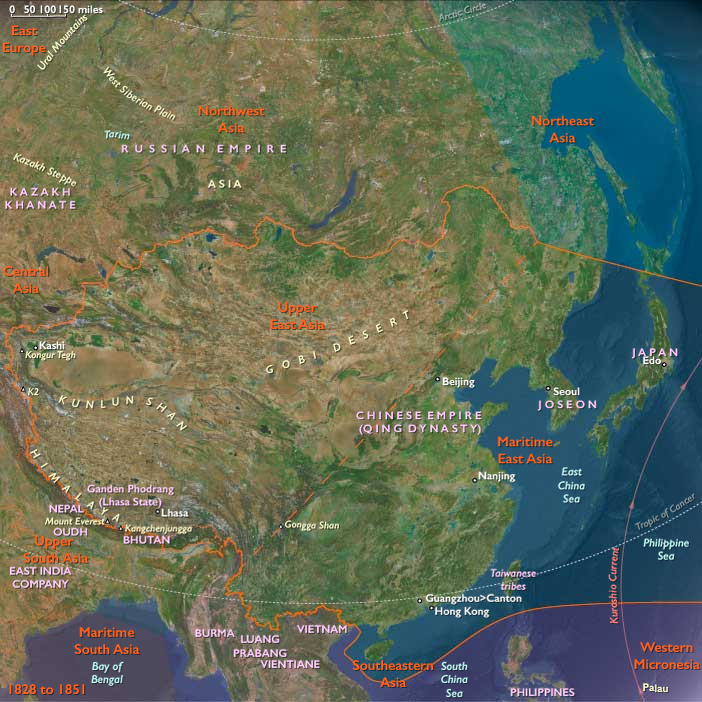
The Taiping army, although it has captured Nanjing and will drive as far north as Tianjin, will fails to establish stable base areas.
The movement's leaders will find themselves in a net of internal feuds, defections, and corruption.
Additionally, British and French forces, being more willing to deal with the weak Qing administration than contend with the uncertainties of a Taiping regime, come to the assistance of the imperial army.
Before the Chinese army succeeds in crushing the revolt, however, fourteen years will have passed, and well over thirty million people will have been reported killed.
People
Groups
Topics
Regions
East Asia
View →Subregions
