Civilis goes to Colonia Agrippina (Cologne) after …
Years: 70 - 70
February
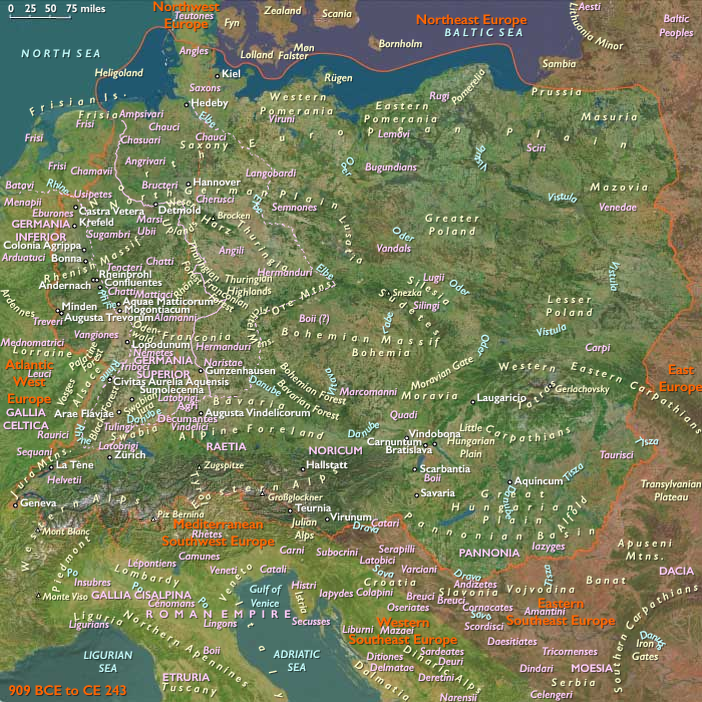
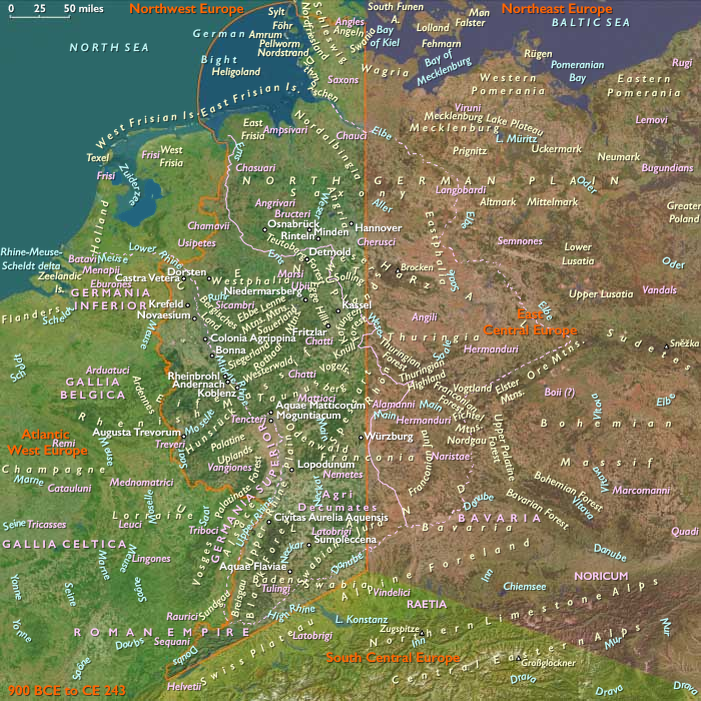
Civilis goes to Colonia Agrippina (Cologne) after this success, and sets up camp here.
He will invest his time in the coming months persuading other tribes from northern Gaul and Germania to join the rebellion.
Locations
People
Groups
- Lingones (Celtic tribe)
- Frisii (East Germanic tribe)
- Treveri (Gaulish tribe)
- Batavi (Germanic tribe)
- Bructeri (Germanic tribe)
- Roman Empire (Rome): Julio-Claudian dynasty
Topics
- Classical antiquity
- Pre-Roman Iron Age of Northern Europe
- Roman Age Optimum
- Pax Romana
- Batavi, Revolt of the
Commodoties
Subjects
Regions
Subregions
Related Events
Filter results
Showing 10 events out of 61606 total
Prince Ying of Chu—incidentally, the only son of Emperor Guangwu not born of either of his empresses but of Consort Xu—hires warlocks in 70 to create golden turtles and jade cranes, and carved characters calling for unusual blessings on them—a major taboo at this time.
Further, he is discovered to have written revolutionary writings.
Emperor Ming does not put him to death, but deposes him from his principality, exiles him, and makes him a commoner (but with a small fief of five hundred households).
Judaea's rebelliousness from 70 requires a governing Roman legate capable of commanding legions.
The rank of the provincial governor of Judaea is raised from procurator to legatus Augusti, signifying a change from equestrian to senatorial rank.
Caesarea Maritima, the governor's residence, becomes a Roman colony.
Saint Andrew in the Christian Bible is the earliest disciple of Jesus and one of the twelve Apostles.
The Gospel of John states that Andrew was a disciple of John the Baptist, whose testimony first led him, and another unnamed disciple of John the Baptist, commonly thought to be John the Evangelist to follow Jesus.[Jn. 1:35-40] Andrew at once recognized Jesus as the Messiah, and hastened to introduce him to his brother.[Jn. 1:41] Thenceforth, the two brothers were disciples of Christ.
On a subsequent occasion, prior to the final call to the Apostolate, they were called to a closer companionship, and then they left all things to follow Jesus.
In the gospels, Andrew is referred to as being present on some important occasions as one of the disciples more closely attached to Jesus, Andrew told Jesus about the boy with the loaves and fishes (John 6:8), with Philip told Jesus about the Greeks seeking Him (John 12:20), and was one of four (the others being Peter, James, and John) to hear Jesus' teaching about what would soon happen (Mark 13:3).
Eusebius quotes Origen as saying Andrew preached along the Black Sea as far as the Volga, Kiev and Novgorod.
Hence he became a patron saint of Ukraine, Romania and Russia.
According to tradition, he founded the See of Byzantium (Constantinople) in CE 38, installing Stachys as bishop.
According to Hippolytus of Rome, he preached in Thrace, and his presence in Byzantium is also mentioned in the apocryphal Acts of Andrew, written in the second century; Basil of Seleucia also knew of Apostle Andrew's mission in Thrace, as well as Scythia and Achaia.
This diocese would later develop into the Patriarchate of Constantinople.
Andrew is recognized as its patron saint.
Andrew is said to have been martyred by crucifixion at the city of Patras (Patræ) in Achaea, on the northern coast of the Peloponnese.
Early texts, such as the Acts of Andrew known to Gregory of Tours, describe Andrew as bound, not nailed, to a Latin cross of the kind on which Jesus is said to have been crucified; yet a tradition developed that Andrew had been crucified on a cross of the form called Crux decussata (X-shaped cross, or "saltire"), now commonly known as a "Saint Andrew's Cross"— supposedly at his own request, as he deemed himself unworthy to be crucified on the same type of cross as Jesus had been.
The district known as Sequania had formed part of Belgica under Augustus..
After the death of Vitellius, the inhabitants refuse to join the Gallic revolt against Rome instigated by Gaius Julius Civilis and Julius Sabinus, and drive back Sabinus, who has invaded their territory.
A triumphal arch at Vesontio (Besançon), which in return for this service is made a colony, possibly commemorates this victory.
The civil war has officially ended but a state of anarchy and lawlessness pervades in the first days following the demise of Vitellius.
In early 70, Vespasian is still in Egypt, the source of Rome's grain supply, and has not yet left for Rome.
According to Tacitus, his trip was delayed due to bad weather.
Modern historians theorize that Vespasian had been and was continuing to consolidate support from the Egyptians before departing.
Stories of a divine Vespasian healing people circulate in Egypt.
During this period, protests erupt in Alexandria over his new tax policies and grain shipments are held up.
Vespasian eventually restores order and grain shipments to Rome resume.
In the short-term, administration of the empire has been given to Mucianus, who soon restores order, aided by Vespasian's younger son, Domitian.
Like his elder brother Titus, Domitian, who acts as the representative of the Flavian family in the Roman Senate, receives the title of Caesar and is appointed praetor with consular power.
Tacitus describes Domitian's first speech in the Senate as brief and measured, at the same time noting his ability to elude awkward questions.
Domitian's authority is merely nominal, however, foreshadowing what is to be his role for at least ten more years.
By all accounts, Mucianus holds the real power in Vespasian's absence and he is careful to ensure that Domitian, still only eighteen years old, does not overstep the boundaries of his function.
Strict control is also maintained over the young Caesar's entourage, promoting away Flavian generals such as Arrius Varus and Antonius Primus and replacing them by more reliable men such as Arrecinus Clemens.
Mucianus starts off Vespasian's rule with tax reform that is to restore the empire's finances.
After Vespasian arrives in Rome in mid-70, Mucianus continues to press Vespasian to collect as many taxes as possible.
On arrival, Vespasian immediately embarks on a series of efforts to stay in power and prevent future revolts.
He offers gifts to many in the military and much of the public.
Soldiers loyal to Vitellius are dismissed or punished.
He also restructures the Senatorial and Equestrian orders, removing his enemies and adding his allies.
Regional autonomy of Greek provinces is repealed.
Additionally, he makes significant attempts to control public perception of his rule.
With the return of Vespasian in late September, Domitian’s political role is rendered all but obsolete and Domitian withdraws from government, devoting his time to arts and literature.
Vespasian and Mucianus renew old taxes and institute new ones, increase the tribute of the provinces, and keep a watchful eye upon the treasury officials.
The Latin proverb "Pecunia non olent" ("Money does not smell") may have been created when he introduced a urine tax on public toilets.
By his own example of simplicity of life—he causes something of a scandal when it is made known he takes his own boots off—he initiates a marked improvement in the general tone of society in many respects.
In addition to the uprising in Egypt, unrest and civil war continue in the rest of the empire in 70.
In Judea, where rebellion has continued from 66, Vespasian's son, Titus, finally subdues the rebellion with the capture of Jerusalem and destruction of the Jewish Temple in 70.
According to Eusebius, Vespasian then ordered all descendants of the royal line of David to be hunted down, causing the Jews to be persecuted from province to province.
Several modern historians have suggested that Vespasian, already having been told by Josephus that he was prophesied to become emperor while in Judaea, was probably reacting to other widely known Messianic prophecies circulating at the time, to suppress any rival claimants arising from that dynasty.
An edict issued in about 70 by Vespasian forces Roman property owners to rebuild fire-damaged structures under penalty of confiscation.

The year 70 begins with the odds favoring the rebels.
Two legions are still besieged at Castra Vetera and the rest of the Roman army is not large enough to cope with the revolt.
Julius Classicus and Julius Tutor, leaders of the Treveri who, like Civilis, are Roman citizens, early in 70 join the revolt.
The Roman garrisons near the Rhine are driven out, and twenty-four ships captured.
The Roman garrison at Novaesium (now Neuss) surrenders without a fight.
The Trevirans and Lingones, apart from the Batavian rebellion, have declared the independence of Gaul.
Julius Sabinus, the rebel emperor, manages to persuade the I Germanica and XVI Gallica to come over to his side.
The situation at Castra Vetera is desperate.
Food supplies have run out and the besieged legions are eating horses and mules to survive.
With no prospect of a relief, the commander of the troops, Munius Lupercus, decides to surrender.
The legions are promised safe conduct if they leave the camp to be sacked by the rebels.
All weapons, artillery material and gold is left to plunder.
V Alaudae and XV Primigenia march out of the camp but after only a few kilometers they are ambushed by Germanic troops and destroyed.
The commander and principal officers are made slaves and given as a present to Veleda, the prophetess who had predicted the rise of the Batavians.
Later, when the praetorian trireme is captured, it is rowed upriver on the Lippe as a gift to Veleda.
Eight cohorts of Batavian veterans join their countrymen, and the troops sent by Vespasian to the relief of Vetera throw in their lot with them.
The Revolt of Julius Sabinus (69 CE): A Failed Bid for the Throne of Gaul
During the chaotic Year of the Four Emperors (69 CE), Julius Sabinus, a Gallic nobleman, sought to exploit Rome’s instability by declaring himself Emperor of Gaul. His rebellion in Gallia Belgica was inspired by the ongoing Batavian Revolt on the Rhine, but it was poorly organized and quickly crushed.
Sabinus’ Claim to Power and the Revolt
- Sabinus claimed descent from Julius Caesar, hoping this would legitimize his rule over Gaul.
- He declared himself Emperor, attempting to rally Gallic support for independence from Rome.
- However, his forces were badly organized and lacked military strength.
- The Sequani, a tribe still loyal to Rome, easily defeated his rebellion before it gained momentum.
Sabinus' Faked Death and Escape
- Facing certain execution, Sabinus devised an elaborate escape plan.
- He told his servants he would commit suicide, then burned down the villa he was staying in to make it appear he had perished.
- Instead of dying, he hid in a cellar, known only to his wife, Epponina, and a few loyal servants.
- This ruse allowed him to evade Roman authorities, but his time in hiding was not permanent.
Aftermath and Legacy
- Julius Sabinus’ rebellion failed to inspire wider support, unlike the Batavian Revolt led by Julius Civilis.
- His story, however, became legendary, particularly because of the devotion of his wife, Epponina, who remained by his side.
- Eventually, after nine years in hiding, Sabinus was discovered, captured, and executed by Emperor Vespasian.
- Epponina’s loyalty to her husband became a romanticized tale of devotion in later Roman accounts.
The failed uprising of Julius Sabinus demonstrated that not all revolts against Rome found widespread backing, especially when local tribal elites still favored Roman rule. His dramatic escape and tragic end, however, ensured that his name would be remembered in Roman history.
Years: 70 - 70
February
Locations
People
Groups
- Lingones (Celtic tribe)
- Frisii (East Germanic tribe)
- Treveri (Gaulish tribe)
- Batavi (Germanic tribe)
- Bructeri (Germanic tribe)
- Roman Empire (Rome): Julio-Claudian dynasty
Topics
- Classical antiquity
- Pre-Roman Iron Age of Northern Europe
- Roman Age Optimum
- Pax Romana
- Batavi, Revolt of the