
Renoir, on his journey to Italy, had…
July 1882 CE
Renoir, on his journey to Italy, had discovered Raphael and the hallmarks of classicism: the beauty of drawing, the purity of a clear line to define a form, and the expressive force of smooth painting when used to enhance the suppleness and modeling of a body.
At this same time, he happened to read Il libro dell'arte (1437; A Treatise on Painting) by Cennino Cennini, which had reinforced his new ideas.
On his return from Italy, Renoir had stayed with Paul Cézanne and worked at L'Estaque.
He had contracted pneumonia and recuperated in Algeria.
The Salon accepts one of his portraits.
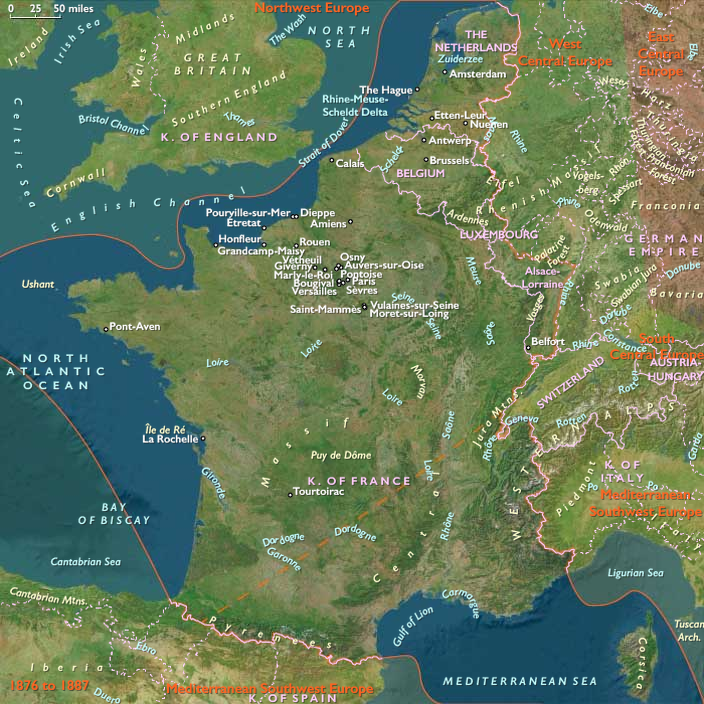
During the summer he visits Monet at Pourville.
Renoir's several trips to Algeria, Italy, and Provence will eventually have a considerable effect on his art and on his life.
He becomes convinced that the systematic use of the Impressionistic technique is no longer sufficient for him and that small brushstrokes of contrasting colors placed side by side do not allow him to convey the satiny effects of the skin.
He also discovers that black does not deserve the opprobrium given to it by his comrades and that, in certain cases, it has a striking effect and gives a great intensity to the other colors.
All of these revelations are so powerful and unexpected that they provoke a crisis, and he is tempted to break with Impressionism, which he has already begun to doubt.
He feels that until now he has been mistaken in pursuing the ephemeral in art.
Images

Pierre-Auguste Renoir: Young Woman with a Bun in Her Hair (1882) oil on canvas; Private Collection
Subjects
Regions
West Europe
View →Subregions
