
Conrad of Monferrat, following his family's alliance …
Years: 1187 - 1187
July
Conrad of Monferrat, following his family's alliance with Manuel I Komnenos, had in 1179 led an army against Frederick Barbarossa's forces, then commanded by the imperial Chancellor, Archbishop Christian of Mainz.
He had defeated them at Camerino in September, taking the Chancellor hostage.
(He had previously been a hostage of the Chancellor.)
Leaving the captive in his brother Boniface's care, he had gone to Constantinople to be rewarded by the Emperor, returning to Italy shortly after Manuel's death in 1180.
Then in his mid-thirties, his personality and good looks had made a striking impression at the imperial court.
Isaac II Angelus had in the winter of 1186–1187 offered his sister Theodora as a bride to Conrad's younger brother Boniface, to renew the imperial family’s alliance with Montferrat, but Boniface is married.
Conrad, recently widowed, had taken the cross, intending to join his father in the Kingdom of Jerusalem; instead, he accepts Isaac's offer and returns o Constantinople in spring 1187.
On his marriage, he is awarded the rank of Caesar.
However, almost immediately, he has to help the Emperor defend his throne against a revolt, led by General Alexios Branas, who is doubly linked to the imperial Komnenos family.
He is the son of Michael Branas and of Maria Komnene, who was the great-niece of Alexios I Komnenos.
He himself had married Anna Vatatzaina, the niece of Manuel I Komnenos, and her sister, Theodora, had been Manuel's lover.
Branas is one of relatively few generals who had never rebelled against Andronikos I Komnenos, who had rewarded his loyalty by raising him to the exalted rank of protosebastos.
Branas had led several successful campaigns on his behalf, against the forces of Béla III of Hungary in 1183, against a rebellion led by Andronikos, Isaac and Alexios Angelos in 1184, and against the Norman invaders under William II of Sicily in 1185 (Battle of Demetritzes).
Shortly after the accession of Isaac II Angelos, Branas is in 1187 sent to counter the Vlach-Bulgarian Rebellion.
This time he does rebel, but is defeated by Conrad of Montferrat, the emperor's brother-in-law, who commands the center of the imperial forces in the battle.
Branas wounds Conrad slightly in the shoulder, who nevertheless unhorses him, his lance striking the cheekpiece of his helmet.
Branas is then beheaded by Conrad's supporting foot soldiers.
The head is taken to the imperial palace, where it is treated like a football, and is then sent to Branas's wife Anna, who (according to the historian Niketas Choniates) reacts bravely to the shocking sight.
However, Conrad, feeling that his service had been insufficiently rewarded, wary of Constantinople’s anti-Latin sentiment (his youngest brother Renier had been murdered in 1182) and of possible vengeance-seeking by Branas's family, sets off for the Kingdom of Jerusalem in July 1187 aboard a Genoese merchant vessel.
Locations
People
- Alexios Branas
- Conrad of Montferrat
- Isaac II Angelos
- Ivan Asen I of Bulgaria
- Peter IV of Bulgaria
- William II of Sicily
Groups
- Greeks, Medieval (Byzantines)
- Genoa, (Most Serene) Republic of
- Jerusalem, Latin Kingdom of
- Italo-Normans
- Sicily, Kingdom of
- Roman Empire, Eastern: Angelid dynasty
Topics
Commodoties
Subjects
Regions
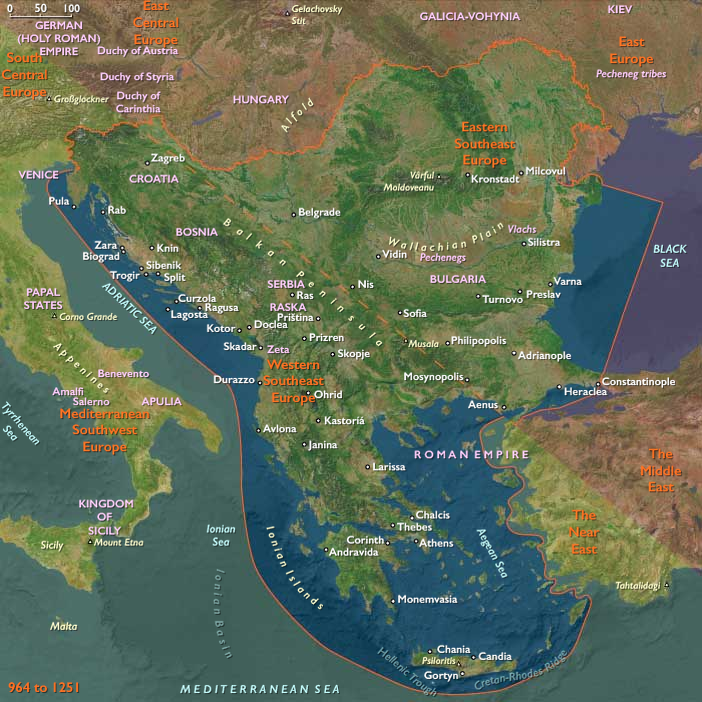
Subregions
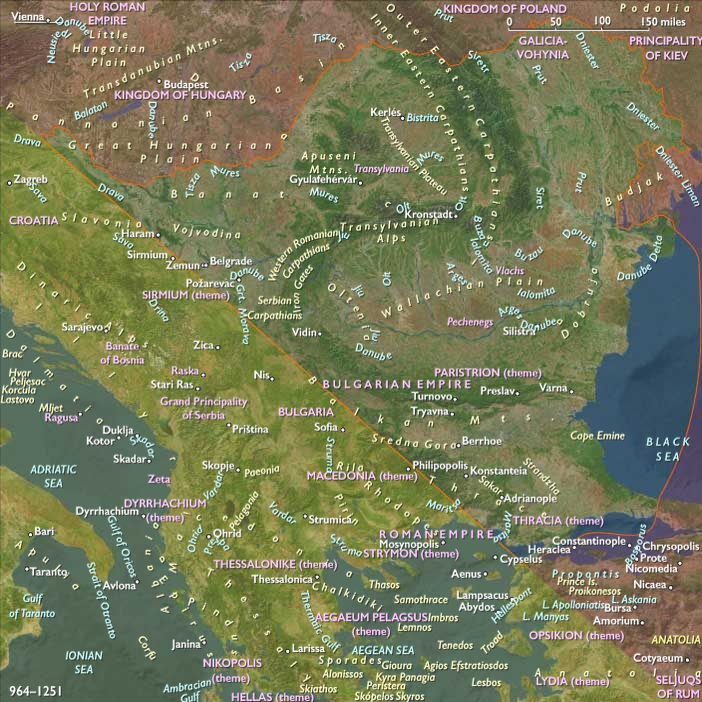
Related Events
Showing 10 events out of 48030 total
Years: 1187 - 1187
July
Locations
People
- Alexios Branas
- Conrad of Montferrat
- Isaac II Angelos
- Ivan Asen I of Bulgaria
- Peter IV of Bulgaria
- William II of Sicily
Groups
- Greeks, Medieval (Byzantines)
- Genoa, (Most Serene) Republic of
- Jerusalem, Latin Kingdom of
- Italo-Normans
- Sicily, Kingdom of
- Roman Empire, Eastern: Angelid dynasty
Topics
Commodoties
Subjects
Regions
Subregions