
Constantine promulgates laws in 326 against the…
326 CE
Constantine promulgates laws in 326 against the prostitution of maidservants, and for the humanization of prisons.
People
Groups
Topics
Regions
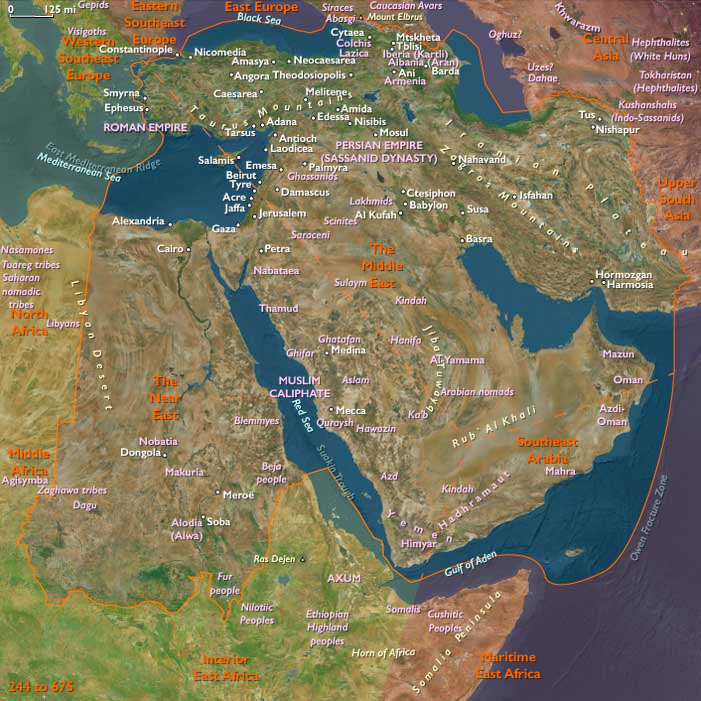
The Near and Middle East
View →Subregions
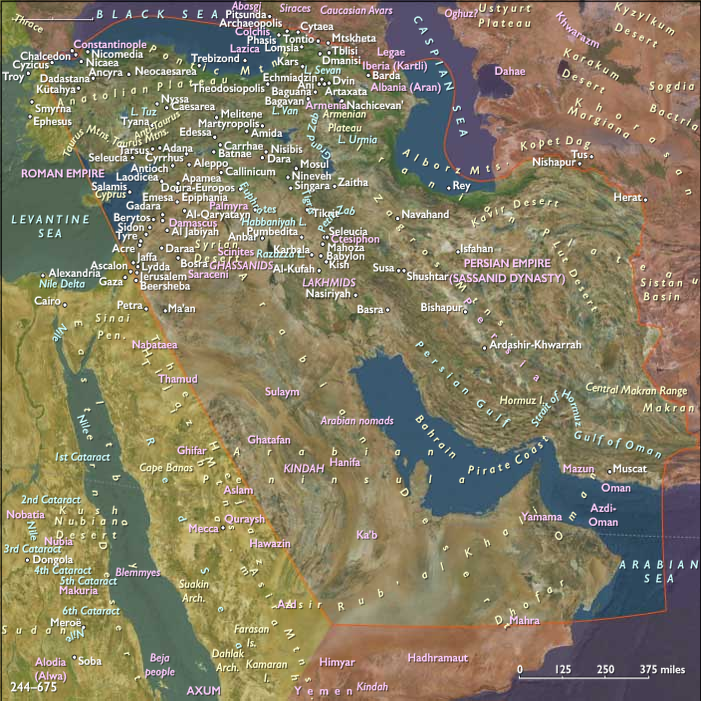
Middle East
View →Related Events
Showing 10 events out of 141 total
The rebellion of Jin Dynasty general Su Jun against Emperor Cheng's regent Yu Liang is initially successful, allowing him to take over the imperial government.
Su Jun, whose rebellion against Emperor Cheng's regent Yu Liang had been successful initially, had eventually been defeated by Tao Kan and Wen Jiao's forces and killed in battle in late 328.
His forces try to coalesce behind his brother Su Yi, but collapse in early 329.
The disturbance Su Jun had created has greatly weakened the Jin regime, which for decades will have no ability to fight back against the rival Later Zhao state.
Han Zhao lasts until 329, when Shi Le defeats Liu Yao at the river Luo.
Liu Yao is captured and executed; his sons succumb to the follow-up military advance.
Shi Hu moves the capital of Later Zhao to Yecheng (in modern Handan, Hebei) in 335.
Here it will remain for the rest of the state's history (except for Shi Zhi's brief attempt to revive the state at Xiangguo).
Murong Huang and his son Murong Jun, who initially claim the Jin Dynasty-created title "Prince of Yan," establish Former Yan, a state of Xianbei ethnicity, in 337.
Li Shou, cousin to Cheng Han's founding emperor Li Xiong, overthrows Li Xiong's son Li Qi in 338, disassociates himself from Li Xiong's regime by renaming the state from Cheng to Han, and sets up a different imperial ancestral temple.
(Traditional historians did not consider his regime a separate state, however, and treated the succession from Li Xiong to Li Shou's son Li Shi as a single Cheng Han state.)
Tensions are high in China following the fall of the ethnically Jie Later Zhao regime in 350 by the Chinese state of Ran Wei.
The Jie people, who had formed the Later Zhao Dynasty, do not accept Ran Min's rule and rise against him, and are joined in this by many other Wu Hu nations.
The resulting war is a decisive victory for Ran Min, who then proceeds to issue his famous "extermination order," which results in the extermination of virtually all of the Jie and most of the Wu Hu.
Goguryeo's expansion meets temporary setbacks when in 342, Former Yan, a Sixteen Kingdoms state of Xianbei ethnicity, attacks Goguryeo’s capital, now at Wandu (in modern Ji'an, Jilin).
Xianbei leader Murong Huang, knowing that he cannot hold the Goguryeo territory, takes Gao Zhao's mother and the body of Gao Zhao's father Gao Yifuli back to Longcheng as collateral for Gao Zhao's submission.
Gao Zhao offers a tribute in 343 and offers to be a vassal.
Murong Huang returns his father's body but keeps his mother as hostage.
Struggles within the Jie Later Zhao regime had resulted in the benefit of Ran Min, who by 350 CE has taken over the regime and massacred the entire ruling Shi family, with the exception of one cousin of Shi Jian, the last emperor of Later Zhao, who leads an uprising against him, beginning the Wei–Jie war.
Shi Jian's cousin, Shi Zhi, had been a Later Zhao general at Xiangguo.
On hearing that Ran Min had massacred the Shi family and declared himself emperor, Shi Zhi had raised a rebellion against Ran Min.
He is quickly joined by several other Later Zhao border armies, mostly composed of Jie soldiers and who despise Ran Min's rule, as well as many other Wu Hu nations.
When he hears of the Jie revolt against him, Ran Min issues his famous "extermination order", in which he calls on the Chinese to kill all the Wu Hu who had conquered them half a century earlier.
The effect is immense; some two hundred thousand Jie are killed in Yecheng (the Wei capital) in a few days, and brutal fighting breaks out between Chinese and Wu Hu throughout North China.
Meanwhile, Ran Min's army meets the main rebel forces under Shi Zhi and defeats them at the Battle of Yecheng.
In spring 351, Ran Min besieges Shi Zhi's capital Xiangguo.
Shi Zhi seeks aid from Former Yan's prince Murong Jun and is able to deal Ran a major defeat.
At this time, the Xiongnu soldiers in Yecheng rebel, capture his son Ran Yin, and surrender to Shi Zhi, who executes Ran Yin.
Ran Min is thought to be dead, but when he appears in Yecheng, the city is calmed.
Shi Zhi has his general Liu Xian besiege Yecheng, but Ran Min defeats Liu in battle and awes him so much that Liu agrees that once he returns to Xiangguo, he will kill Shi Zhi and surrender.
He does so and sends Shi Zhi's head to Ran Min, and Ran Min has Shi Zhi's head burned on a busy street in Yecheng.
Later Zhao is at its final end.
The city of Xiangguo is burned, and its population moved to Yecheng.
Following the victory at Xiangguo, Ran Min's forces proceed northwards and defeat two Later Zhao border armies.
Wherever he capture territory from the rebels, Ran Min's forces massacre any Wu Hu living there, burying them in large pits.
Some one hundred thousand are reputedly killed in this way.
Thousands of Wu Hu flee China or are killed.