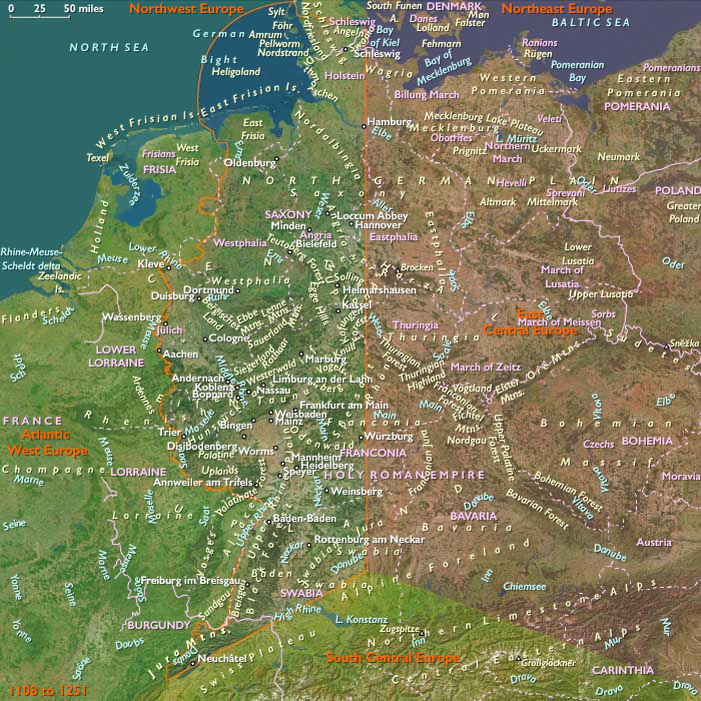
Construction begins in 1211 on the Cathedral …
Years: 1211 - 1211
Construction begins in 1211 on the Cathedral of Limburg an der Lahn, whose four-story elevation is planned in emulation of the Cathedral of Laon.
When complete, the Limburger Dom is to be one of the most fully realized iterations of Late Romanesque architecture.
Locations
Groups
Topics
Subjects
Regions
Subregions
Related Events
Filter results
Showing 10 events out of 47436 total
Tensions between the Jin and the Mongols had begun to escalate and Genghis Khan declares war with the Jin.
The Jin government had provided Mongol leader Genghis Khan with an excuse to invade when, in 1210, it orders him to do homage to a new Jin ruler.
Refusing, the khan has mobilized his forces, ordering Öngüd raids on the northern Jin borders.
Many members of the Öngüd, or Öngüt, a Turkic tribe active in Mongolia around the time of Genghis Khan, are Nestorian Christians.
They live in an area lining the Chinese Great Wall, in the northern part of the Ordos and territories to the northeast of it.
They apparently have two capitals, a northern one at the ruin known as Olon Sume and the another a bit to the south at a place called Koshang or Dongsheng.
They act as wardens of the marches for the Chinese Empire to the north of the province of Shanxi.
The ancestors of the Ongud were the Shatuo Turks of the Western Göktürk Khaganate.
In the seventh century, they had moved to eastern Xinjiang under the protection of the Tang Dynasty.
By the ninth century, the Shatuo were scattered over North China and modern Inner Mongolia.
A Shatuo warlord, Li, had mobilized ten thousand Shatuo cavalrymen and served the Tang as ally.
In 923, his son had defeated the rebellious dynasty and become emperor of the Later Tang Dynasty.
After the overthrow of the Li family, the Shato commanders had established the Later Jin Dynasty, the Later Han Dynasty and the Northern Han.
When the Jin Dynasty conquered North China in the twelfth century, the Shatuo were called "White Tatars".
The Jin had recruited them as auxiliaries and made them guards of the Jin frontier.
The Mongols call them Onggud (Wall or Western).
The Onguds might have been converted to Christianity by the Uyghurs.
The Öngüd chief Alakush tegin had revealed the Naiman plan to attack Genghis Khan in 1205 and had allied with the Mongols.
Genghis Khan, having earlier won over both the Turkish Öngüds, or Öngüts, and the Khitan Mongols of northern China, benefits from the Öngüd location on the Jin’s northern border and the Khitans’ desire for revenge against those who had displaced them.
Genghis Khan conducts raids deep into the areas south of the Great Wall in 1211.
Using information from captured Jin engineers knowledgeable in siege craft, he develops a plan to divide his armies and make a three-pronged attack into Liaoning and Hebei.
When Genghis invades the Jin Dynasty, Alakush tegin supports him; the khan bestows his daughter Alaqai beki on his son.

The Idiquts, the title of the Kara-Khoja rulers, had ruled independently until the 1120s, when they submitted to the Kara-Khitan Khanate, then continued from 1209 as vassal rulers under the Mongols.
The Uyghur Idiqut ruler, Barchukh, voluntarily submits in 1211 to Genghis Khan and is given his daughter, Altani.
Corruption has risen to new heights during Xiangzong's reign, and the peasants are mired in poverty.
The Western Xia army is also untrained and ill-equipped.
Xiangzong abdicates after his nephew Lǐ Zūnxū stages a coup d'état and seizes power as Emperor Shenzong; Xiangzong dies a month later in the same year, 1211.
Shenzong continues his predecessor's policy of invading the Jin Empire.
The first German colonists (the future Transylvanian Saxon community) arrive in Transylvania, following grants by Andrew II of Hungary.
The Teutonic Knights, under the leadership of the grand master Hermann von Salza, begin transferring their main center of activity from the Holy Land to eastern Europe.
The order's first European enterprise starts in Hungary in 1211, when King Andrew II invites a group of the Teutonic Knights to protect his Transylvanian borderland against the Cumans by colonizing it and by converting its people to Christianity.
The Knights establish Kronstadt (modern Brasov), a city in the region of present central Romania on the northern slope of the Transylvanian Alps, in 1211.
Latin emperor Henry, having defeated the Bulgarians in Europe between 1209 and 1211, holds the forces of Theodore Lascaris at bay.
Aram Shah had succeeded Aibak, who has spent his short reign maintaining control over his kingdom rather than expanding it.
An elite group of forty nobles named Chihalgani ("the Forty") conspire against Aram Shah and invite Shams-ud-din Iltutmish, Governor of Badaun, to replace Aram.
Iltutmish defeats Aram in the plain of Jud near Delhi in 1211.
Aram’s ultimate fate is unknown.
Iltutmish establishes Delhi as the primary capital and …
…Ghur (modern Ghowr, Afghanistan) as the Ghurids’ secondary capital.
Iltutmish has inherited his predecessors’ rivalry for control, as well as the ongoing conflict of the Ghurids with the Khwarezm-shah dynasty over authority in Khwarezm.
King Peter II of Aragon (and, as Peter I, Count of Barcelona), had responded to Pope Innocent III’s call for a crusade against the heretics in southern France by dispatching Christian crusaders into Aragonese-held Provence, where Albigensian heretics had garnered a large following.
With Montfort having turned the crusade into a political war to end the independence of the southern French nobles, Peter endeavors to placate the northern crusaders by arranging a marriage between his son James, now three years old, and Simon's daughter.
He entrusts the boy to be educated in Montfort's care in 1211.
The Almohads had taken important cities as Trujillo, Plasencia, Talavera, Cuenca and Uclés after the defeating Alfonso VIII of Castile in 1195 in the so-called Disaster of Alarcos.
Muhammad An-Nâsir, who had succeeded his father, Abû Yûsuf Ya'qûb al-Mansûr, as Almohad caliph in 1198, has inherited an empire that is showing signs of instability.
Because of his father's victories against the Christians in al-Andalus), an-Nasir had been temporarily relieved from serious threats on that front and able to concentrate on combating and defeating attempts by the Banu Ghaniya to seize Ifriqiya (Tunisia).
Needing, after this, to deal with problems elsewhere in the empire, an-Nasir had appointed Abû Muhammad ben Abî Hafs as governor of Ifriqiya, thus unwittingly inaugurating the rule of the Hafsid dynasty here, which is to last until 1574.
He now has to turn his attention back to Iberia to deal with the crusade proclaimed by Pope Innocent III.