The Franco-Angevin Invasion of Normandy and the…
1054 CE
The Franco-Angevin Invasion of Normandy and the Battle of Mortemer (1054)
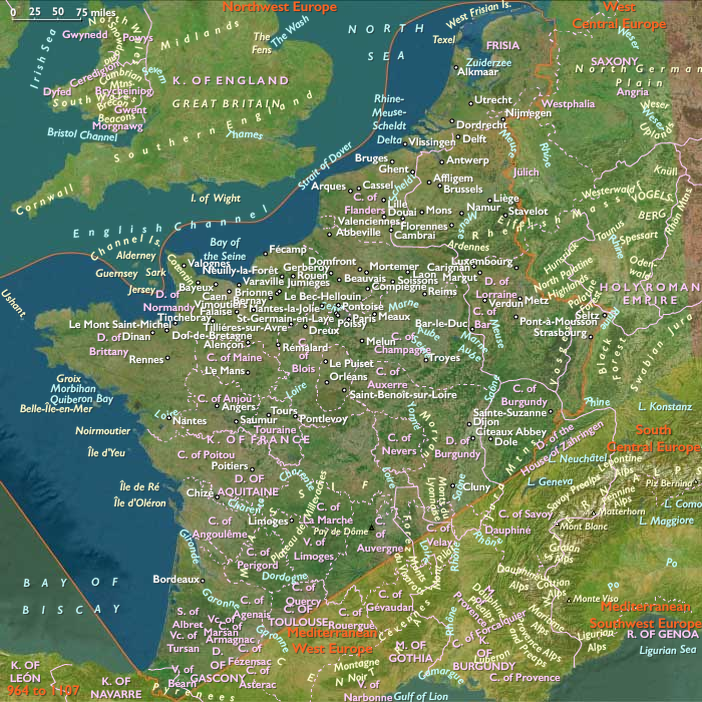
By early 1054, King Henry I of France and Count Geoffrey Martel of Anjou had renewed their war against Duke William of Normandy, launching a coordinated two-pronged invasion down the Seine and through eastern Normandy. Despite their numerical superiority, the invasion ended in disaster, with William’s forces securing a decisive victory at the Battle of Mortemer, forcing the French and Angevin armies into retreat. This battle marked another crucial turning point in William’s consolidation of power in Normandy.
The Invasion of Normandy (January–February 1054)
- King Henry I and Count Geoffrey Martel jointly invaded Normandy, advancing down the Seine toward Rouen.
- Henry divided his forces into two wings:
- One force, under his personal command, advanced down the Seine River toward Rouen.
- The other, commanded by Henry’s brother Odo, was sent through eastern Normandy, accompanied by:
- Count Reginald of Clermont
- Count Ralph of Montdidier
- Guy I, Count of Ponthieu, who had succeeded his late brother, Enguerrand II.
William’s Defensive Strategy
- William also divided his forces:
- He personally led an army against King Henry in the Seine Valley, ensuring the defense of Rouen.
- A second force, led by his loyal barons, faced the French-Ponthievin army in eastern Normandy.
This second force included some of William’s firmest supporters, such as:
- Robert, Count of Eu
- Walter Giffard
- Roger of Mortemer
- William de Warenne
The Battle of Mortemer (February 1054)
- The Franco-Ponthievin army in eastern Normandy proved to be undisciplined and fragmented, engaging in widespread plundering instead of maintaining military cohesion.
- William’s second force struck while the French-Ponthievin troops were disorganized, inflicting a crushing defeat on the invaders.
- Guy I of Ponthieu’s younger brother, Waleran, was mortally wounded, while Guy himself was captured.
Aftermath: The French Retreat and William’s Political Gains
- Upon learning of the disaster at Mortemer, King Henry panicked and ordered a hasty retreat out of Normandy, abandoning the invasion.
- Count Geoffrey Martel of Anjou, seeing the campaign collapse, withdrew alongside the French forces.
- Guy of Ponthieu remained William’s prisoner for two years, during which time his uncle, Bishop Guy of Amiens, ruled Ponthieu as regent.
- After his release, Guy I of Ponthieu became a vassal of William, marking another major political victory for the Norman duke.
The Deposition of Archbishop Mauger of Rouen
- With William’s authority strengthened, his ecclesiastical supporters seized the opportunity to depose Mauger, the Archbishop of Rouen, who had long been an opponent of the duke.
- This further consolidated William’s control over the Church in Normandy, eliminating another internal threat to his rule.
Significance and Legacy
- The Battle of Mortemer decisively ended the 1054 invasion, proving William’s ability to outmaneuver and defeat superior forces.
- The capture of Guy I of Ponthieu secured William’s influence over Ponthieu, a key coastal territory that would later aid his English ambitions.
- With the removal of Archbishop Mauger, William also reinforced his control over the Norman Church, ensuring loyal clerical support.
- However, his conflict with King Henry I and Count Geoffrey Martel would continue, with further wars lasting until 1060.
The Battle of Mortemer (1054) was a crucial milestone in William’s rise to power, demonstrating his military skill, political cunning, and ability to neutralize internal and external threats, all of which would later contribute to his successful conquest of England in 1066.
Locations
People
Groups
Regions
West Europe
View →Subregions