
Crassus has meanwhile begun his attempt to …
Years: 53BCE - 53BCE
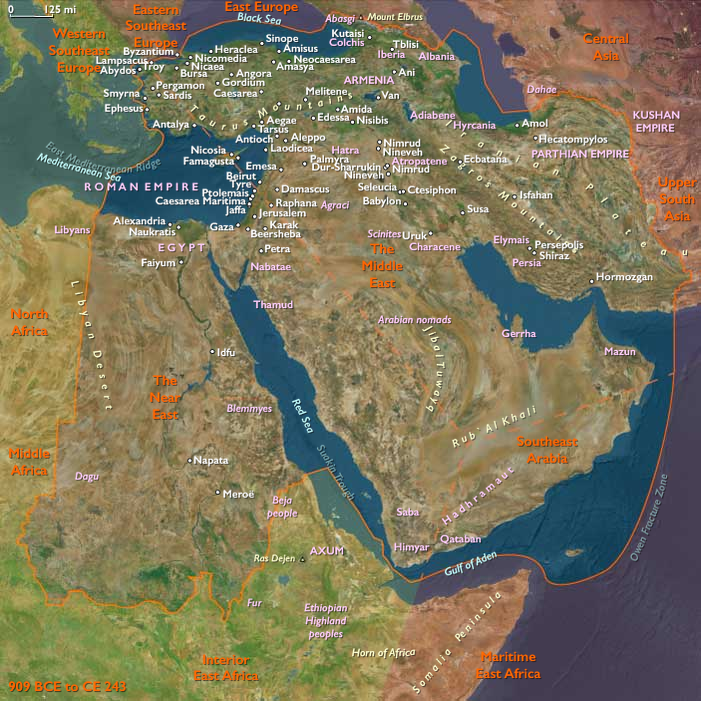
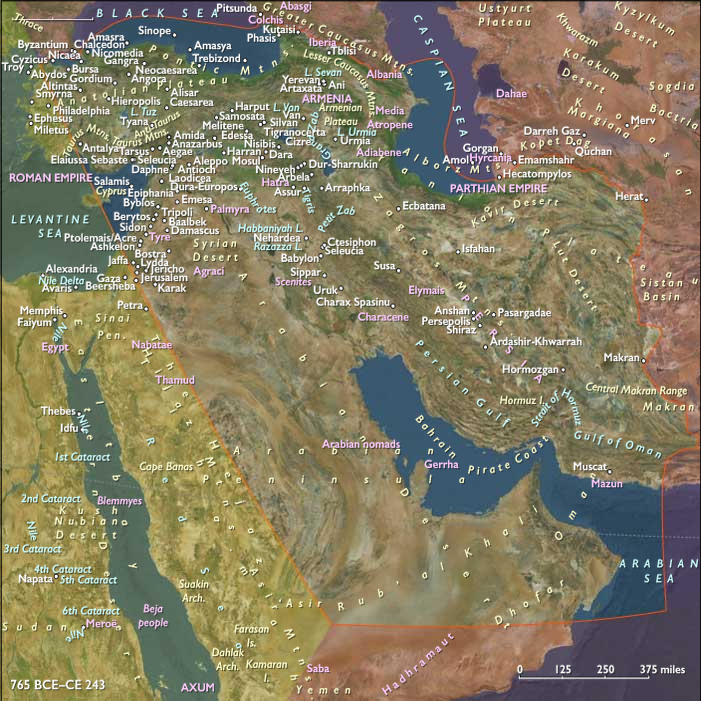
Crassus has meanwhile begun his attempt to conquer the east: the Romans in 53 BCE advance on the western Arsacid vassalaries.
Orodes II in response sends his cavalry units under Surenas to combat them.
Gaius Cassius Longinus' first office is as quaestor under Crassus in 53 BCE, an office in which he proves himself to have a capable military mind.
He has traveled with Crassus to the province of Syria, and attempts to dissuade him from attacking the Parthians, suggesting that they secure a base at the Euphrates.
Ignoring Cassius, Crassu leads the army into the Battle of Carrhae, during which he also ignores Cassius' plans for strengthening the Roman line.
The result is the most famous Roman rout since the Second Punic War.
Crassus, learning that Surenas (i.e., “the Suren”) is in the desert east of the Euphrates River, leaves the cover of the river and strikes out toward Carrhae.
(Some later historians will condemn this move as rash, but, because Seleucia on the Tigris is Crassus' ultimate objective, he must at some time cross open country.)
Suddenly the Parthians are upon him, with a force of about a thousand armored knights and nearly ten thousand horse archers.
His troops, though superior in numbers, are neither acclimatized nor adapted to desert warfare.
While his son Publius launches an unsuccessful covering attack with his cavalry, the main Roman forces form a square against the encircling Parthians and attempt unsuccessfully to cover both body and head with their shields against the showers of Parthian arrows.
Surenas' provision of a corps of one thousand Arabian camels, one for every ten men, enable the Parthians to retire by sections and replenish their quivers.
Crassus, lacking provisions, is compelled by his demoralized men to negotiate but is cut down by the Parthians in the attempt.
About ten thousand Romans escape, but the rest of Crassus' men are either captured or killed.
Cassius manages to save the remnants of the army with the help of Crassus' legate, Gaius Octavius.
The army in turn tries to make Cassius its new commander, but he refuses out of loyalty to Crassus.
Crassus is killed by Parthian forces after treacherous guides lead him astray during the retreat from Carrhae, but Cassius manages to escape with five hundred and nine cavalry and meet up with the surviving legionaries.
The Parthians have dealt a stunning blow to Roman prestige in the East, and the death of Crassus is to have serious repercussions on Roman political life.
Although this feat of arms takes a severe toll on the Roman troops (Plutarch speaks of twenty thousand dead and ten thousand prisoners), and "produced a mighty echo amongst the peoples of the East," it did not cause "any decisive shift in the balance of power," that is, the Arsacid victory did not gain them territory.
For Surena, "it soon cost him his life. Probably fearing that he would constitute a threat to himself, King Orodes II had him executed."
Locations
People
Groups
Topics
- Classical antiquity
- Roman Republic, Crisis of the
- Carrhae, Battle of
- Roman-Parthian War of 55-36 BCE
Commodoties
Subjects
Regions
Subregions
Years: 53BCE - 53BCE
Locations
People
Groups
Topics
- Classical antiquity
- Roman Republic, Crisis of the
- Carrhae, Battle of
- Roman-Parthian War of 55-36 BCE
Commodoties
Subjects
Regions
Subregions