
Crespi, an eclectic artist, is a portrait …
Years: 1710 - 1710
Crespi, an eclectic artist, is a portrait painter and a brilliant caricaturist, and is also known for his etchings after Rembrandt and Salvator Rosa.
He could be said to have painted a number of masterpieces in different styles.
He paints few frescoes, in part because he refuses to paint for quadraturists, though in all likelihood, his style would not have matched the requirements of a medium often used at this tie for grandiloquent scenography.
He is not universally appreciated: Lanzi quotes Mengs as lamenting that the Bolognese school should close with the capricious Crespi.
Lanzi himself describes Crespi as allowing his "turn for novelty at length to lead his fine genius astray".
He finds Crespi includes caricature in even scriptural or heroic subjects, he cramps his figures, he "fell in to mannerism", and paints with few colors and few brushstrokes, "employed indeed with judgment but too superficial and without strength of body". (Luigi, Lanzi (1847). Thomas Roscoe. ed. The History of Painting in Italy; from period of the revival of the arts to the eighteenth century. Henry G. Bohn; Digitized by Googlebooks from Oxford University copy on June 31, 2007. pp. 162–165.)
Crespi is best known today as one of the main proponents of baroque genre painting in Italy.
Italians, until the seventeenth century, had paid little attention to such themes, concentrating mainly on grander images from religion, mythology, and history, as well as portraiture of the mighty.
In this they differ from Northern Europeans, specifically Dutch painters, who have a strong tradition in the depiction of everyday activities.
There are exceptions: Annibale Carracci, the Bolognese Baroque titan of fresco, had painted pastoral landscapes, and depictions of homely tradespeople such as butchers.
Before him, Bartolomeo Passerotti and the Cremonese Vincenzo Campi had dallied in genre subjects.
In this tradition, Crespi also follows the precedents set forth by the Bamboccianti, mainly Dutch genre painters active in Rome.
Subsequently this tradition will also be upheld by Piazzetta, Pietro Longhi, Giacomo Ceruti and Giandomenico Tiepolo to name a few.
Crespi paints many kitchen scenes and other domestic subjects.
The painting of Searching for Fleas (1709–10) depicts a young woman readying for sleep and supposedly grooming for a nagging pest on her person.
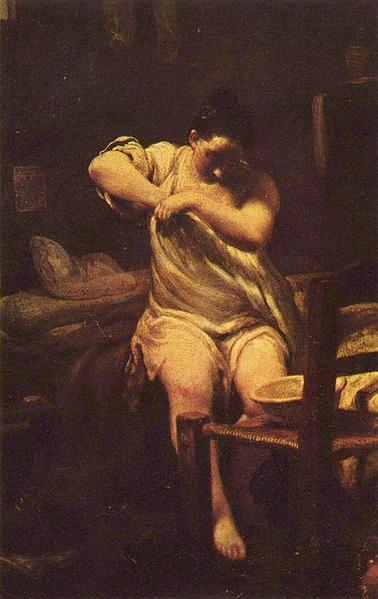
Giuseppe Crespi: Searching for Fleas circa 1709; oil on copper; 2 × 30 cm (16.5 × 11.8 in); Uffizi Gallery
Locations
People
Groups
Topics
Subjects
Regions
Subregions

Years: 1710 - 1710
Giuseppe Crespi: Searching for Fleas circa 1709; oil on copper; 2 × 30 cm (16.5 × 11.8 in); Uffizi Gallery
Locations
People
Groups
Topics
Subjects
Regions
Subregions