Europeans had begun to take a greater…
1888 CE to 1899 CE
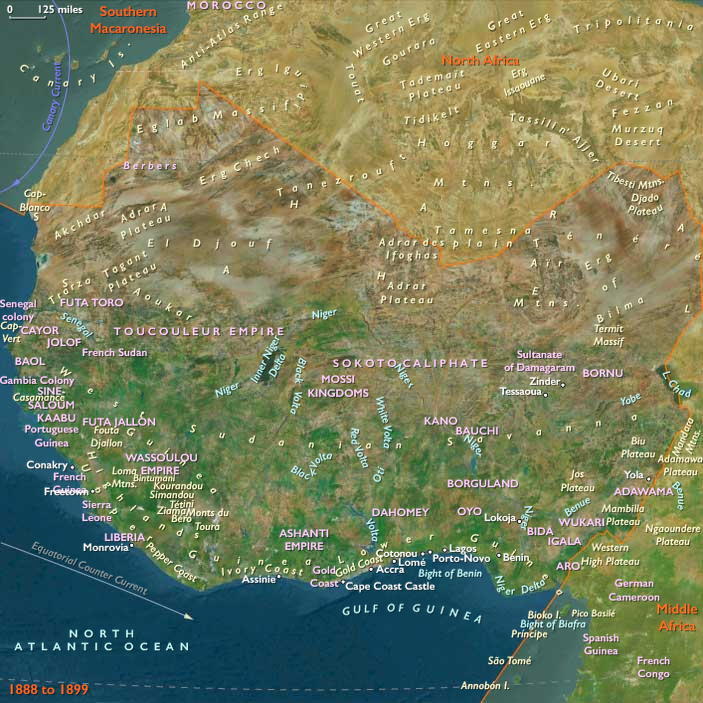
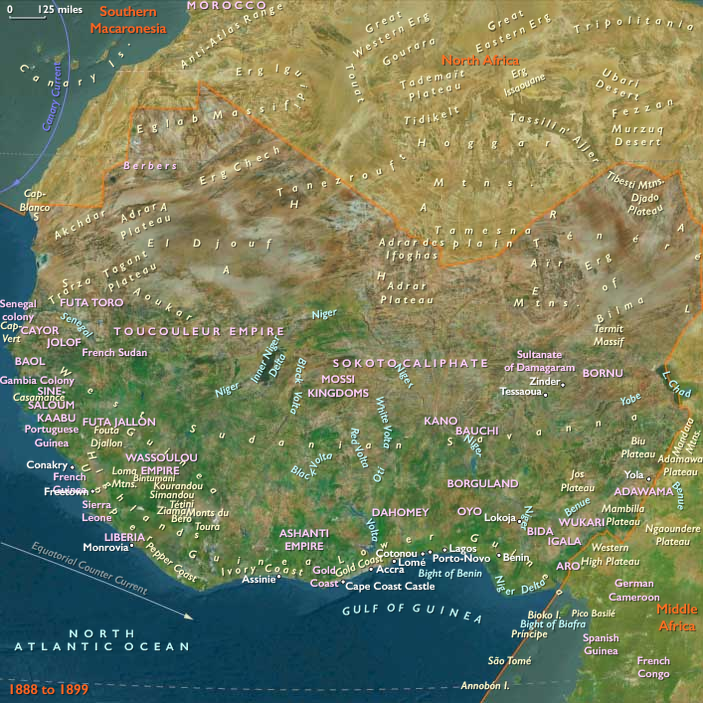
Europeans had begun to take a greater interest in Africa in the nineteenth century, and several European explorers had traveled in the area of modern Niger, such as Mungo Park (in 1805-06), the Oudney-Denham-Clapperton expedition (1822-25), Heinrich Barth (1850-55; with James Richardson and Adolf Overweg), Friedrich Gerhard Rohlfs (1865-67), Gustav Nachtigal (1869-74) and Parfait-Louis Monteil (1890-92).
Several European countries already possessed littoral colonies in Africa, and in the latter half of the century they had begun to turn their eyes towards the interior of the continent.
This process, known as the 'Scramble for Africa', had culminated in the 1885 Berlin conference in which the colonial powers outlined the division of Africa into spheres of influence.
As a result of this, France has gained control of the upper valley of the Niger River (roughly equivalent to the areas of modern Mali and Niger).
France now sets about making a reality of their rule on the ground.
In 1897 the French officer Marius Gabriel Cazemajou is sent to Niger; he reaches the Sultanate of Damagaram in 1898 and stays in Zinder at the court of Sultan Amadou Kouran Daga; however, he is later killed as Daga fears he will ally with the Chad-based warlord Rabih az-Zubayr.
Locations
People
Groups
Regions
West Africa
View →Subregions