
David IV follows his success with the…
1122 CE
David IV follows his success with the capture of Tbilisi, the last Muslim enclave, and moves the Georgian capital there.
Locations
People
Groups
Commodities
Subjects
Regions
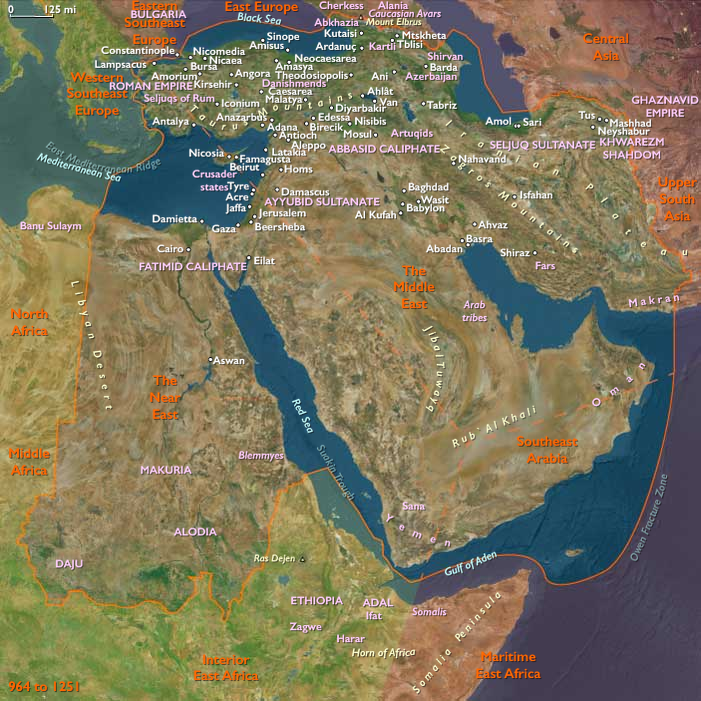
The Near and Middle East
View →Subregions
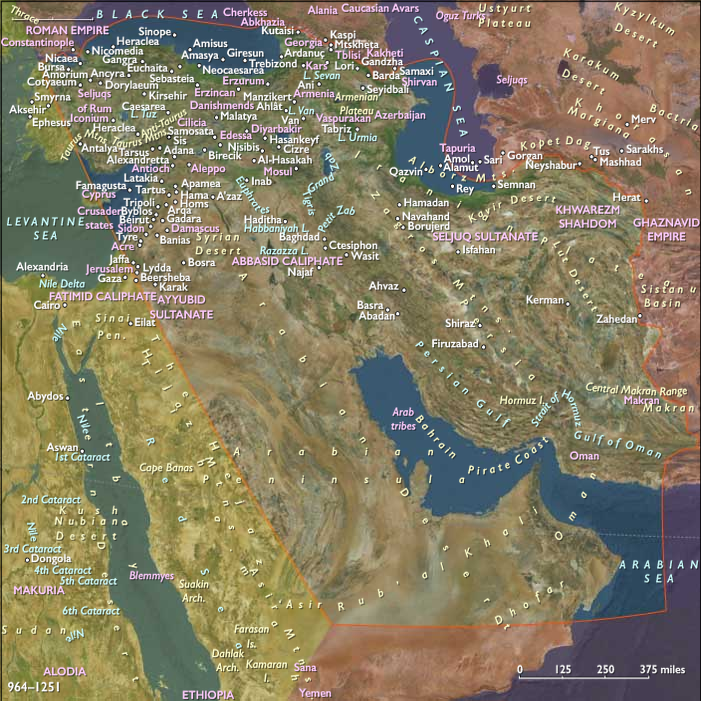
Middle East
View →Related Events
No active filters.
Showing 10 events out of 49318 total
The Venetians had been pleased to help drive the Normans out of the Adriatic Sea but had demanded a heavy price.
Emperor Alexios I Komnenos had in 1108 granted them trading privileges in Constantinople and elsewhere on terms calculated to outbid the empire’s Greek merchants.
This charter, the cornerstone of the commercial empire of Venice in the eastern Mediterranean, has fed the flames of Greek resentment against the Latins and has provoked the rich, who might have been encouraged to invest their capital in shipbuilding and trade, to rely on the more familiar security of landed property.
Venice had at first been chiefly concerned with gaining control of the European trading ports of the Empire, leaving to private interests the commercial opportunities in Syria and Asia Minor.
Although the Venetians had been the first to win a commercial quarter in Constantinople, they antagonize the Greeks by their arrogance and lawlessness as well as by their superior enterprise.
John II Komnenos, seeking to strengthen imperial finances by ending Venetian trading privileges in the empire, is forced to restore them in 1122 after an unsuccessful war.
John, who keeps an austere court, proves a gifted soldier and diplomat, having reestablished imperial authority in the Balkans by reincorporating Serbia, annihilates the Pecheneg forces in 1122 at the Battle of Beroia, and checks Hungarian expansion.
Constantinople’s victory effectively destroys the Pechenegs as an independent force.
For some time, significant communities of Pechenegs will remain in Hungary, but eventually the Pechenegs will cease to be a distinct people and will be assimilated by neighboring peoples such as the Bulgarians and Magyars.
Al-Mustarshid, son of the preceding Caliph, Al-Mustazhir, has achieved more independence as a ruler while the Seljuq sultan Mahmud II is engaged in war in the East.
In 1122, al-Mustarshid deposes and imprisons his vizier Amid al-dawla Jalal al-Din Hasan ibn Ali.
Mahmud II then imposes Ahmad ibn Nizam al-Mulk as his vizier.
The Navarro-Aragonese king Alfonso the Battler founds a confraternity of knights in 1122 in Belchite to fight against the Almoravids; it is the start of the military orders in Aragon.
Years later, he will organize a branch of the Militia Christi of the Holy Land at Monreal del Campo.
Guy, Bishop of Lescar, is present for the foundation of the Confraternity of Belchite.
The Almoravid fleet attacks Sicily in 1122 to contain the attacks of the Norman raiders.
The same year, …
…the Muslim population of Malta rebels against the Normans.
The Almohads had added Sintra and Santarém to their domain under Yusuf ibn Tashfin's son and successor, Ali ibn Yusuf, and Iberia was again invaded in 1119 and 1121, but the tide has turned, the French having assisted the Aragonese to recover Zaragoza.
Fulk V of Anjou’s Shift in Alliances and Support for the Knights Templar (1118–1121 CE)
Initially an opponent of King Henry I of England, Fulk V of Anjou had aligned himself with King Louis VI of France during the Anglo-French conflicts over Normandy. However, between 1118 and 1119, Henry secured Fulk’s loyalty by arranging the marriage of his son and heir, William Adelin, to Fulk’s daughter Matilda. This alliance effectively ended Fulk’s hostility toward the Anglo-Norman king.
With his political position in Anjou stabilized, Fulk turned his focus toward the Holy Land, embarking on a crusade in 1119 or 1120.
Fulk’s Crusade and Connection to the Knights Templar
- During his time in the Levant, Fulk became closely associated with the emerging military order, the Knights Templar.
- The Templars, founded around 1119, were still a new and largely unrecognized order, devoted to protecting Christian pilgrims in the Holy Land.
- According to Orderic Vitalis, Fulk became deeply attached to the Templars, likely seeing their mission as an extension of his own crusading ideals.
After his return to Anjou in late 1121, Fulk began financially supporting the Templars, marking one of the earliest recorded instances of noble patronage for the order:
- He subsidized two Templar knights in the Holy Land for a year, effectively covering the costs of their arms, horses, and provisions.
- His patronage helped establish a model of noble sponsorship that many later European rulers and lords would follow.
Impact of Fulk’s Patronage
- Fulk’s support for the Templars contributed to the order’s early growth, providing it with funds and prestige among European nobility.
- His involvement with the Crusader States foreshadowed his later return to the Levant, where he would become King of Jerusalem in 1131, further entrenching Angevin influence in the Crusades.
- His shifting alliances, from being a Capetian ally to an Anglo-Norman partner, and later a Crusader King, illustrate his political adaptability and ambition, making him one of the most dynamic rulers of his era.
Fulk’s early patronage of the Knights Templar placed him among the first Western rulers to recognize the importance of the military orders, a movement that would later become a defining feature of the Crusader States and medieval Christendom.
The Concordat of Worms resolves the Investiture Controversy, thus bringing to an end the first phase of the power struggle between the Papacy and the Holy Roman Emperors.
The King is recognized as having the right to invest bishops with secular authority ("by the lance") in the territories they govern, but not with sacred authority ("by ring and staff"); the result is that bishops owe allegiance in worldly matters both to the pope and to the king, for they are obligated to affirm the right of the sovereign to call upon them for military support, under his oath of fealty.
Previous Holy Roman Emperors had thought it their right, granted by God, to name the Pope, as well as other Church officials, such as bishops.
One long-delayed result will be an end to the belief in the divine right of kings.
A more immediate result of the Investiture struggle identifies a proprietary right that adheres to sovereign territory, recognizing the right of kings to income from the territory of a vacant diocese and a basis for justifiable taxation.
These rights lie outside feudalism, which defines authority in a hierarchy of personal relations, with only a loose relation to territory.
The Pope emerges as a figure above and out of the direct control of the Holy Roman Emperor.
Stephen II of Hungary, in agreeing to aid the dethroned Prince Yaroslav, leads his armies against Volhynia and lays siege to its capital, Vladimir.
However, Yaroslav is slain during the siege, and the Hungarian nobles want to abandon the struggle.
Although Stephen wants to continue the war, his barons threaten him with a new king if they do not return home; therefore Stephen is obliged to leave Volhynia.