
Diego Velázquez around 1650 paints a portrait …
Years: 1650 - 1650
March
Diego Velázquez around 1650 paints a portrait of Juan de Pareja (1606-1670), a native of Seville and mulatto son of a female slave, primarily known as a member of the painter’s household and workshop. (He is also a painter in his own right; his 1661 work "The Calling of St. Matthew" (sometimes also referred to as "The Vocation of St. Matthew") is currently on display at the Museo del Prado in Madrid, Spain.)
As court painter to Philip IV of Spain in 1648, Velázquez had been sent to Rome to purchase works of art for the Alcázar in Madrid, and had brought Juan de Pareja with him.
During his stay in Rome, Velázquez executed this oil portrait, which is displayed on March 19, 1650, as part of a larger exhibition of paintings at the Pantheon.
According to Antonio Palomino's biography of Velázquez, the painting "was generally applauded by all the painters from different countries, who said that the other pictures in the show were art but this one alone was 'truth'."
Velázquez had painted the Juan de Pareja as an exercise in preparation for his official portrait of Pope Innocent X.
The Pope, a ruddy-faced man who would be depicted in the bright pink and crimson robes of his office, presents a tricky study in both color and composition.
Additionally, since he will be executing a portrait from life, Velázquez will be forced to work quickly while still capturing the essence of Innocent X's character.
The Juan de Pareja reflects Velázquez's exploration of the difficulties he is to encounter in the Pope's portrait.
To compensate for a restricted palette of colors, Velázquez has adopted a loose, almost impressionistic style of brushwork to bring an intense vitality to his subject—a style which will make both the Juan de Pareja and the subsequent portrait of Innocent X two of the most renowned paintings of his career.
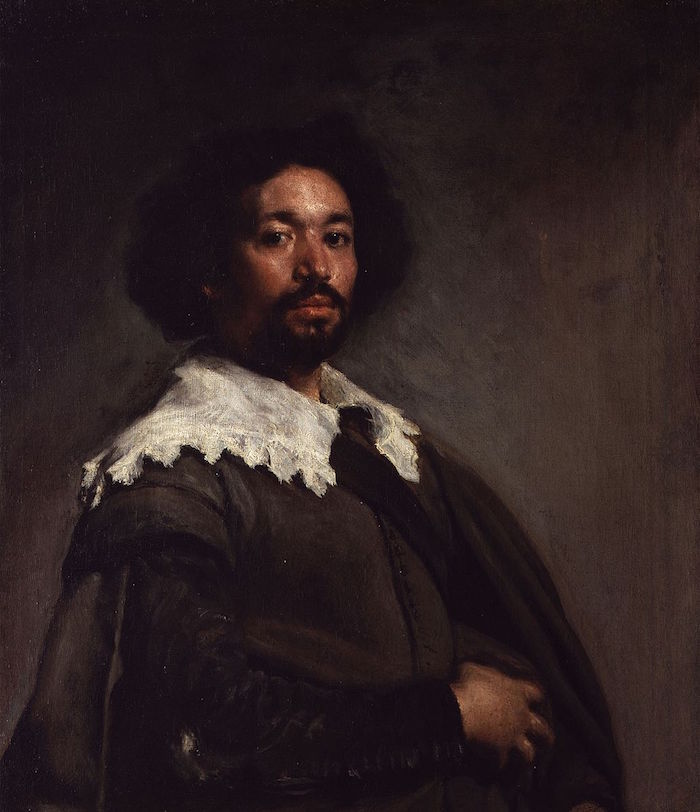
Diego Velázquez: Juan de Pareja (c. 1650) Oil on canvas, 81.3 cm × 69.9 cm (32.0 in × 27.5 in) Metropolitan Museum of Art, New York City
Locations
People
Groups
Topics
Subjects
Regions
Subregions
Years: 1650 - 1650
March
Diego Velázquez: Juan de Pareja (c. 1650) Oil on canvas, 81.3 cm × 69.9 cm (32.0 in × 27.5 in) Metropolitan Museum of Art, New York City
Locations
People
Groups
Topics
Subjects
Regions
Subregions